

Food supply chains are expanding as demand for efficient distribution, stronger traceability, and reliable product movement continues to rise across global food markets. Businesses must manage sourcing, storage, transportation, cold-chain systems, quality control, compliance, and last-mile delivery to meet consumer and retailer expectations. A clear market entry strategy helps companies evaluate infrastructure readiness, partner networks, regulatory requirements, technology adoption, and customer demand before scaling operations.
Food supply chain market expansion strategy supports informed growth by identifying distribution gaps, traceability needs, logistics efficiencies, and market access opportunities across increasingly complex food production and delivery networks.
The global food logistics market was valued at about USD 145.8 billion in 2025 and is projected to reach USD 312.2 billion by 2035, growing at 7.9% CAGR. The food traceability market was valued at USD 34.35 billion in 2025 and may reach USD 67.44 billion by 2034.
Role of Efficient Distribution in Food Supply Chain Expansion
Efficient distribution supports food supply chain expansion by improving product movement, reducing delays, lowering spoilage risks, strengthening retailer access, optimizing logistics costs, and enhancing customer service:
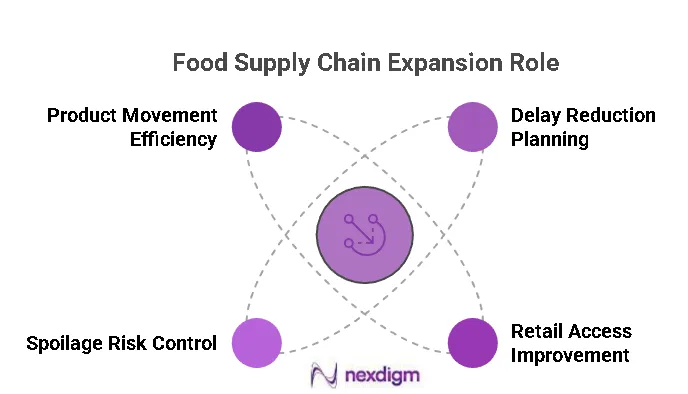
-
Product Movement Efficiency
Assess transport routes, delivery frequency, handling processes, and coordination systems to improve food movement across supply chains.
-
Delay Reduction Planning
Identify bottlenecks in warehousing, dispatch, transit, and last-mile delivery to improve supply chain responsiveness.
-
Spoilage Risk Control
Evaluate cold-chain systems, packaging, storage conditions, and transit times to reduce food quality deterioration.
-
Retail Access Improvement
Map distributors, retailers, wholesalers, and delivery partners to improve market reach and shelf availability.
Nexdigm Last-Mile Delivery Strategy for Food Market Access
Nexdigm’s last-mile delivery strategy can help food supply chain providers assess delivery routes, local distribution partners, retailer coverage, order frequency, cold-chain needs, and service reliability. This supports market expansion by improving product availability, reducing delivery delays, minimizing spoilage risks, and strengthening access to high-demand food markets.
Nexdigm Distribution Efficiency Assessment for Food Supply Networks
Nexdigm can assess transport routes, warehouse placement, delivery timelines, partner performance, inventory flow, spoilage risks, and logistics costs to improve food supply network efficiency.
-
Transport Route Assessment
Evaluate route length, delivery frequency, congestion risks, and transit time to improve food movement efficiency.
-
Warehouse Placement Review
Assess warehouse locations, storage capacity, demand proximity, and service coverage across food supply networks.
-
Delivery Timeline Analysis
Review order processing, dispatch speed, transit duration, and delivery reliability to reduce delays.
-
Partner Performance Evaluation
Assess distributors, logistics providers, retailers, and delivery partners based on reliability, reach, and service quality.
Nexdigm’s case:
Nexdigm supported a food supply chain provider assess distribution efficiency across regional food networks. The analysis identified 18–22% route inefficiency, 15% warehouse placement gaps, and 10–12% spoilage risk across key delivery clusters. These insights helped the company optimize routes, reposition storage points, evaluate logistics partners, improve inventory flow, and build a scalable food supply chain market expansion strategy.
To take the next step, simply visit our Request a Consultation page and share your requirements with us.
Harsh Mittal
+91-8422857704