

Global food trade is shaped by more than population growth or rising consumption. Import demand depends on purchasing power, domestic production capacity, climate conditions, food preferences, and the ability of local industries to supply particular products. Export supply, meanwhile, is influenced by harvest outcomes, production costs, logistics, and government trade policies. For businesses assessing international expansion, understanding how these factors interact is more useful than simply identifying the largest food-importing countries.
The OECD-FAO Agricultural Outlook 2025-2034 projects that global consumption of agricultural and fish commodities will increase by 13% by 2034 in constant prices. Much of this additional consumption is expected in low- and middle-income economies. However, projected demand growth does not automatically translate into an accessible export opportunity. Businesses need to determine which products are gaining demand, whether imports are increasing in volume, and which suppliers are positioned to serve that demand.
Import growth needs to be examined at product level
National import figures can conceal substantial differences between food categories. A market may record rising food imports because of higher purchases of cereals, vegetable oils or animal feed, while demand for a prospective exporter’s product remains flat.
A useful assessment begins with product-level trade data across several years. Import value indicates the money spent on foreign supplies, while import volume helps establish whether more physical product is entering the market. Comparing both measures can reveal whether apparent growth is driven by higher quantities, higher prices or a combination of the two.
For example, an increase in the value of edible oil imports may reflect rising consumption, international price movements, currency depreciation, or changes in the mix of oils purchased. Each explanation has different implications for an exporter deciding whether to expand capacity or adjust pricing.
Businesses should examine several indicators together:
- Import growth: whether demand is expanding consistently or responding to a temporary supply shock.
- Volume and value: whether higher import spending corresponds to increased quantities.
- Supplier shares: which countries dominate the market and whether their positions are changing.
- Seasonality: when imports peak and how those cycles align with the exporter’s harvest and production schedule.
- Domestic production: whether imports complement local output or compete directly with it.
These measures help distinguish durable market demand from short-term trade movements.
Export supply can change the competitive landscape
Demand is only one side of the opportunity. A market with rising imports may already be served by exporters that have scale, established distribution networks or preferential access. A new supplier must understand not only how much a country buys, but also why buyers purchase from particular origins.
Trade data can reveal whether supply is concentrated among a few exporting countries or distributed across a broader supplier base. A dominant supplier may benefit from established commercial relationships, consistent quality, and reliable logistics. Yet concentration can also create an opening when buyers seek alternative origins to reduce disruption risk.
A country experiencing strong production growth may increase its export availability, intensifying competition in destinations it already serves. Weather-related losses, export restrictions, or freight disruptions can reverse this pattern quickly.
The same market may therefore be attractive in one season and difficult to serve in another.
Where are the most relevant growth signals?
The strongest opportunities often emerge when multiple indicators point in the same direction. Import growth becomes more compelling when volumes are rising; demand is spread across several buyers, and the market is not entirely dependent on a single supplier.
Three signals deserve particular attention:
- Persistent volume growth: increasing quantities over multiple years suggest a stronger demand signal than a one-year increase in import value.
- Changing supplier rankings: a declining share for an established supplier may indicate room for competitors, although the reason for the shift must be investigated.
- A mismatch between local supply and demand: imports may remain substantial where domestic production cannot reliably meet quality, processing or seasonal requirements.
The third signal is especially important for processed foods and ingredients. A country can produce a commodity domestically yet continue importing specialised grades, processed forms or products that meet particular industrial specifications.
From trade patterns to a market decision
Effective food trade analysis combines trade statistics with information on tariffs, food safety rules, distribution, pricing, and customer requirements. UN Comtrade provides detailed import and export statistics by product and trading partner, while FAO market publications help explain developments in agricultural commodity supply, demand and prices. These sources answer different questions and should be used together rather than treated as substitutes.
Businesses should also compare the cost of serving a destination. Freight, insurance, duties, storage, wastage, certification and distributor margins can erode an apparent price advantage. Perishable products require particular attention to transit time, cold-chain capacity, and shelf life.
A market with moderate import growth may offer better commercial potential than a much larger market if buyers are accessible; specifications match the exporter’s portfolio, and delivered margins are sustainable.
Nexdigm’s Market Growth Assessment Framework
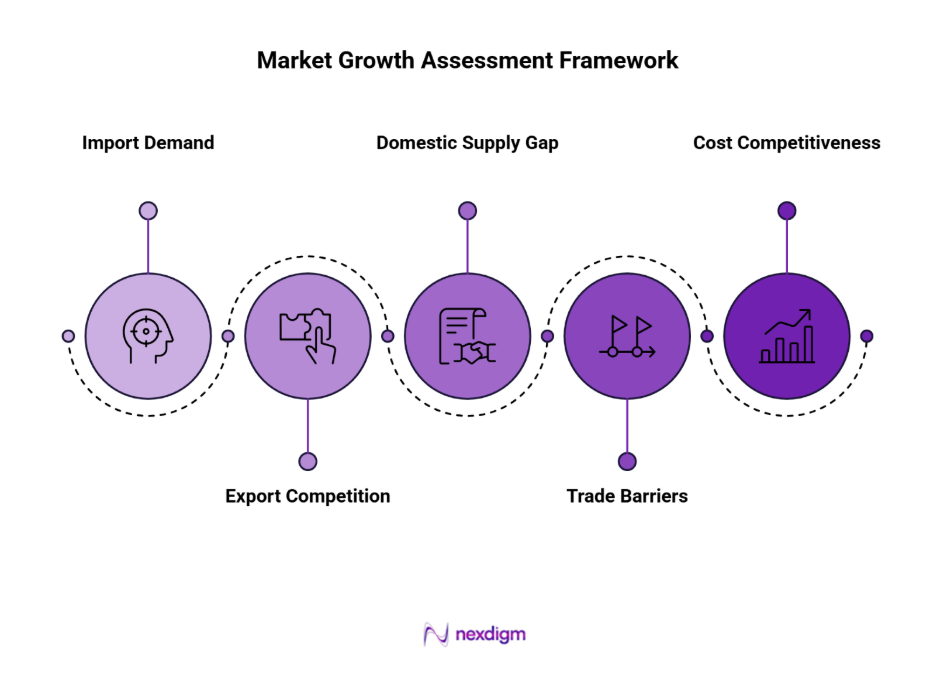
- Demand: Measure import value and volume over several years, separating price effects from quantity growth.
- Supply: Identify major exporting countries, their market shares and changes in supplier rankings.
- Domestic fit: Assess local production, seasonal shortages and product categories that imports serve.
- Access: Review tariffs, sanitary and phytosanitary requirements, labelling rules and distribution barriers.
- Commercial viability: Calculate delivered costs and test whether achievable prices support a sustainable margin.
Nexdigm Case Study
A food exporter evaluating international expansion screened 8 destination markets using product-level import trends and supplier data. An initial review identified 4 markets with sustained import growth, but a closer assessment found that 2 were dominated by established suppliers with strong price advantages. The remaining shortlist focused on destinations where import volumes were rising and the exporter’s product specifications aligned with buyer requirements. Management then prioritised customer validation and landed-cost assessment before committing to a wider export launch.
To take the next step, simply visit our Request a Consultation page and share your requirements with us.
Harsh Mittal
+91-8422857704