
Global food trade has expanded significantly, creating a large and increasingly complex dataset for businesses seeking new markets and sourcing opportunities. FAO reports that food and agricultural trade increased fivefold between 2000 and 2024, while low- and middle-income economies became more integrated into global markets. Yet greater integration has also increased exposure to climate, geopolitical, economic, and supply-chain shocks.
FAO’s latest trade data also highlights how uneven these flows remain. Major agricultural commodities can be highly concentrated among a small number of exporters, while Asia’s agricultural trade deficit has widened as food and feed import requirements have increased.
For businesses, this makes food trade data more than a record of historical transactions. When analyzed at product, country, company, supplier, buyer, price, and shipment levels, it can reveal demand gaps, emerging export markets, sourcing dependencies, competitive shifts, and potential trade relationships.
The challenge is turning these signals into decisions that reflect the realities of production, regulation, logistics, pricing, and market access.
Identifying Demand Gaps Through Food Trade Analysis
Food trade data can reveal where demand exceeds local supply and where reliance on imports is increasing. By analyzing import growth, consumption patterns, sourcing dependencies, and trade imbalances, businesses can identify unmet market needs and potential opportunities for exporters, suppliers, and investors.
Tracking Export Opportunities and Competitive Market Changes
Trade patterns continuously evolve as markets expand, suppliers gain or lose share, and sourcing strategies change. Evaluating export growth, supplier participation, trade relationships, pricing trends, and shipment activity helps businesses identify emerging export markets and understand shifting competitive dynamics across the global food value chain.
Together, demand gap analysis and competitive trade monitoring provide a stronger foundation for identifying attractive markets, sourcing opportunities, and future growth areas in global food trade.
Nexdigm Offering Data-Driven Insights for Food Trade Industry
In an increasingly dynamic global food trade environment, businesses need reliable intelligence to navigate changing demand patterns, shifting supplier landscapes, and evolving trade dynamics. Nexdigm helps organizations transform complex trade data into actionable insights, enabling informed decisions across market expansion, sourcing, investment, and competitive strategy.
Nexdigm’s Food Trade Intelligence for Opportunity Identification
Transforming food trade data into actionable business intelligence requires more than analyzing imports and exports alone. Nexdigm analyzes food trade data to help businesses uncover demand gaps and understand evolving competitive dynamics across global food markets through:
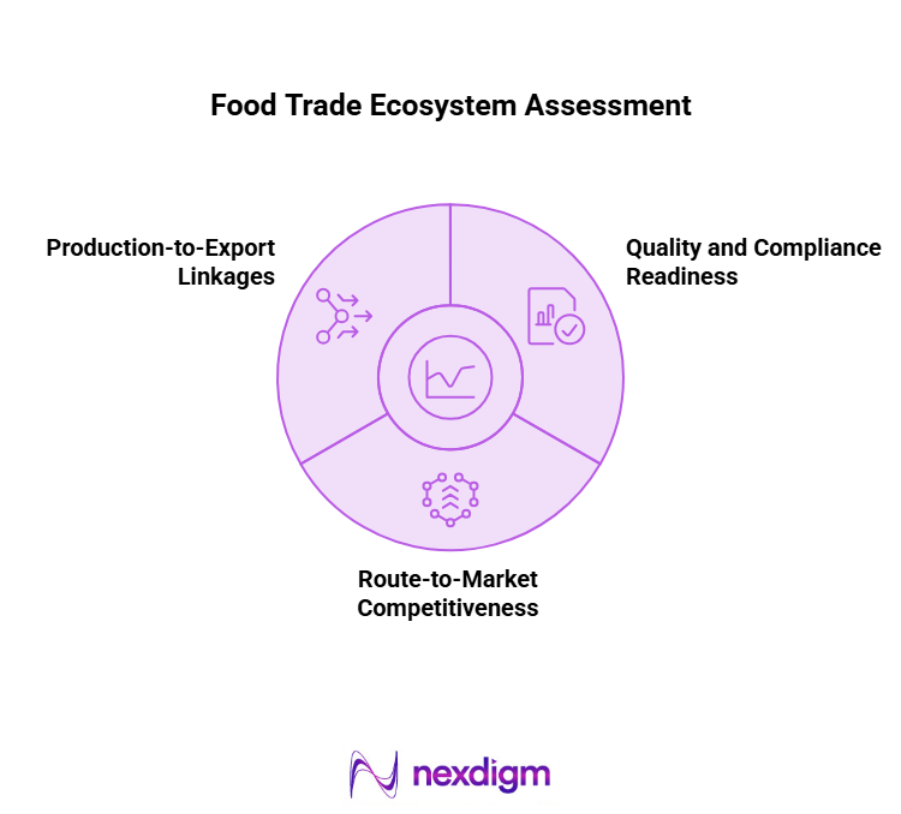
- Comprehensive Trade Data Assessment: Nexdigm analyzes product-level trade flows, import-export trends, supplier participation, pricing movements, and shipment activity to identify meaningful market signals.
- Demand Gap and Market Opportunity Analysis: By evaluating trade imbalances, import dependency, and consumption trends, Nexdigm helps businesses identify markets with unmet demand and growth potential.
- Competitive and Supplier Landscape Evaluation: Nexdigm assesses supplier concentration, market shares, and competitive movements to understand changing market structures and emerging opportunities.
- Commercial Feasibility Assessment: Trade insights are complemented with market access, regulatory, logistics, and pricing considerations to ensure identified opportunities are commercially relevant.
By connecting trade data with market realities, Nexdigm helps businesses move beyond historical trade patterns and identify actionable opportunities across demand assessment, market expansion, sourcing strategies, and competitive positioning.
Why Businesses Choose to Partner With Nexdigm
Businesses require more than trade data alone to navigate evolving food markets. Nexdigm combines trade intelligence, market assessment, and commercial analysis to help organizations identify opportunities, evaluate risks, and make well-informed strategic decisions.
- Integrated Market Perspective: Combines trade data, market trends, competitive intelligence, and commercial considerations to provide a holistic view of opportunities.
- Industry-Focused Expertise: Deep understanding of food trade dynamics enables targeted insights across products, markets, suppliers, and trade routes.
- Decision-Oriented Analysis: Focuses on actionable recommendations that support market entry, sourcing, investment, and growth strategies.
By connecting food trade intelligence with strategic decision-making, Nexdigm helps businesses transform food trade insights into measurable growth opportunities.
Benefits of Nexdigm’s Food Trade Intelligence
By combining trade data with commercial and market insights, Nexdigm helps businesses derive practical value from complex food trade information by:
- Identifying Attractive Market Opportunities: Uncover demand gaps, high-growth export markets, and emerging trade corridors with stronger commercial potential.
- Strengthening Market Entry Decisions: Evaluate market attractiveness, competitive intensity, pricing dynamics, and accessibility before pursuing expansion.
- Enhancing Sourcing and Supply Chain Resilience: Identify alternative suppliers, sourcing regions, and trade routes to reduce dependency and mitigate supply risks.
- Monitoring Competitive Market Shifts: Track supplier share movements, trade patterns, and emerging competitors to stay ahead of evolving market dynamics.
- Supporting Data-Driven Growth Planning: Convert complex trade data into actionable insights that guide investment, expansion, procurement, and business development strategies.
Through a structured evaluation of food trade dynamics, Nexdigm helps businesses reduce uncertainty, uncover growth opportunities, and make strategic decisions with greater confidence.
Nexdigm’s Case
Nexdigm supported an agribusiness client evaluating product-market combinations across 12 international markets. By analyzing demand growth, supplier movements, pricing, buyer activity, and market accessibility, the engagement identified priority opportunities and 11 emerging supplier gaps. The resulting strategy contributed to a 27% increase in qualified leads and reduction in market-development costs.
To take the next step, simply visit our Request a Consultation page and share your requirements with us.
Harsh Mittal
+91-8422857704