

Global food and agricultural trade has become significantly more interconnected. FAO reports that the value of food and agricultural trade increased fivefold between 2000 and 2024, reaching about US$2 trillion. At the same time, growing trade integration has increased exposure to extreme weather, conflicts, economic pressures, and other disruptions that can rapidly alter sourcing and supply patterns.
The geography of these flows is also uneven. FAO’s latest trade analysis finds that Asia’s food trade deficit has widened over time, reflecting increasing reliance on imports, while major agricultural commodities remain highly concentrated among a limited number of exporting countries. For example, the top two exporters of both soybeans and palm oil accounted for about 85% of global exports in 2024.
For food producers, processors, exporters, importers, and investors, these movements raise important questions. This is where food trade flow analysis can help businesses understand not only where products move, but how supplier relationships, market dependencies, and competitive positions are changing.
Why Food Trade Flows Matter
A shipment is only one part of a larger commercial relationship. Behind every import or export movement are production clusters, processing facilities, suppliers, buyers, ports, distributors, and end markets.
Mapping these relationships can reveal whether a market is dependent on a particular origin, whether buyers are diversifying suppliers, and whether an emerging exporter is gaining access to new destinations. This makes trade-flow analysis useful for both growth strategy and supply-chain planning.
Import Dependence Can Reveal Structural Opportunities
A market that consistently relies on imported food products may offer opportunities for international suppliers. However, dependence needs to be assessed alongside demand growth, supplier concentration, pricing, domestic production, and accessibility.
A market importing heavily from one or two countries presents a different opportunity from one with multiple competing origins. Understanding this distinction helps businesses assess whether there is genuine room for supplier diversification or market entry.
Nexdigm’s Industry based Expertise for Food and Agriculture Markets
Nexdigm brings experience across the food and agriculture value chain, combining industry research with trade intelligence to evaluate changing market structures and international supply networks. Its work spans producers, processors, exporters, importers, distributors, and other ecosystem participants.
This sector understanding enables Nexdigm to interpret trade flows alongside production capacity, sourcing conditions, processing ecosystems, buyer requirements, pricing, logistics, and market-access factors, providing businesses with a more commercially grounded view of international food opportunities.
Nexdigm’s Food Trade Flow Intelligence Approach
Food trade flows reveal more than cross-border movement. They provide signals on demand, sourcing, suppliers, buyers, pricing, and supply-chain dependencies. Nexdigm combines industry expertise with food trade flow analysis to interpret these signals within the broader food value chain. This approach can help businesses assess:
- Demand Centres: Identify countries and regions where food import demand is expanding, helping businesses recognize emerging consumption markets and prioritize potential growth destinations.
- Sourcing Dependencies: Examine reliance on specific countries, suppliers, or trade corridors to identify concentrated sourcing structures and potential procurement diversification opportunities.
- Supplier Competitiveness: Compare supplier shares, shipment activity, pricing, and destination coverage to determine which exporters are strengthening their competitive position across international food markets.
- Buyer Networks: Map active importers, distributors, and trading companies to identify organizations driving product demand and potential commercial-account opportunities within priority markets.
These insights enable businesses to move from tracking where food products are moving to understanding why those flows are changing and how they can influence market entry, exports, sourcing, and competitive strategy.
Nexdigm’s Food Trade Flow Analysis
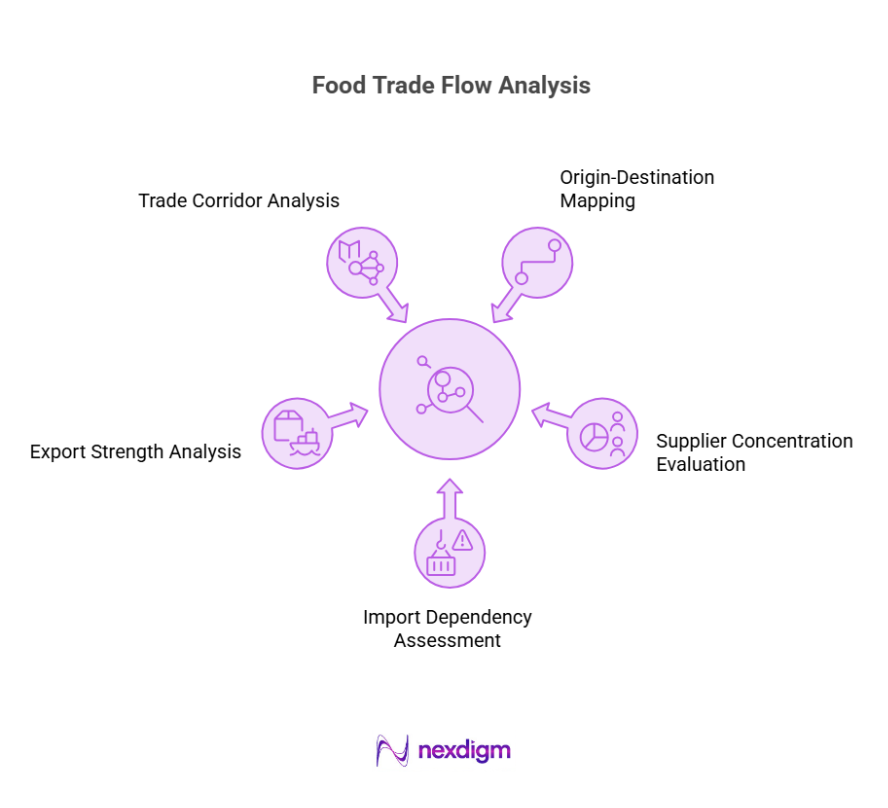
Nexdigm can evaluate food trade flows through multiple interconnected dimensions. These dimensions provide insights into how businesses can get benefit from Nexdigm’s Trade Intelligence service offerings. Such dimensions are:
- Origin-Destination Mapping: Mapping product movements between origins and destinations to identify major trading relationships, emerging markets, geographic dependencies, and changing international supply patterns.
- Supplier Concentration Evaluation: Measuring supplier and country shares to identify concentrated sourcing structures, competitive dependencies, diversification opportunities, and markets open to alternative suppliers.
- Import Dependency Assessment: Assessing product-level import reliance to identify markets where international supply is structurally important and additional suppliers may find opportunities.
- Export Strength Analysis: Analyzing export growth, destination coverage, supplier shares, and shipment activity to identify countries strengthening their position within global food markets.
- Trade Corridor Analysis: Evaluating ports, routes, origins, and destinations to identify established corridors, emerging pathways, logistics dependencies, and potential alternative trade routes.
Together, these dimensions help businesses move beyond simply tracking shipments. Nexdigm can connect trade movements with commercial drivers, allowing companies to identify where sourcing is changing, where demand is strengthening, and where supplier or buyer relationships may create actionable opportunities.
Nexdigm’s Case
Nexdigm supported a food-sector client in evaluating international trade flows across 9 product categories and 16 destination markets. The analysis identified 6 markets with accelerating import demand, 8 emerging supplier origins, and 31 high-priority buyer accounts. The resulting strategy helped the client redirect market-development efforts toward higher-potential opportunities and improve qualified opportunity conversion by 21%.
To take the next step, simply visit our Request a Consultation page and share your requirements with us.
Harsh Mittal
+91-8422857704