

A food product’s journey from farm to foreign buyer involves a network of decisions that trade statistics alone cannot fully explain. Production may be concentrated in one region, processing carried out in another, and final consumption spread across several markets. Between these stages, businesses must manage quality, storage, transport, certification, pricing and changing buyer requirements.
The opportunity lies in understanding how products move through this network and where value or reliability is being lost. Trade intelligence connects international trade flows with supply-chain conditions, helping businesses assess not only where a product is being purchased but also how it can be supplied competitively.
The OECD-FAO Agricultural Outlook 2025-2034 highlights the growing importance of international trade as agricultural production and consumption evolve differently across regions. This geographic separation makes trade essential for moving food from surplus-producing areas to markets where demand exceeds domestic supply.
A Shipment is the Outcome of an Entire Supply Chain
Export performance is often discussed in terms of destination markets and selling prices. Yet the ability to fulfil an order depends on several upstream factors: availability of raw materials, processing capacity, consistency of quality, packaging, storage, and transport.
An exporter of frozen fruit, for instance, may identify strong demand in a destination market but discover that its current cold-storage infrastructure cannot maintain the required temperature throughout transit. A grain processor may have access to raw materials but lack the testing and documentation needed by an overseas food manufacturer.
Trade intelligence helps identify these constraints before a company commits to a market-entry plan. Import and export records can reveal sourcing relationships, shipment frequency, and the origins that already serve a destination. Additional research is needed to determine whether those flows reflect long-term contracts, seasonal procurement, or temporary shortages.
Where Can Supply Chain Opportunities Emerge?
Trade patterns can point to opportunities at different stages of the food value chain.
- At origin: export growth may indicate an expanding production base, while repeated supply interruptions may reveal the need for alternative sourcing.
- During processing: imports of processed foods or ingredients can highlight demand that domestic processing industries do not fully satisfy.
- In storage and logistics: seasonal export surges may create requirements for cold storage, warehousing, reefer capacity or improved handling.
- At the destination: buyers may need products that meet specific grades, packaging formats, traceability standards, or delivery schedules.
- Across sourcing networks: heavy dependence on a small number of origins may encourage buyers to qualify additional suppliers.
These signals indicate where further investigation may be worthwhile.
Why the Product’s Journey Matters
Two products with similar trade values can present very different commercial prospects. Frozen seafood, fresh produce, grains and shelf-stable ingredients have different storage requirements, spoilage risks and transport economics.
For temperature-sensitive products, a low factory-gate price may be offset by refrigeration, specialised packaging, and losses during handling. For bulk commodities, the economics may depend on shipment size, port capacity, storage availability, and freight rates. Processed foods may require more documentation, but their longer shelf life can make distribution more flexible.
A useful supply-chain assessment should therefore consider:
- Origin reliability: production volumes, seasonality and exposure to weather or other disruptions.
- Processing readiness: capacity to meet buyer specifications consistently.
- Logistics feasibility: transit time, storage, temperature control and port access.
- Compliance: food safety standards, traceability, certificates and destination-specific rules.
- Buyer requirements: order sizes, packaging, delivery frequency, and payment terms.
The purpose is to connect the market opportunity to the operational capability required to serve it.
Trade intelligence as a risk-management tool
Supply-chain analysis is not limited to identifying growth markets. It can also reveal dependencies that create vulnerability. If a company sources a critical ingredient from one country, changes in weather, export policy, freight availability or geopolitical conditions can disrupt production.
Supplier concentration should be assessed at both country and company level where data is available. A country may account for a large share of imports, but several independent suppliers within that country can create a different risk profile from one dominant producer. Conversely, buying from multiple intermediaries does not necessarily diversify exposure if they all rely on the same origin.
Businesses should also distinguish between a theoretically available alternative and a qualified alternative. A supplier may appear in trade records but lack the capacity, certification, quality consistency, or commercial terms required by the buyer.
Connecting Market Signals to Operational Decisions
Food trade intelligence combines trade-flow data with supplier mapping, logistics assessment, regulatory research, and commercial validation. UN Comtrade can establish which products move between countries and how trade patterns change over time. FAO’s commodity market analysis adds context on production, supply, demand and price movements. Logistics and regulatory research then help determine whether a particular flow can be replicated profitably.
The analysis should end with a practical decision: whether to enter a destination, diversify a source, change a product specification, invest in processing or postpone expansion until an operational constraint is resolved.
For businesses managing several product lines, the same approach can prioritise investments. A product with moderate demand but reliable supply and manageable logistics may be a better expansion candidate than one with faster growth but severe cold-chain or compliance constraints.
Food Supply-Chain Opportunity Framework
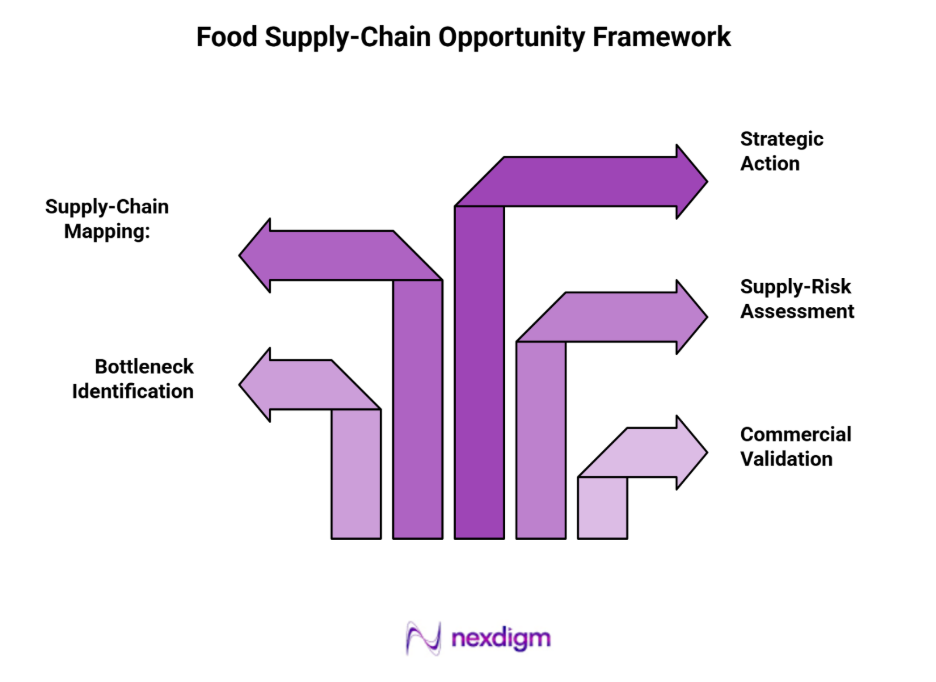
- Trace: Map the product’s movement from production origin through processing and distribution to the destination market.
- Locate: Identify bottlenecks in storage, transport, certification, or processing capacity.
- Assess: Evaluate supplier concentration, seasonal availability and the reliability of alternative origins.
- Validate: Confirm buyer specifications, regulatory requirements and logistics feasibility.
- Act: Prioritise the sourcing, export or operational changes that can be supported by commercial evidence.
Nexdigm Case Study
A processed-fruit exporter assessed 5 destination markets after identifying rising imports of frozen fruit products. The initial trade review highlighted demand in 3 markets, but a supply-chain assessment found that 1 required cold-chain transit arrangements the exporter could not reliably support.
The company focused on the remaining 2 markets, evaluating shipment frequency, packaging requirements, certification and distributor capacity before beginning customer discussions. This narrowed the opportunity to destinations that matched both demand conditions and operational readiness.
To take the next step, simply visit our Request a Consultation page and share your requirements with us.
Harsh Mittal
+91-8422857704