

Global food trade is being reshaped by changing consumption patterns, production economics, geopolitical developments, climate-related disruptions, and evolving sourcing strategies. FAO reports that the value of food and agricultural trade increased fivefold between 2000 and 2024, reaching around US$2 trillion. This expansion reflects deeper global integration, but it also creates greater interdependence between producers, exporters, importers, and consumers.
The geography of trade is changing alongside its scale. Asia’s growing food and feed requirements have contributed to a widening agricultural trade deficit, while several developing regions are strengthening their export positions.
These developments make food trade trends increasingly important for businesses. Understanding where demand is growing and which trade routes are becoming strategically important can influence decisions across exports, procurement, investment, and supply-chain planning.
Understanding Where Food Demand Is Shifting
As consumer preferences, population dynamics, and economic conditions evolve, food demand continues to shift across regions and product categories. Understanding these changes helps businesses identify:
- Changing Consumption Patterns: Shifts in dietary preferences, health awareness, urbanization, and income levels are influencing demand for different food products across global markets.
- Growing Import Requirements: Supply constraints, population growth, and changing consumption needs are increasing food import demand in several regions, creating new trade opportunities.
Monitoring demand shifts enables businesses to identify growing markets, align their offerings with evolving needs, and position themselves for future trade growth.
Analyzing Supplier Shifts and Emerging Trade Corridors
Global food trade routes are continuously changing as countries diversify suppliers, respond to geopolitical developments, improve production capabilities, and adapt to supply-chain risks. Understanding which exporters are gaining market share and which trade corridors are strengthening helps businesses anticipate competitive changes and identify new sourcing and export opportunities. Together, demand trends and evolving trade routes provide valuable insights into how global food markets are changing.
Nexdigm’s Role in Assessing the Emerging Supplier Shifts
With growing complexity across global food supply chains, businesses need a clear understanding of demand shifts, supplier dynamics, and evolving trade routes to make informed decisions. Nexdigm brings industry expertise to help organizations navigate changing food trade trends through:
- Industry-Focused Trade Intelligence: Nexdigm combines food trade data with market and industry insights to deliver a comprehensive view of evolving trade dynamics.
- Data-Driven Opportunity Evaluation: By analyzing demand trends, supply structures, competitive activity, and market developments, Nexdigm helps businesses identify commercially relevant opportunities.
- Strategic Decision Support: Assessing complex trade information into actionable insights that support expansion, sourcing, investment, and market-entry decisions.
Leveraging deep industry expertise and structured market analysis, Nexdigm helps businesses transform food trade trends into informed strategic actions and sustainable growth opportunities through its strategic framework process.
Nexdigm’s Framework for Assessing Emerging Shifts in Food Trade Supply Chain
Tracking global food trade requires a structured methodology that converts market signals into actionable business insights. Nexdigm’s framework evaluates food trade opportunities through the following interconnected steps:
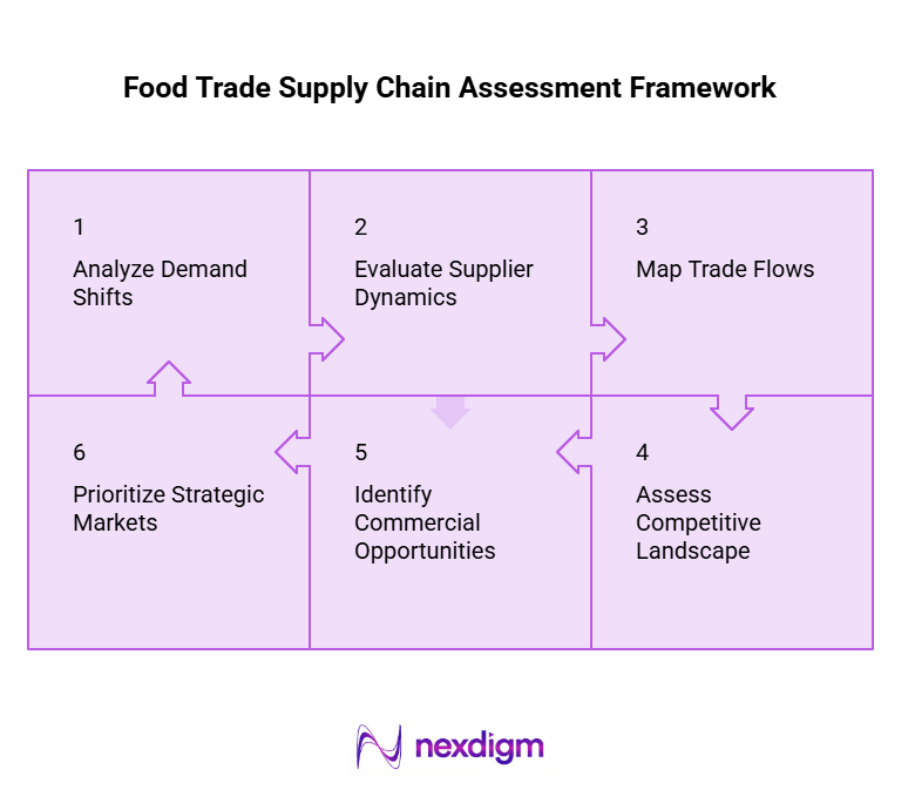
- Step 1: Analyze Demand Shifts: Assess import trends, consumption patterns, and market growth drivers to identify regions and products experiencing increasing demand.
- Step 2: Evaluate Supplier Dynamics: Examine key exporting countries, supplier concentration, and competitive movements to understand evolving supply structures and market participation.
- Step 3: Map Trade Flows and Routes: Analyze trade corridors, sourcing patterns, and shipment activity to identify strategic routes and changing trade relationships.
- Step 4: Assess Competitive Landscape: Evaluate market concentration, supplier shares, buyer preferences, and entry barriers to understand the competitive intensity within target markets.
- Step 5: Identify Commercial Opportunities: Compare demand growth, supply availability, pricing trends, and market gaps to pinpoint commercially attractive opportunities.
- Step 6: Prioritize Strategic Markets: Integrate insights across all dimensions to rank markets and trade opportunities based on their attractiveness, feasibility, and growth potential.
By following a structured assessment framework, Nexdigm helps businesses move beyond trade data interpretation and confidently identify, evaluate, and prioritize food trade growth opportunities.
Applications of Nexdigm’s Food Trade Assessment Framework
Insights become most valuable when they support real business decisions. Nexdigm’s framework can be applied across multiple strategic and operational areas to help businesses with:
- Market Expansion: Identify attractive export destinations based on demand growth, competitive intensity, and market accessibility.
- Supplier Diversification: Evaluate alternative sourcing markets and suppliers to strengthen supply chain resilience and reduce dependency risks.
- Investment Evaluation: Assess demand potential, trade dynamics, and competitive conditions before pursuing capacity expansion or market entry.
By applying trade intelligence to practical business decisions, organizations can transform food trade insights into targeted growth, sourcing, and investment strategies.
Nexdigm’s Framework for Strategic Food Trade Decisions
A structured understanding of demand shifts, supplier dynamics, and trade routes enables businesses to move beyond market observation and toward strategic action. By converting trade intelligence into actionable insights, organizations can prioritize opportunities, reduce uncertainty, and make more informed decisions across exports, sourcing, investments, and long-term growth planning.
Nexdigm’s Case
Nexdigm supported an agribusiness client in assessing product categories across 12 export markets, combining trade flows, supplier movements, pricing, and demand indicators. The analysis identified 7 high-growth product-market combinations and 11 emerging supplier opportunities, helping the client redirect its export strategy. Within the targeted markets, qualified leads increased 24% and market-development costs declined 15%.
To take the next step, simply visit our Request a Consultation page and share your requirements with us.
Harsh Mittal
+91-8422857704