

In a competitive food industry, reducing food waste has become both a profitability strategy and a sustainability priority. Businesses are increasingly using competitive intelligence to analyze operational performance, compare industry practices, and identify opportunities for improvement through food waste benchmarking metrics.
By tracking indicators such as waste percentage, inventory loss, disposal costs, and resource efficiency, organizations can measure performance against competitors and industry standards.
Globally, around 1.05 billion tones of food are wasted, representing nearly 19% of food available to consumers. Food waste is also responsible for approximately 8-10% of global greenhouse gas emissions, making it a major environmental concern. Research indicates that organizations adopting food waste benchmarking metrics and data-driven monitoring systems can reduce waste-related costs by up to 20% while improving operational efficiency.
A reduction in food waste not only lowers operational expenses and improves profit margins but also strengthens environmental responsibility by reducing carbon emissions and resource consumption. Effective benchmarking and data-driven insights help companies build sustainable, cost-efficient, and competitive business models.
Competitive Intelligence Role of Food Waste Benchmarking Metrics in Business Performance
Competitive intelligence helps businesses use food waste benchmarking metrics to compare performance, identify inefficiencies, reduce operational costs, improve sustainability outcomes, and enhance decision-making for achieving stronger profitability and long-term competitive advantage:
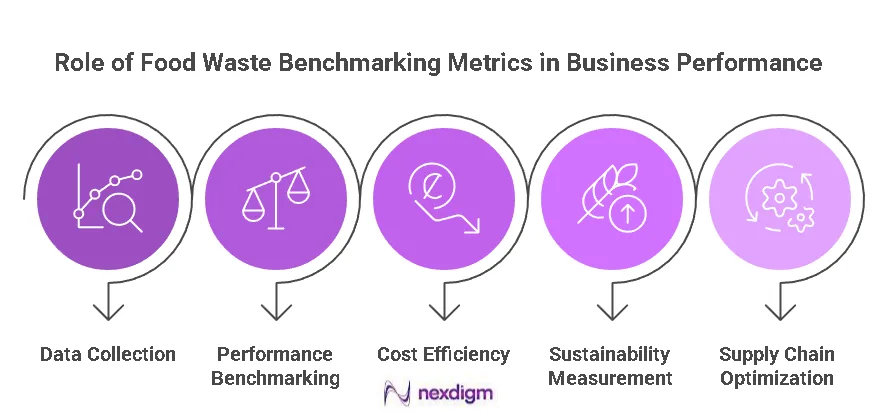
Data Collection and Monitoring
Tracking food waste data helps businesses identify inefficiencies, measure losses, and improve operational decision-making accuracy consistently.
Performance Benchmarking
Comparing waste metrics against industry standards reveals competitive gaps and highlights opportunities for operational improvement and cost reduction.
Cost Efficiency Analysis
Food waste benchmarking identifies unnecessary expenses, enabling businesses to reduce disposal, storage, and procurement costs effectively.
Sustainability Performance Measurement
Benchmarking environmental impact supports sustainability goals by reducing emissions, conserving resources, and improving corporate responsibility outcomes.
Supply Chain Optimization
Analyzing waste patterns improves inventory management, forecasting accuracy, and supplier coordination across the food supply chain.
Nexdigm Strategic Advisory for Food Waste Reduction
Nexdigm Strategic Advisory for Food Waste Reduction helps organizations identify inefficiencies, optimize operational processes, and implement data-driven waste management strategies. Through competitive intelligence, food waste benchmarking metrics, and sustainability assessments, businesses can reduce unnecessary costs, improve resource utilization, and strengthen ESG performance.
The advisory approach also supports regulatory compliance, supply chain optimization, and long-term profitability by integrating sustainable practices into core business operations and decision-making frameworks.
Nexdigm’s Recommendations for Improving Waste Reduction Performance
Nexdigm recommends using food waste benchmarking metrics, predictive analytics, supply chain optimization, employee awareness, and sustainability-focused operational strategies to reduce waste, improve efficiency, strengthen ESG performance, and enhance profitability.
Food Waste Benchmarking Metrics
Using benchmarking metrics helps organizations monitor waste patterns, compare industry performance, and identify operational improvement opportunities effectively.
Predictive Analytics for Waste Reduction
Predictive analytics improves demand forecasting, reduces overproduction, and supports efficient inventory planning to minimize food waste generation.
Supply Chain Optimization
Optimizing supply chain processes enhances inventory control, supplier coordination, and product distribution efficiency while reducing avoidable food losses.
Employee Awareness and Training
Employee training programs encourage responsible handling, storage, and consumption practices that contribute to long-term waste reduction goals.
Data-Driven Decision Making
Real-time data analysis supports informed decisions that improve operational efficiency, profitability, and sustainable waste management performance across organizations.
Nexdigm’s case:
In one of Nexdigm’s advisory engagements, a food processing company implemented food waste benchmarking metrics and predictive analytics to improve inventory and production planning. Within 12 months, the organization reduced food waste by nearly 20%, lowered disposal and procurement costs by 15%, and improved supply chain efficiency by 18%.
The initiative also contributed to a measurable reduction in carbon emissions and strengthened the company’s ESG reporting and sustainability performance through data-driven competitive intelligence practices.
To take the next step, simply visit our Request a Consultation page and share your requirements with us.
Harsh Mittal
+91-8422857704