

With an increasingly competitive retail environment, expansion is no longer just about opening more stores. Whether a brand is entering a new geography, scaling through franchising, or diversifying its retail footprint, growth decisions must be rooted in data, market intelligence, and financial feasibility. As consumer expectations evolve and operational costs rise, retail businesses need a structured framework to evaluate expansion opportunities before committing capital.
This is where franchise retail entry feasibility services have become indispensable. Organizations that combine strategic assessment, market analytics, and financial diligence help brands move beyond assumptions and towards sustainable growth. Among such advisors, Nexdigm has emerged as a trusted partner for businesses seeking clarity on retail expansion decisions.
The Retail Expansion: Growth or Risk Opportunity?
In a competitive market, increasing consumer demand, and interest from potential franchisees may appear to signal a green light for expansion. However, history has shown that many retail ventures fail not because the concept is weak, but because expansion decisions were made without understanding market realities. Questions that often determine success include:
- Is the target market large enough to support another outlet?
- What is the competitive intensity in the location?
- Can the proposed store generate profitable unit economics?
- Does the franchise model align with local consumer behavior?
- How long will it take for the outlet to break even?
Answering these questions requires more than market intuition. It requires a comprehensive feasibility analysis that assesses both demand potential and outlet economics.
Understanding the Franchise Demand
A common misconception among retailers is equating franchise inquiries with actual market readiness. While franchise demand can indicate brand visibility, it does not necessarily guarantee commercial success.
A prospective franchise partner may be convinced about the brand, but the local market may not support the expected sales volume. Similarly, a region that demonstrates strong customer demand may face operational constraints such as high rentals, supply chain limitations, or staffing challenges. An effective retail expansion strategy therefore evaluates:
- Consumer demographics and spending habits
- Category demand and growth trends
- Competitive landscape
- Preferred retail formats
- Accessibility and catchment analysis
- Regulatory and operational considerations
This is where specialized franchise retail entry feasibility services create value by bridging the gap between ambition and practicality.
The Economics of an Outlet: Where Expansion Decisions Are Made
Retail success ultimately depends on outlet-level profitability. Even a strong brand can struggle if individual stores cannot generate sustainable returns. Outlet economics typically includes analysis of:
Revenue Drivers
- Footfall projections
- Average transaction value
- Conversion rates
- Repeat customer potential
Cost Components
- Rental costs
- Employee expenses
- Inventory carrying costs
- Marketing expenditure
- Utilities and maintenance
Financial Performance Indicators
- Gross margin
- Operating margin
- Break-even timeline
- Return on investment
- Payback period
A comprehensive outlet economics assessment allows retailers to identify whether expansion will strengthen profitability or dilute overall business performance.
Why Retailers Need a Structured Feasibility Framework
Retail markets are becoming more fragmented, with consumers demanding convenience, personalization, and omnichannel experiences. A successful location for one brand may be unsuitable for another. A structured feasibility framework evaluates expansion from multiple dimensions:
- Market Attractiveness: Understanding demand patterns, economic indicators, and consumer preferences.
- Location Viability: Assessing catchment potential, accessibility, and surrounding commercial activity.
- Competitive Positioning: Evaluating direct and indirect competitors and identifying differentiation opportunities.
- Financial Sustainability: Testing multiple revenue and cost scenarios to assess viability under varying market conditions.
- Scalability Potential: Determining whether the expansion model can be replicated across additional locations. These insights provide decision-makers with a realistic picture of investment opportunities and associated risks.
Nexdigm’s Approach to Retail Expansion Feasibility
As businesses navigate increasingly complex retail ecosystems, they require advisors who can combine strategy, analytics, and execution-oriented insights. Nexdigm supports organizations through comprehensive feasibility assessments that help retailers make informed expansion decisions.
Nexdigm’s methodology goes beyond conventional market research by integrating commercial, operational, and financial perspectives into a unified evaluation framework. Their approach typically focuses on:
- Market opportunity assessment
- Demand estimation and consumer analysis
- Location and catchment evaluation
- Competitive benchmarking
- Franchise model evaluation
- Financial modeling and sensitivity analysis
- Risk identification and mitigation planning
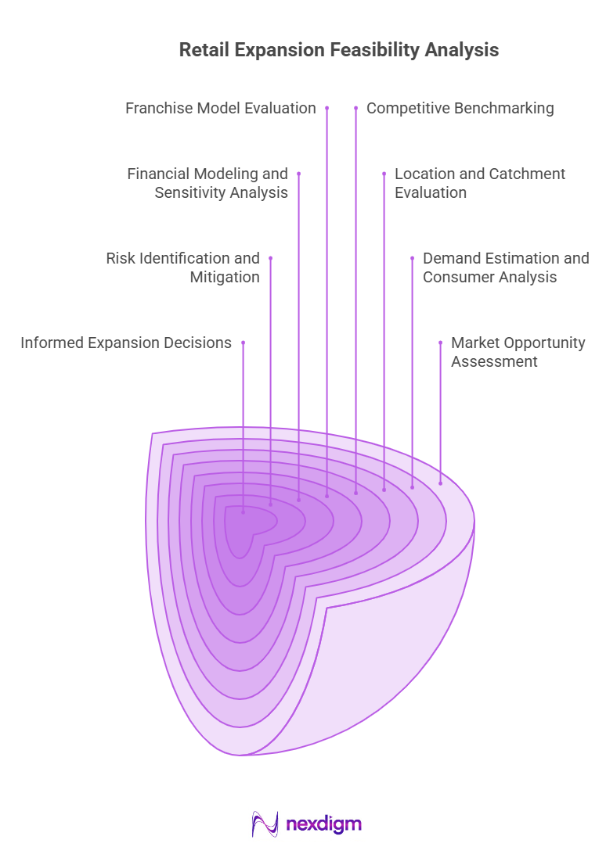
By evaluating expansion opportunities through multiple lenses, Nexdigm helps businesses build confidence in investment decisions while reducing the likelihood of costly market-entry mistakes.
Turning Data Into Expansion Confidence with Nexdigm
Retail leaders often face pressure to scale quickly. However, rapid expansion without disciplined evaluation can lead to underperforming outlets, strained operations, and lower profitability.
Companies that invest in robust franchise retail entry feasibility services gain access to actionable insights that support smarter decision-making. Rather than relying solely on market sentiment or franchise interest, they can validate assumptions through data-backed analysis. Nexdigm’s advisory-led approach empowers organizations to:
- Evaluate whether expansion opportunities are commercially viable
- Prioritize high-potential markets and locations
- Assess franchise attractiveness and sustainability
- Optimize outlet economics before investment
- Reduce expansion-related risks
Through such a comprehensive approach and strategic evaluation, Nexdigm enables businesses to transform expansion ambitions into data-driven growth strategies.
Nexdigm’s Case
In a recent engagement, Nexdigm supported a retail client in assessing franchise expansion viability through demand analysis, outlet economics, and market evaluation. Real-time insights improved franchise opportunity screening by 34%, optimized outlet profitability forecasts by 28%, and reduced expansion risks by 25%.
This retail expansion assessment approach enabled the client to identify scalable franchise opportunities, evaluate outlet potential, and develop a sustainable growth roadmap backed by market intelligence.
To take the next step, simply visit our Request a Consultation page and share your requirements with us.
Harsh Mittal
+91-8422857704