

Franchise retail pricing feasibility research helps brands create consistent, locally relevant prices across multi-location store networks. Through structured Pricing Strategy Analysis, franchisors can compare regional demand, customer affordability, competitor pricing, operating costs, promotional practices, and franchisee margins.
These insights make it easier to establish practical pricing guardrails while allowing appropriate market flexibility. A well-designed approach reduces price inconsistencies, strengthens brand trust, improves franchisee alignment, and supports healthier margins. It also enables faster pricing decisions across stores, channels, product categories, and changing local market conditions without weakening the overall customer experience.
The U.S. franchise sector is projected to reach 845,000 establishments and generate over USD 921 billion in output in 2026. At this scale, consistent pricing research can reduce store-level variation, protect margins, improve franchisee compliance, and strengthen customer trust across locations.
Pricing Strategy Analysis for Consistent Franchise Store Performance
Pricing Strategy Analysis helps franchise networks align prices, local market conditions, franchisee economics, and brand standards to improve consistency, customer trust, profitability, and scalable performance across every store location. Its major advantages include:
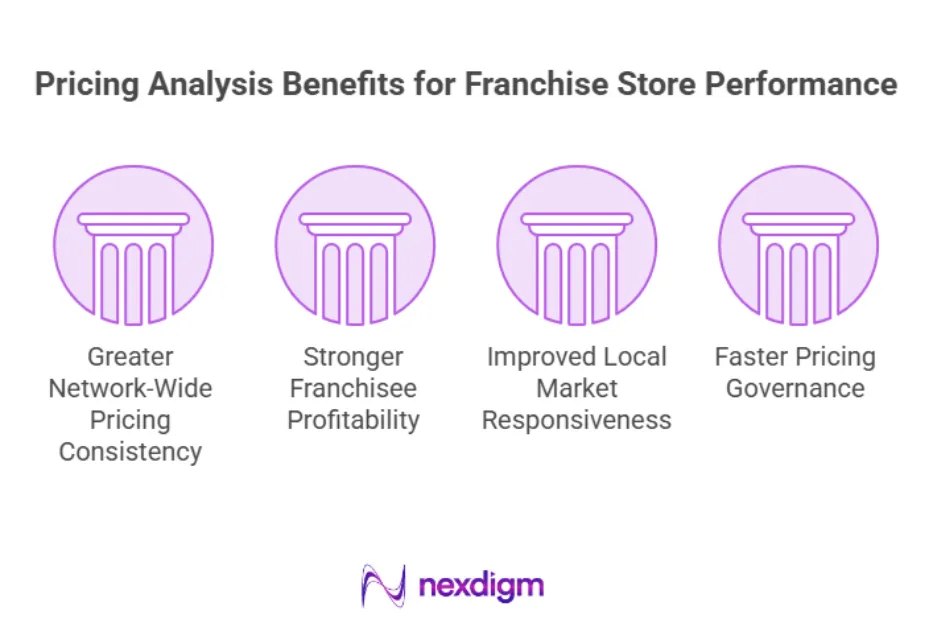
- Greater Network-Wide Pricing Consistency: Clear pricing principles reduce unnecessary store-level variation, helping franchisees present a consistent customer proposition while preserving flexibility for legitimate regional cost and demand differences.
- Stronger Franchisee Profitability: Store-level cost, margin, and sales analysis supports pricing decisions that improve franchisee economics without creating prices that conflict with brand positioning or customer expectations.
- Improved Local Market Responsiveness: Regional demand, competition, purchasing power, and operating conditions inform localized price adjustments, enabling stores to remain relevant while operating within clearly defined brand pricing boundaries.
- Faster Pricing Governance: Standardized approval processes, pricing thresholds, and performance dashboards help franchisors resolve pricing issues quickly, improve accountability, and support more disciplined decisions across growing store networks.
Nexdigm’s Role in Franchisee Profitability and Pricing Optimization
Nexdigm helps franchise networks improve store-level performance through Franchise Retail Pricing Analysis, Pricing Strategy Analysis, Franchise Pricing Feasibility Research, and Multi-Location Price Optimization. By evaluating local costs, customer demand, competitor pricing, franchisee margins, and promotional effectiveness, Nexdigm develops data-driven pricing strategies that strengthen profitability, improve pricing consistency, support brand alignment, and enable scalable growth across diverse store networks and regional markets.
Nexdigm’s Strategic Planning Model for Franchise Pricing Decisions
Nexdigm’s strategic planning model helps franchise networks make balanced pricing decisions by combining local economics, brand standards, customer demand, and governance to improve profitability, consistency, resilience, and scalable long-term growth. Its major steps include:
- Set Network Pricing: Setting network-wide pricing principles, profitability targets, flexibility limits, and approval responsibilities so franchisees understand which decisions are standardized and where controlled local adaptation is permitted.
- Evaluate Store-Level Economics: Comparing store economics, rental costs, labor expenses, sales mix, and customer traffic to identify locations requiring differentiated pricing support, targeted intervention, or corrective commercial action.
- Measure Local Market Sensitivity: Measuring local customer sensitivity, competitor pricing, demand patterns, and regional affordability to determine where standard prices may need controlled market-specific adjustments without weakening brand consistency
- Create Pricing Flexibility Guidelines: Designing price bands, promotional limits, surcharge rules, and exception criteria that give franchisees practical flexibility while protecting margins, fairness, consistency, and the wider brand proposition.
- Pilot and Validate Pricing Changes: Summarizing revised prices across selected locations, then compare sales, margin, traffic, and customer feedback to validate results before expanding successful changes throughout the broader franchise network.
Nexdigm’s Case
Nexdigm supported a franchise dealer to improve pricing consistency across its multi-location network. The analysis reduced unexplained store-level price variation by 19%, improved average franchisee margins by 8%, increased promotional compliance to 94%, and shortened pricing approval cycles by 25%, enabling faster decisions, stronger brand alignment, and sustainable network-wide profitability.
To take the next step, simply visit our Request a Consultation page and share your requirements with us.
Harsh Mittal
+91-8422857704