

Fraud detection is becoming more difficult as financial institutions face faster payments, identity manipulation, social engineering, and AI-enabled attacks. INTERPOL’s 2026 Global Financial Fraud Threat Assessment estimates global financial-fraud losses at USD 442 billion in 2025, while warning that AI is making fraud more scalable and sophisticated.
The pressure is also visible at the transaction level. TransUnion reported that 3.8% of attempted consumer transactions globally were suspected digital fraud in 2025, while India’s rate was considerably higher at 7.1%. Account creation was the highest-risk stage globally, with an 8.3% suspected fraud rate.
Meanwhile, fraud detection is becoming increasingly time-sensitive. Mastercard notes that real-time transactions can leave institutions only seconds to identify and stop suspicious activity, increasing the importance of AI and real-time data in fraud prevention.
Against this backdrop, fraud detection service provider analysis can help financial institutions compare providers on detection accuracy, response speed, risk coverage, analytics, integration, and operational effectiveness.
Fraud Detection Is Moving From Rules to Adaptive Risk Intelligence
Traditional rules remain important, but evolving fraud patterns require providers to combine rules with behavioral analytics, machine learning, network intelligence, identity signals, and real-time risk assessment. The objective is increasingly to identify suspicious behavior before losses occur while limiting unnecessary friction for legitimate customers. This shift is particularly important as criminals increasingly exploit human behavior and AI-generated deception rather than relying only on conventional technical vulnerabilities.
Balancing Effective Fraud Detection Practices
Fraud controls need to protect legitimate customers as effectively as they identify suspicious activity. Excessive alerts, unnecessary authentication steps, or delayed transactions can create friction and affect customer trust. Providers therefore need to balance risk sensitivity, decision speed, false-positive management, and intervention levels. This balance can help institutions strengthen fraud controls while maintaining a smoother experience across digital and payment channels.
Nexdigm’s Approach to Assessing the Operational Impact of Fraud Controls
Building on the need to balance protection with customer experience, experts at Nexdigm can assess how provider capabilities affect both fraud outcomes and day-to-day operations. The evaluation can focus on:
- False-Positive Management: Examine how effectively providers reduce unnecessary alerts while maintaining sufficient sensitivity to genuine fraudulent activity.
- Investigation Efficiency: Assess alert prioritization, case workflows, analyst tools, and automation that can help teams resolve suspicious activity faster.
- Customer Impact: Evaluate intervention methods, authentication requirements, transaction delays, and friction created for legitimate customers during fraud checks.
Overall, this helps institutions identify providers that can strengthen fraud controls without creating disproportionate operational workloads or customer friction.
How Nexdigm’s Fraud Detection Approach Is Different
Nexdigm’s fraud detection service provider analysis goes beyond comparing fraud detection features or headline accuracy metrics. It brings together multiple perspectives to understand how each provider performs within the institution’s actual environment. Building on the operational analysis, the approach considers:
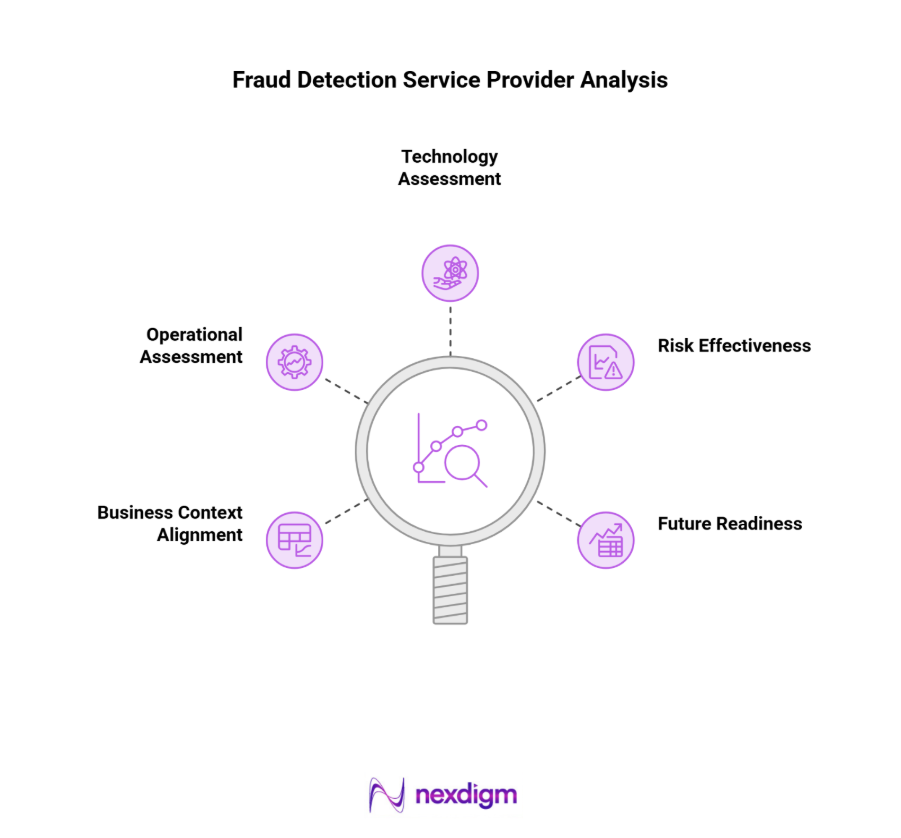
- Business Context: Align provider evaluation with the institution’s fraud exposure, transaction channels, customer profile, and risk priorities.
- Operational Context: Examine how detection capabilities affect investigations, response processes, customer friction, and existing fraud operations.
- Technology Context: Assess integration, scalability, analytics, automation, data requirements, and the ability to support evolving fraud threats.
- Risk Effectiveness: Evaluate how effectively providers address different fraud scenarios, manage emerging threats, and balance detection sensitivity with false-positive exposure.
- Future Readiness: Consider whether provider capabilities can adapt to changing fraud patterns, increasing transaction volumes, evolving technologies, and the institution’s longer-term fraud-management objectives.
By combining these perspectives, Nexdigm’s experts provide a more contextual view of supplier suitability, helping institutions distinguish between providers with strong technology and those with stronger practical, operational, and strategic relevance to their fraud-management objectives.
How Nexdigm’s Distinct Approach Creates Significant Impact
Nexdigm’s contextual approach can help institutions move beyond supplier comparison toward practical fraud-management decisions. By connecting provider capabilities with business, operational, technology, and risk considerations, the assessment can help institutions:
- Shortlist Relevant Providers: Focus evaluation on suppliers whose capabilities align closely with the institution’s fraud exposure and priorities.
- Identify Capability Gaps: Highlight areas where existing or potential providers may require stronger detection, coverage, integration, automation, or investigation capabilities.
- Prioritize Investments: Identify where technology, automation, or fraud-control investments could have the greatest operational and risk-management impact.
Overall, the approach creates a more actionable basis for provider selection, technology planning, and fraud-control improvement, while keeping the assessment aligned with evolving fraud risks and transaction environments.
Nexdigm’s Case
Nexdigm assessed fraud detection service providers across detection accuracy, response speed, risk coverage, analytics, integration, and scalability. 28% demonstrated strong alignment with priority fraud scenarios, 19% showed differentiated real-time detection capabilities, and 16% required additional validation around integration or model governance. The assessment helped the institution prioritize providers for technical due diligence, proof-of-concept testing, and commercial evaluation.
To take the next step, simply visit our Request a Consultation page and share your requirements with us.
Harsh Mittal
+91-8422857704