

Fraud risks are expanding across payment rails, banking channels, and digital finance, increasing the importance of technology that can identify suspicious activity before losses escalate. The RBI’s 2026 discussion paper reported that digital-payment frauds in India reached 28 lakh reported cases involving ₹22,931 crore in 2025, up from 2.6 lakh cases involving ₹551 crore in 2021. The RBI also highlighted the growing role of deepfake-driven impersonation and mule-account networks.
The pressure is visible across other markets. Federal Reserve Financial Services found that 75% of surveyed U.S. financial institutions reported debit-card fraud attempts, while 23% reported account-takeover fraud, a 7% year-over-year increase.
Payment fraud is also becoming more costly. The Central Bank of Ireland reported €179.04 million in fraudulent payments during 2025, a 27.2% increase from 2024, with authorized push-payment fraud accounting for 45% of total fraud value.
These developments are expanding the competitive landscape for fraud technology providers and making it increasingly important to understand which vendors lead in specific fraud use cases and why.
Fraud Technology Is Expanding Across Multiple Risk Layers
The market is no longer centered on transaction monitoring alone. Providers increasingly combine identity intelligence, behavioral analytics, device signals, network analysis, AI, authentication, and real-time decisioning to address fraud across the customer lifecycle. This creates a more fragmented supplier landscape, where broad platforms and specialist technologies can both play important roles.
Market Leadership Depends on More Than Vendor Visibility
A provider’s scale or market presence does not necessarily indicate leadership across every fraud category. Some suppliers may specialize in payments, while others have stronger capabilities in identity, account takeover, scams, or digital onboarding. Comparing providers across detection effectiveness, response speed, risk coverage, integration, and use-case depth can therefore provide a more meaningful view of competitive positioning.
Nexdigm’s View of the Fraud Technology Vendor Landscape
Nexdigm can provide a structured view of the fraud detection technology vendor landscape by assessing the following areas:
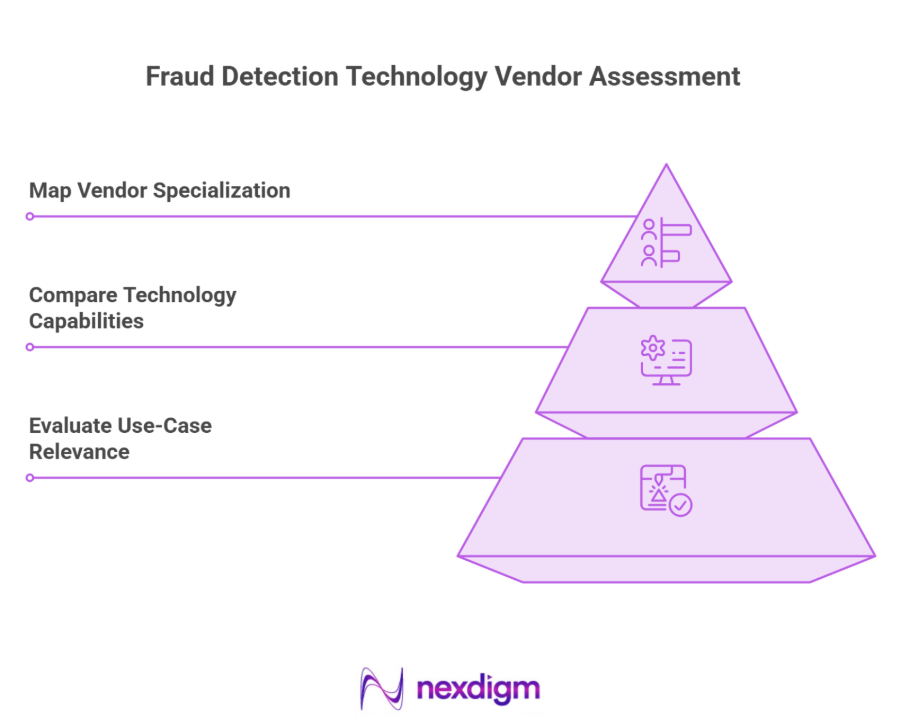
- Mapping Vendor Specialization: Identifying providers focused on payments, identity, account takeover, scams, transaction monitoring, behavioral analytics, or broader fraud platforms.
- Comparing Technology Capabilities: Assessing detection sophistication, real-time decisioning, AI, analytics, integration, scalability, and ability to support evolving fraud scenarios.
- Evaluating Use-Case Relevance: Determining which providers demonstrate stronger alignment with specific fraud risks, channels, operating models, and institutional requirements.
This approach helps institutions understand where vendors are differentiated, where capabilities overlap, and which providers are most relevant to specific fraud-management priorities.
Why Trust Nexdigm for Fraud Technology Research
Nexdigm brings together financial-services expertise, market intelligence, technology assessment, and structured supplier research to help institutions with:
- Broader Market Perspective: Map established platforms and specialized providers to understand market positioning, areas of specialization, and emerging capabilities.
- Contextual Technology Evaluation: Assess detection, AI, analytics, real-time decisioning, integration, scalability, and response capabilities against the institution’s specific fraud requirements.
- Actionable Supplier Insights: Translate market and technology findings into clearer shortlists, capability-gap identification, technology priorities, and potential investment areas.
This approach gives decision-makers a more structured basis for evaluating both established and specialized fraud technology providers, supporting supplier selection and longer-term fraud-management planning.
Nexdigm Connects Market Intelligence With Provider Assessment
Nexdigm can translate its view of the fraud detection technology vendor landscape into a structured assessment by evaluating providers across multiple dimensions. The approach can include:
- Detection Effectiveness: Assess fraud-detection accuracy, false-positive management, behavioral analytics, machine learning, and the ability to identify emerging fraud patterns.
- Real-Time Decisioning: Evaluate transaction-processing speed, real-time risk scoring, automated intervention, alert generation, and response capabilities across high-volume channels.
- Risk Coverage: Examine capabilities across payment fraud, identity fraud, account takeover, scams, synthetic identities, mule activity, and other emerging threats.
- Technology & Integration: Assess APIs, data connectivity, architecture compatibility, cloud readiness, interoperability, automation, and integration with existing fraud-management systems.
- Scalability & Performance: Determine whether providers can support increasing transaction volumes, expanding digital channels, geographic growth, and more complex fraud scenarios.
- AI & Analytics Maturity: Examine the use of AI, machine learning, network analysis, predictive models, explainability, model governance, and analytical decision support.
By bringing these assessments together, Nexdigm provides a multi-dimensional view of supplier strengths, limitations, differentiation, and practical fit, helping institutions identify which providers warrant deeper validation and where specialist capabilities may complement broader fraud platforms.
Nexdigm’s Case
Nexdigm’s assessment considered fraud technology providers across payments, banking, identity, and analytics. The analysis was informed by RBI data showing 28 lakh digital-payment fraud cases involving ₹22,931 crore in 2025. Findings helped identify relevant platform and specialist providers, prioritize capability gaps, and support focused technical validation and commercial evaluation.
To take the next step, simply visit our Request a Consultation page and share your requirements with us.
Harsh Mittal
+91-8422857704