

Freight and courier providers play a central role in maintaining supply chain continuity. Their ability to move goods reliably influences production schedules, inventory availability, customer deliveries and business operations. A disruption involving a critical logistics supplier can therefore create consequences well beyond transportation delays.
Vendor risk assessment is particularly important for organisations that depend on a limited number of freight operators, use providers across multiple markets or manage time-sensitive shipments. Financial instability, inadequate capacity, regulatory issues and operational weaknesses can expose businesses to unexpected costs and service interruptions.
A structured freight and courier vendor risk profiling exercise helps procurement teams identify these vulnerabilities before they affect supply chain performance.
Understanding Risk Across Freight and Courier Suppliers
Logistics vendor risk is not limited to a supplier’s ability to meet delivery schedules. It includes financial, operational, geographical, regulatory and technology-related exposure.
Freight providers may face risks associated with fleet availability, fuel price fluctuations, route restrictions, infrastructure disruptions and dependence on subcontractors. Courier operators may be exposed to delivery workforce shortages, network congestion, high return volumes and technology failures.
The nature of risk also varies according to the service model. A company transporting bulk industrial materials has different continuity requirements from an e-commerce business handling thousands of individual parcels.
Procurement teams should therefore develop risk profiles based on supplier responsibilities, shipment characteristics and the operational importance of each service.
Assessing Capacity and Operational Resilience
Capacity risk arises when a supplier cannot meet current or expected shipment requirements. This can occur because of limited fleet availability, insufficient warehouse infrastructure, workforce constraints or dependence on external transportation partners.
Freight vendor assessments should examine fleet size, vehicle categories, route coverage, warehouse access, equipment availability and the ability to manage peak volumes.
For courier providers, relevant factors include sorting infrastructure, delivery hub density, serviceable locations, delivery personnel availability and reverse logistics capacity.
Capacity should be assessed against actual operating requirements rather than headline figures. A provider may advertise extensive network coverage but rely heavily on third-party operators in certain regions.
Service continuity also depends on contingency arrangements. Procurement teams should examine how suppliers respond to vehicle breakdowns, severe weather, labour shortages, technology outages and route disruptions.
A supplier with documented contingency procedures and alternative operating arrangements may offer stronger resilience than one relying entirely on normal operating conditions.
Financial Health and Business Stability
Financial risk can affect a logistics provider’s ability to maintain equipment, retain employees, invest in technology and meet contractual obligations.
Procurement teams should examine available financial statements, revenue trends, profitability, liquidity, debt exposure and cash flow indicators. Where detailed financial information is unavailable, businesses may use other credible indicators, including credit assessments, payment behaviour, ownership information and publicly available corporate disclosures.
Supplier dependence should also be considered. A provider that relies heavily on a small number of customers may face greater exposure if a major contract is lost.
Likewise, a business dependent on a single subcontractor, transport corridor or operating facility may have limited flexibility during disruptions.
Financial assessment should be proportionate to the supplier’s importance and the value of the contracted services.
Regulatory, Technology and Geographical Exposure
Freight and courier operations involve several regulatory and compliance considerations. Depending on the service and jurisdiction, these may include transport permits, vehicle documentation, insurance, customs requirements, labour obligations and applicable safety standards.
Procurement teams should verify whether suppliers maintain appropriate licences and documentation for the activities they perform.
Technology risk has become increasingly relevant as logistics operations depend on digital booking systems, tracking platforms, route management and electronic proof of delivery.
Businesses should evaluate system availability, data security, integration arrangements and incident response procedures.
Geographical exposure should also be assessed. Suppliers operating through regions affected by infrastructure constraints, border delays, political instability or extreme weather may require additional contingency planning.
Building a Risk-Based Supplier Portfolio
Risk profiling should produce actionable supplier classifications rather than a collection of isolated observations.
A practical approach is to classify vendors as low, moderate or high risk according to their financial stability, operational capacity, service continuity, compliance and geographical exposure.
High-risk suppliers may require closer monitoring, additional documentation, alternative sourcing arrangements or more frequent performance reviews.
Organisations should also distinguish between the likelihood of a disruption and its potential business impact. A small regional supplier may have a limited financial footprint but still be critical if it is the only provider serving an important delivery location.
Freight and Courier Vendor Risk Profiling Framework
A structured freight and courier vendor risk profiling exercise should cover:
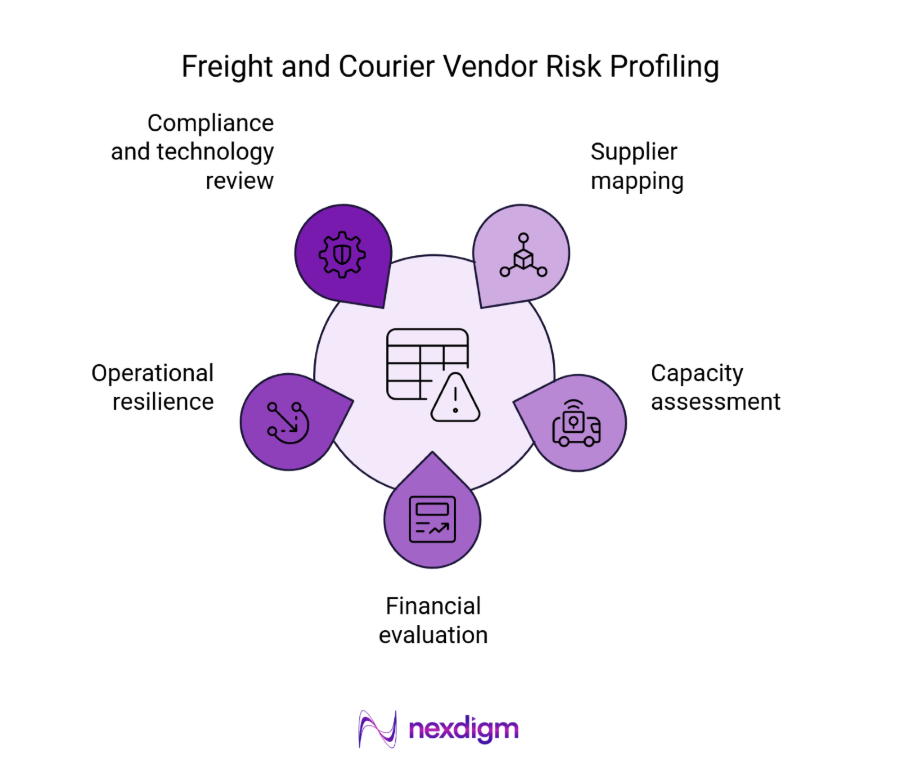
- Supplier mapping: Identify critical freight and courier providers, service categories and operational dependencies.
- Capacity assessment: Review fleet availability, network coverage, workforce strength and peak-period capability.
- Financial evaluation: Examine financial stability, liquidity, debt exposure and business concentration.
- Operational resilience: Assess contingency plans, alternative routes, subcontractor dependence and recovery procedures.
- Compliance and technology review: Evaluate licences, insurance, documentation, data security and platform reliability.
- Risk classification: Score suppliers according to risk likelihood, potential impact and criticality to business operations.
Nexdigm can support organisations through logistics supplier intelligence, vendor risk profiling, financial and operational assessments, and market-level risk analysis. These services help procurement teams identify supplier vulnerabilities, evaluate exposure and strengthen logistics sourcing decisions.
Nexdigm’s Case Study: Mapping Logistics Supplier Exposure
Nexdigm profiled 15 freight and courier vendors across 5 operating markets, assessing financial health, capacity, subcontractor dependence and service continuity. The exercise identified 5 high-risk suppliers, highlighted 4 critical operational dependencies and established 6 monitoring indicators.
To take the next step, simply visit our Request a Consultation page and share your requirements with us.
Harsh Mittal
+91-8422857704