

Freight demand follows economic activity, but the relationship is rarely linear. Manufacturing, consumer spending, international trade, production shifts, and transportation choices can all change future shipment volumes.
UNCTAD reported that global trade reached a record $35 trillion in 2025, while goods trade grew by approximately 6.5%.
For carriers, logistics providers, manufacturers, ports, freight forwarders, and infrastructure investors, the challenge is turning these signals into reliable volume expectations.
Freight demand forecasting helps organizations estimate where freight volumes will increase, which commodities will drive growth, and how transportation requirements may change.
Nexdigm brings economic, trade, manufacturing, and logistics intelligence together to create a more practical view of future freight demand.
Understanding the Freight Market
Nexdigm starts by examining the economic conditions behind freight movement. GDP, industrial production, consumer spending, construction, manufacturing output, business investment, and employment can indicate where future transportation demand is heading.
Rather than treating economic growth as a direct measure of freight growth, Nexdigm connects individual economic indicators with specific freight categories and markets.
How Nexdigm Tracks Trade Movement
International trade provides another important forecasting signal. Nexdigm analyzes imports, exports, commodities, trading partners, origin-destination flows, and changes in production locations.
This reveals whether freight growth is broad-based or concentrated around specific industries, countries, or corridors.
Manufacturing relocation and nearshoring can also create new freight routes even when overall global trade growth remains moderate. UNCTAD has highlighted continuing changes in supply-chain geography as businesses adapt to economic and geopolitical conditions.
Understanding the Modal Shifts
Different products create very different transportation requirements. Automotive manufacturing can generate component and finished-vehicle flows, while agricultural growth may increase bulk and cold-chain requirements.
Electronics and other high-value goods can generate greater demand for time-sensitive transportation.
Nexdigm connects commodity-level growth with transportation characteristics to produce more useful volume expectations.
The Nexdigm Freight Demand Framework
The Freight demand forecasting framework forms the core of the analysis. It connects four dimensions to show not only how much freight could grow, but why, where, and through which logistics networks.
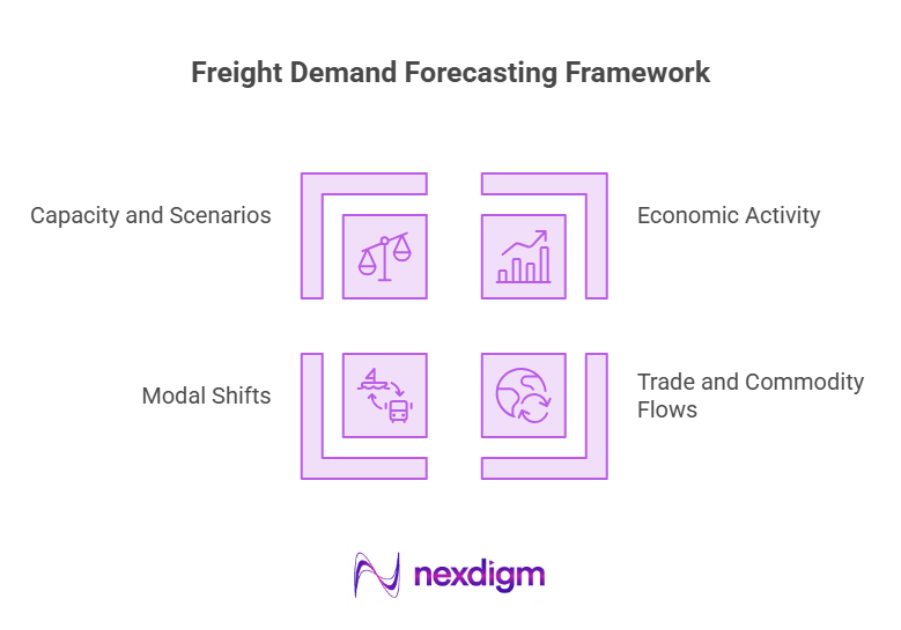
Economic Activity
- Measure industrial growth: Manufacturing and production trends reveal potential increases in inbound materials and outbound finished-goods movement.
- Track consumer demand: Retail spending and consumption patterns indicate future requirements for distribution, replenishment, warehousing, and last-mile transportation.
- Monitor investment: Business and infrastructure investment can signal new production capacity and future freight-generating economic activity.
- Assess construction: Construction activity can indicate rising demand for building materials, machinery, equipment, and related transportation services.
- Connect indicators: Nexdigm links economic signals with relevant freight categories rather than applying one growth assumption across every market.
Trade and Commodity Flows
- Map imports and exports: Trade flows identify the countries, regions, and corridors generating increasing volumes of cross-border freight.
- Follow commodity changes: Nexdigm tracks which product categories are expanding because each creates different transportation, storage, and handling requirements.
- Study trading partners: Changes in supplier and customer relationships can redirect freight toward new origins, destinations, and logistics corridors.
- Track manufacturing relocation: New factories and supplier movements can create sustained freight demand around emerging production clusters.
- Identify corridor growth: Combining trade and commodity data helps Nexdigm distinguish structurally growing routes from temporary shipment increases.
Modal Shifts
- Compare transportation modes: Nexdigm evaluates road, rail, sea, and air according to cost, capacity, speed, infrastructure, and customer requirements.
- Track modal share: Changes in transportation preferences can redirect freight demand even when total market volumes remain relatively stable.
- Assess fuel economics: Fuel-price changes can influence the relative attractiveness of different transportation modes and alter future logistics demand.
- Measure infrastructure effects: New rail lines, ports, highways, or terminals can shift freight toward previously underused transportation networks.
- Identify efficiency gains: Modal analysis reveals where combining transportation methods can improve cost, reliability, capacity utilization, or transit performance.
Capacity and Scenarios
- Compare demand with capacity: Forecast volumes are measured against available trucks, rail, warehouses, ports, containers, terminals, and border infrastructure.
- Identify bottlenecks: Nexdigm highlights markets where projected freight growth could exceed existing logistics capacity.
- Build a base scenario: The base case represents the most likely combination of economic, trade, production, and transportation developments.
- Test upside growth: Stronger economic activity or faster manufacturing expansion shows where additional freight capacity may be required sooner.
- Test downside risk: Slower growth, trade restrictions, geopolitical disruption, or weaker consumption can reveal potential overcapacity and investment risks.
How Nexdigm Turns Forecasts Into Decisions
Forecasting becomes valuable when it influences operational and investment decisions.
Nexdigm uses projected freight volumes to support fleet planning, warehouse expansion, route development, infrastructure investment, transportation-mode decisions, budgeting, and market entry.
For logistics operators, this can help determine where additional vehicles or facilities may be required.
For investors, it provides a framework for evaluating whether infrastructure assets are positioned around durable freight growth.
For manufacturers, it can support decisions about distribution networks, supplier locations, and transportation requirements.
Nexdigm’s Case
A logistics provider used Nexdigm’s Freight demand forecasting to anticipate corridor growth and optimize capacity. Within 12 months, forecast accuracy improved 32%, fleet utilization increased 24%, transportation costs declined 17%, and shipment delays fell 21%, strengthening network efficiency, customer reliability, and overall operating performance.
To take the next step, simply visit our Request a Consultation page and share your requirements with us.
Harsh Mittal
+91-8422857704