

Freight demand forecasting has become a strategic factor as global trade volumes continue to expand across regions. Accurate prediction of cargo flows enables logistics providers and businesses to anticipate capacity needs, optimize routing, and reduce operational costs. Competitive intelligence helps in understanding emerging trade patterns and shifts in regional demand allows companies to gain an edge over competitors by aligning resources proactively and identifying market opportunities before others.
Leveraging data analytics, economic indicators, and supply chain insights, freight demand forecasting not only improves operational efficiency but also supports strategic decision-making in an increasingly complex global trade environment.
In 2025 global trade continued expanding, with total trade flows projected to exceed $35 trillion, about a 7 % increase, marking a new record high as goods and services movements solidified growth across regions. Maritime and air freight volumes also rose, with air cargo demand up around 3–6 % year‑on‑year and container traffic expanding modestly, while forecasts for 2026 project continued, albeit slower, freight demand growth across major corridors.
How Global Trade Trends Shape Freight Demand through Competitive Intelligence?
Global trade trends, such as rising exports, regional shifts, and e-commerce growth, influence freight volumes. Competitive intelligence analyzes these patterns, enabling businesses to forecast demand, optimize logistics, and gain market advantage:
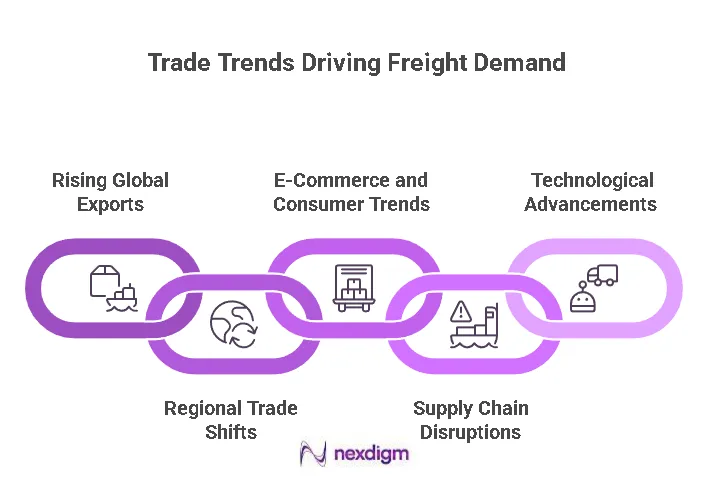
-
Rising Global Exports
Increased exports drive higher freight volumes; competitive intelligence identifies emerging markets and peak trade periods for proactive capacity planning.
-
Regional Trade Shifts
Shifts in trade flows between Asia, Europe, and the Americas impact logistics routes; intelligence helps anticipate demand surges regionally.
-
E-Commerce and Consumer Trends
E-commerce growth increases air and parcel freight; competitive intelligence predicts seasonal spikes, enabling optimized delivery networks.
-
Supply Chain Disruptions
Disruptions like port congestion or geopolitical tensions alter freight patterns; intelligence aids in risk assessment and contingency planning.
-
Technological Advancements in Logistics
Automation, AI, and tracking systems enhance freight forecasting; competitive intelligence integrates data to refine demand predictions.
Nexdigm’s Approach to Freight Demand Forecasting
Nexdigm’s approach to freight demand forecasting combines advanced data analytics, market insights, and competitive intelligence to predict cargo volumes accurately. By analyzing global trade trends, regional demand shifts, and seasonal fluctuations, Nexdigm helps clients optimize logistics planning, allocate resources efficiently, and reduce operational costs. This proactive methodology enables businesses to respond swiftly to evolving trade patterns and maintain a competitive edge.
Nexdigm’s Approach in Turning Global Trade Trends to Actionable Logistics Insights
Nexdigm transforms global trade trends into actionable logistics insights by combining data analytics, competitive intelligence, and market expertise, enabling businesses to optimize freight planning, anticipate demand shifts, and enhance supply chain efficiency.
-
Analyzing Global Trade Patterns
Nexdigm examines trade flows, import-export data, and economic indicators to identify trends impacting freight volumes and logistics requirements.
-
Integrating Competitive Intelligence
By tracking competitors and market movements, Nexdigm provides insights that help businesses anticipate shifts and adjust logistics strategies effectively.
-
Predictive Freight Demand Modeling
Using AI and data analytics, Nexdigm forecasts cargo volumes, seasonal spikes, and regional demand fluctuations for proactive planning.
-
Regional and Market-Specific Insights
Nexdigm evaluates specific regions and trade corridors, highlighting opportunities and risks for optimized supply chain allocation.
-
Actionable Logistics Recommendations
Insights are translated into practical strategies, enabling companies to streamline operations, reduce costs, and improve delivery performance.
-
Continuous Monitoring and Adaptation
Nexdigm ensures dynamic updates as global trade conditions change, allowing businesses to respond swiftly to evolving freight demands.
Nexdigm’s case:
In a recent supply chain engagement, Nexdigm helped a consumer improve resiliency amid rising logistics costs and disruptions. Through strategic sourcing and analytics, Nexdigm avoided approximately USD 0.56 million in air freight costs, protected USD 192 million in net trade sales, and created 30 days of safety stock, significantly reducing lead‑time risks and improving supply flexibility.
To take the next step, simply visit our Request a Consultation page and share your requirements with us.
Harsh Mittal
+91-8422857704