

Freight forwarder alliances are becoming important for improving network coverage across global trade lanes, especially as businesses expand into new regions. These alliances help companies access wider shipping routes, customs expertise, carrier relationships, multimodal transport options, and destination-market support.
For organizations entering international markets, a strong market entry strategy must evaluate freight partner capability, trade lane coverage, documentation support, cost efficiency, and risk management. A well-planned freight forwarder alliance entry strategy improves shipment reliability, reduces transit delays, strengthens cross-border coordination, and supports smoother movement of goods across regional and global supply chains while maintaining service consistency.
Data shows why freight forwarder alliances are important for global trade lane expansion. Around 80% of international goods trade by volume moves through maritime transport, while the global freight forwarding market was valued at about USD 225.4 billion in 2025 and is projected to reach USD 340.1 billion by 2033. These trends support stronger freight forwarder alliance entry strategy for wider network coverage.
Strengthening Cross-Border Logistics Networks with Freight Forwarders
Strengthening cross-border logistics networks with freight forwarders helps businesses improve shipment coordination, customs handling, route planning, carrier access, and delivery reliability across regional and international trade lanes:
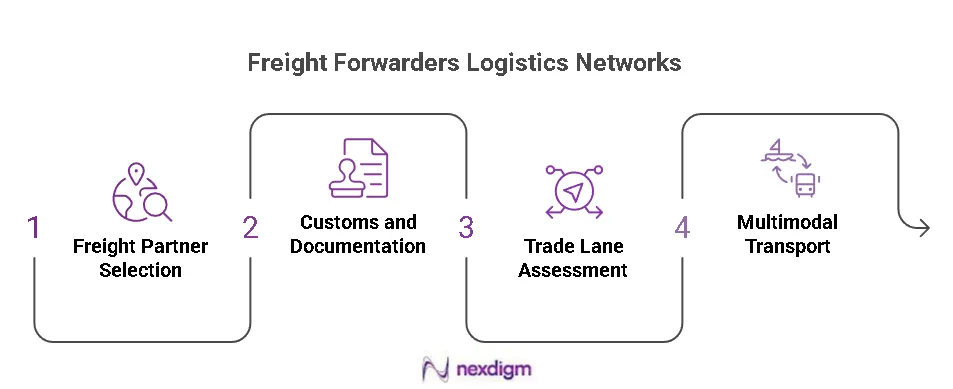
- Freight Partner Selection: Identify reliable freight forwarders with strong trade lane coverage, customs knowledge, carrier access, and international logistics experience.
- Customs and Documentation Support: Freight forwarders help manage export-import documents, customs clearance, compliance checks, and shipment approvals across borders.
- Trade Lane Coverage Assessment: Evaluate route availability, port access, transit times, and regional reach to strengthen cross-border logistics performance.
- Multimodal Transport Coordination: Combine sea, air, road, and rail options to improve shipment flexibility, cost control, and delivery reliability.
Nexdigm Cross-Border Logistics Strategy for Import and Export Movement
Nexdigm cross-border logistics strategy for import and export movement helps businesses assess trade lanes, freight partners, customs requirements, documentation processes, route efficiency, and delivery risks. This supports compliant market entry, smoother cargo movement, reduced delays, and stronger logistics reach across regional and international supply chains.
Nexdigm Freight Forwarder Partner Identification Across Global Trade Lanes
Nexdigm freight forwarder partner identification across global trade lanes helps evaluate partner reach, customs expertise, carrier access, service reliability, compliance capability, and scalability for efficient international logistics expansion.
- Compliance and Risk Readiness: Nexdigm reviews regulatory alignment, shipment controls, documentation accuracy, and risk preparedness for cross-border logistics operations.
- Cost and Commercial Evaluation: Nexdigm assesses freight rates, pricing transparency, service costs, and commercial terms to support efficient partner selection.
- Technology and Shipment Visibility: Nexdigm evaluates tracking systems, digital updates, reporting tools, and shipment visibility across global trade lanes.
- Scalability for International Expansion: Nexdigm identifies freight forwarders capable of supporting higher shipment volumes, new markets, and long-term logistics growth.
Nexdigm’s case:
Nexdigm helped a logistics company identify suitable freight forwarder partners across global trade lanes before international expansion. By assessing route coverage, customs expertise, carrier access, pricing transparency, and service reliability, Nexdigm helped improve shipment visibility by 30%, reduce transit delays by 18%, and expand trade lane coverage from 12 to 20 priority routes.
To take the next step, simply visit our Request a Consultation page and share your requirements with us.
Harsh Mittal
+91-8422857704