

Freight forwarders play an important role in international supply chains by coordinating cargo movement across shipping lines, airlines, road transport operators and other logistics providers. Their responsibilities often extend beyond transportation booking to include customs documentation, shipment consolidation, cargo insurance coordination and end-to-end shipment visibility.
For organisations operating across multiple international markets, selecting a freight forwarder requires a detailed understanding of its carrier relationships, trade lane coverage, customs capabilities and service network.
A provider with extensive geographical reach may not necessarily offer the best service on every route. Procurement teams must evaluate capabilities against actual shipping requirements.
Why Freight Forwarder Supplier Intelligence Matters
International shipments involve multiple service providers, regulatory requirements and transportation arrangements. Freight forwarders coordinate these activities and help businesses manage the complexity of cross-border movement.
However, forwarders differ in their operating models.
Some maintain extensive international agency networks, while others operate through owned offices and established carrier relationships. Their service capabilities may also vary across air freight, ocean freight, road transportation and multimodal logistics.
Supplier intelligence helps organisations understand these differences before entering into commercial agreements.
Important evaluation areas include:
- Trade lane coverage: Availability of services across priority import and export markets.
- Carrier relationships: Access to shipping lines, airlines and regional transportation operators.
- Customs capability: Documentation support, customs brokerage and regulatory coordination.
- Service reach: Presence of local offices, agents, warehouses and distribution partners.
- Shipment visibility: Tracking systems, digital documentation and exception management.
- Commercial performance: Freight rates, handling fees, surcharges and contractual flexibility.
Mapping Trade Lanes and Carrier Networks
Trade lane coverage should be evaluated at the origin-destination level rather than through broad claims of global presence.
A forwarder may have strong capabilities across major Asia-Europe corridors but limited access to secondary destinations. Similarly, its carrier relationships may differ depending on whether the shipment moves by air or sea.
Procurement teams should examine:
- Origin and destination coverage: Identify operational presence across major manufacturing, consumption and distribution markets.
- Carrier access: Review relationships with shipping lines, airlines and road transport providers.
- Consolidation capabilities: Assess less-than-container-load and consolidated air freight services.
- Transit arrangements: Compare direct services, transshipment options and connecting routes.
- Alternative routing: Determine whether the forwarder can manage disruptions through alternative carriers and gateways.
Carrier relationships should also be assessed for transparency. Organisations should understand whether the forwarder purchases capacity directly, relies on intermediaries or uses a combination of arrangements.
Assessing Customs Capability and Service Quality
Customs handling is a critical part of freight forwarding, particularly for businesses shipping regulated, high-value or specialised products.
Documentation errors, classification issues and incomplete declarations can delay shipments and create additional costs.
A forwarder’s customs capabilities should therefore be assessed across the following areas:
- Import and export documentation support.
- Customs classification and declaration processes.
- Coordination with licensed customs brokers.
- Duty and tax documentation assistance.
- Management of inspections and shipment holds.
- Regulatory update communication.
- Record management and audit support.
Service quality should be evaluated through shipment milestones, documentation accuracy, customs clearance timelines, exception resolution and communication standards.
Digital integration also matters. FIATA’s digital strategy highlights the importance of standardised trade documents, secure data exchange and interoperability between freight forwarding systems. These capabilities can improve coordination between forwarders, carriers and other supply chain participants.
Freight Forwarder Supplier Intelligence Framework
A structured freight forwarder supplier intelligence exercise should combine market mapping, operational assessment and commercial benchmarking.
The evaluation can follow six stages:
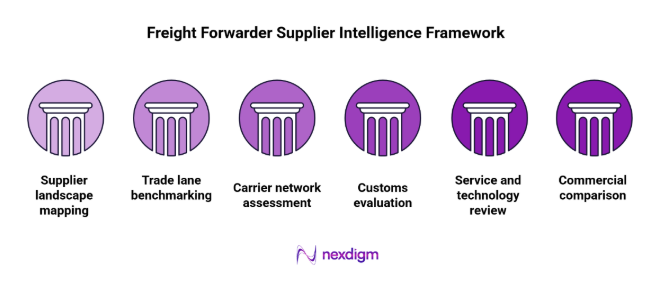
- Supplier landscape mapping: Identify freight forwarders operating across relevant markets and transportation modes.
- Trade lane benchmarking: Compare origin-destination coverage, transit times and service frequency.
- Carrier network assessment: Review airline, shipping line and regional partner relationships.
- Customs evaluation: Examine documentation processes, brokerage arrangements and regulatory support.
- Service and technology review: Assess shipment tracking, reporting, communication and exception management.
- Commercial comparison: Evaluate freight rates, handling fees, surcharges and contractual commitments.
Nexdigm can support organisations through freight forwarder market research, supplier intelligence, trade lane comparisons and commercial benchmarking. These assessments help procurement teams understand supplier capabilities, identify service gaps and make informed decisions when selecting international logistics partners.
Nexdigm’s Case Study
Nexdigm assessed 13 freight forwarders across 7 international trade lanes, comparing carrier networks, customs support, service coverage and shipment visibility. The research identified 4 preferred providers, uncovered a 17% variation in comparable freight costs and helped the client establish trade lane-specific supplier evaluation criteria.
To take the next step, simply visit our Request a Consultation page and share your requirements with us.
Harsh Mittal
+91-8422857704