

A shipper with ten predictable full-container loads from one plant may need less outside help than a smaller company moving hundreds of mixed consignments from dispersed suppliers. The forwarder’s opportunity appears where coordination consumes scarce employee time, creates avoidable delay or exposes the company to errors it cannot easily detect. Shipment count is a volume measure. Complexity is a measure of decisions, exceptions and hand-offs per shipment.
The World Bank’s 2025 Logistics Performance Indicators use shipment-level tracking across maritime, air and postal networks to examine connectivity, transit time and reliability. That operational lens is useful inside a shipper as well: record actual milestones, missed cut-offs, customs holds and document corrections rather than relying only on survey estimates of logistics burden. Complexity varies by lane and product. A medical-device shipment can be light but documentation-intensive; project cargo can be infrequent yet require route surveys, permits and lift plans.
Find the Work That Strains Internal Teams
A practical diagnostic maps origin-destination pairs, supplier count, shipment frequency, mode, Incoterms, customs regime, shipment size and service requirement. It then marks the work performed in-house: booking, consolidation, classification, broker instruction, insurance, exception management and invoice audit. Fragmentation increases when purchase orders are small, suppliers ship from different countries or production schedules change late. LCL consolidation may reduce freight spend but adds coordination and documentation tasks. Multimodal moves increase hand-offs and the probability that one delay breaks the whole schedule.
Outsourcing decisions should compare total cost, not the forwarder’s quoted fee against freight alone. Include internal labor, working capital tied up in transit, demurrage and detention, expedite costs, compliance exposure and service failure. The calculation should also recognize the capabilities a company wants to retain, such as supplier relationships, trade policy decisions or high-value customer commitments. A multinational may keep control-tower governance while outsourcing execution; an SME may need the forwarder to provide both operating capability and purchasing scale.
Price the Service Around a Measurable Gap
The assessment sequence is to score complexity by lane, identify capability gaps, quantify the cost of exceptions, and package the services that remove those costs. A forwarder can create a distinct offer through origin consolidation, customs expertise, time-critical control, project-cargo engineering or a managed exception desk. Willingness to pay is strongest when the benefit is observable: lower landed cost, fewer stock-outs, more reliable delivery or reduced staff hours. Pilot results should be compared with a defined baseline and should separate freight-market movements from provider performance.
Nexdigm can help a shipper build this fact base and help a forwarder prioritize verticals where coordination pain is high and service economics support investment. The final choice may be selective outsourcing by lane, product or activity rather than a wholesale transfer of logistics responsibility.
Converting Trade Growth Into Fleet Demand
A robust shipping demand forecasting approach should connect trade growth to the actual fleet requirement rather than applying one headline growth rate across the business.
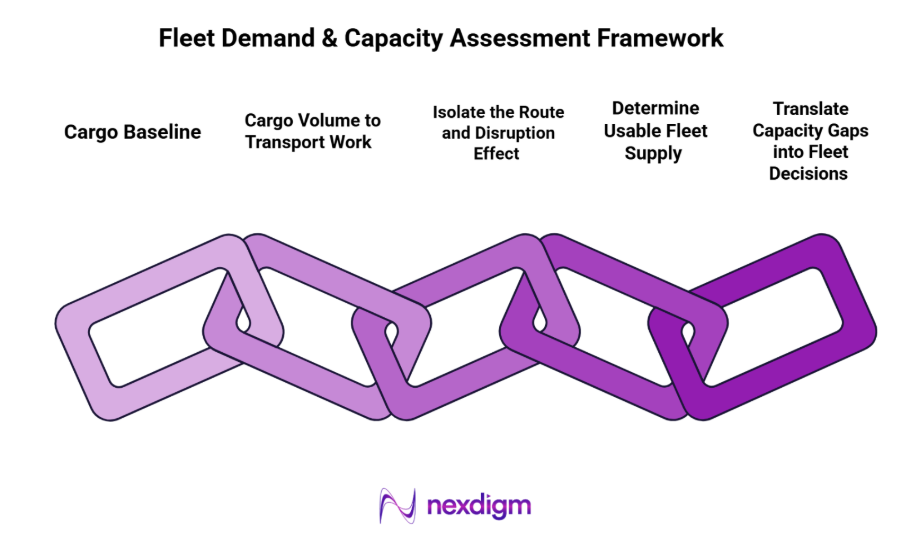
- Establish the Cargo Base
Start with tonnes rather than trade value. Segment demand by commodity, vessel type, origin-destination pair and underlying growth driver. This identifies the cargo actually generating transport demand and prevents high-value, low-weight goods from distorting the forecast. - Translate Cargo Into Transport Work
Convert cargo volumes into vessel requirements using parcel sizes, average haul distances, vessel suitability and sailing patterns. Ton-miles provide the bridge between cargo growth and fleet requirements because similar volume growth can generate very different capacity needs when voyage distances differ. - Model the Route Effect
Assess how chokepoint disruption, canal restrictions, congestion and port turnaround affect vessel utilisation. The objective is to quantify the additional ship-days or slot-days created by longer routes and operational delays rather than treating disruption as an unexplained increase in demand. - Build Effective Fleet Supply
Separate nominal fleet growth from usable capacity. Account for vessel deliveries, retirements, dry-docking, ageing, vessel speeds and schedule reliability. This establishes whether additional vessels are genuinely required or whether existing assets can absorb demand through redeployment or improved utilisation. - Convert the Capacity Gap Into a Fleet Action
The final assessment should translate the projected gap into a commercial response by lane and vessel class. Temporary shortages may favour chartering or redeployment, while persistent structural gaps may justify long-term charter commitments or newbuilds. Scenario analysis should establish the conditions under which each option becomes economically preferable.
How Nexdigm Turns Trade Forecasts Into Fleet Decisions
Nexdigm combines trade forecasts, commodity flows, route-level dynamics and fleet assumptions to assess how changes in cargo demand translate into vessel requirements. The analysis can identify the lanes where capacity will tighten, quantify the effect of longer voyages and disruptions, and compare the economics of chartering, redeployment and newbuild investment. This gives carriers a lane-level view of where capacity should be added and when.
Nexdigm Case Study
Nexdigm assessed fleet requirements across six Asia-Europe and intra-Asia lanes for a global carrier, covering 3 vessel classes and multiple demand scenarios. The analysis converted commodity-level trade forecasts into slot-day requirements and incorporated vessel deliveries, retirements and port delays. It identified a 9% effective-capacity gap across 2 lanes, supporting short-term chartering while informing the carrier’s newbuild planning.
To take the next step, simply visit our Request a Consultation page and share your requirements with us.
Harsh Mittal
+91-8422857704