

Freight forwarding is becoming more important as companies manage increasingly complex international supply chains, diversified sourcing, e-commerce growth, and changing trade routes. Forwarders must coordinate transportation, documentation, customs, warehousing, and multiple logistics providers while maintaining competitive pricing and reliable service.
The freight forwarding market is expanding rapidly. Industry estimates place the global freight forwarding market at more than $200 billion, supported by international trade, manufacturing, e-commerce, and increasingly outsourced logistics requirements.
For freight forwarders, logistics companies, exporters, importers, manufacturers, retailers, investors, technology providers, and entrepreneurs, the key questions are where cargo volumes are growing, which corridors offer potential, what service gaps exist, and whether operating economics can support sustainable returns.
A freight forwarding feasibility study consulting approach helps evaluate cargo volumes, trade corridors, pricing, infrastructure, and operating costs to help organizations determine where freight forwarding businesses can enter, expand, differentiate, and scale.
Cargo Volumes Defining Market Potential
A freight forwarding business requires sufficient cargo demand to support sustainable operations. Shipment volumes, commodity mix, trade flows, customer concentration, and growth trends help determine the attractiveness of a market. Specialized or high-value cargo can also create opportunities beyond volume-driven routes.
Trade Corridors in Driving Growth Opportunities
Strong trade corridors support efficient cargo movement through reliable road, rail, air, and maritime connectivity. As supply chains evolve and new manufacturing and consumer hubs emerge, forwarders can benefit from expanding sourcing and distribution networks.
Service Gaps Enabling Differentiation
Even competitive markets may contain unmet customer needs. Challenges such as limited visibility, inefficient customs support, inconsistent transit performance, or restricted multimodal options can create opportunities for forwarders to offer differentiated and higher-value services.
How Nexdigm Identifies Freight Market Potential
Nexdigm helps stakeholders identify the markets, customer segments, and trade routes that offer the strongest prospects for sustainable growth. By evaluating multiple market dimensions, Nexdigm enables organizations to focus on opportunities with the highest commercial potential by conducting:
- Market Attractiveness Assessment: Evaluation of market size, growth trends, trade activity, and industry dynamics to identify geographies with the strongest demand and expansion potential.
- Customer Segment Analysis: Assessment of customer profiles, logistics requirements, purchasing behavior, and outsourcing trends to determine the most attractive target segments.
- Trade Route Evaluation: Examination of key trade corridors, cargo flows, connectivity, and transportation patterns to identify routes that can support sustainable forwarding operations.
By combining insights from these dimensions, Nexdigm helps organizations identify where sustainable growth potential exists and where strategic investments are most likely to succeed.
Nexdigm’s Data-Driven Approach to Evaluating Market Potential
Identifying attractive freight forwarding markets requires more than understanding cargo volumes or trade routes. Organizations must assess customer demand, competitive dynamics, operational requirements, and commercial viability to determine where sustainable growth can be achieved.
Nexdigm combines market intelligence, industry expertise, and analytical rigor to evaluate these factors through a structured, evidence-based approach. This enables stakeholders to compare opportunities objectively, understand potential risks, and prioritize markets that align with their strategic and commercial objectives.
To evaluate market potential consistently and comprehensively, Nexdigm applies its structured framework which provides a systematic approach to assess market attractiveness, competitive dynamics and commercial viability, enabling informed expansion and investment decisions.
Nexdigm’s Freight Forwarding Feasibility Framework
Nexdigm’s experts refer to freight forwarding feasibility study consulting framework that evaluates five major areas which help determine whether a forwarding opportunity can generate sufficient demand, competitive differentiation, and sustainable profitability. These areas are:
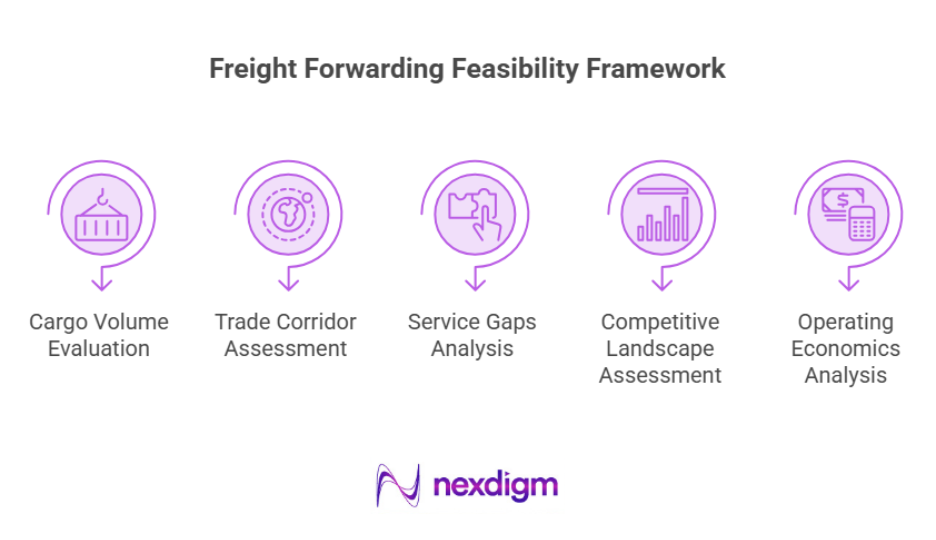
- Cargo Volumes: Nexdigm evaluates shipment volumes, commodity flows, customer concentration, seasonality, origins, destinations, and growth trends to estimate addressable forwarding demand.
- Trade Corridors: The assessment maps road, rail, air, and maritime routes to compare connectivity, transit times, costs, reliability, and corridor growth potential.
- Service Gaps: Nexdigm identifies customer pain points, underserved segments, specialized requirements, visibility challenges, and service limitations that could create opportunities for differentiation.
- Competitive Landscape: The framework benchmarks freight forwarders, carriers, 3PLs, digital platforms, and specialized providers across pricing, services, networks, technology, and customer positioning.
- Operating Economics: Nexdigm assesses pricing, handling costs, staffing, technology, transportation expenses, customer acquisition, utilization, margins, and investment requirements to evaluate business viability.
The framework assesses these dimensions thoroughly, helping organizations determine where freight forwarding opportunities can support sustainable market entry or expansion.
Outcomes of Nexdigm’s Assessment Framework
Applying Nexdigm’s Freight Forwarding Feasibilty Assessment Framework enables organizations to gain actionable insights that support strategic growth and market-entry decisions by:
- Identification of Attractive Markets: Pinpoints markets and trade corridors with the strongest demand, growth potential, and commercial attractiveness.
- Customer Opportunity Prioritization: Highlights the customer segments and industries that offer the greatest revenue and growth opportunities.
- Competitive Positioning Insights: Identifies market gaps, differentiation opportunities, and areas where a freight forwarder can build a competitive advantage.
The framework delivers a clear understanding of market attractiveness, operational readiness, and commercial viability, helping organizations pursue growth opportunities with greater confidence and reduced risk.
Nexdigm’s Case
A freight forwarding company engaged Nexdigm to assess shipment volumes, trade corridors, service gaps, pricing, and operating economics. The assessment supported a network redesign that improved capacity utilization by 19%, reduced operating costs by 13%, and shortened transit times by 16%, enabling stronger service reliability and profitable market expansion.
To take the next step, simply visit our Request a Consultation page and share your requirements with us.
Harsh Mittal
+91-8422857704