

Entering a new freight forwarding market with a broad promise to handle every type of cargo across every major trade lane creates a difficult commercial problem. Established forwarders already have carrier relationships, purchasing scale and large customer portfolios. A new entrant needs a more specific reason for customers to switch.
The stronger starting point is to identify a concentrated cargo opportunity, understand the trade lanes around it and build the service capability required to solve a problem that existing providers are not addressing well.
Start With Cargo, Not a Sales Territory
Different cargo categories create very different forwarding requirements. Pharmaceuticals require temperature-controlled handling and regulatory compliance. Automotive components depend on predictable transit and production schedules. Chemicals require dangerous-goods expertise. Consumer goods may require consolidation, documentation and inventory coordination.
Specialization can therefore create an entry point where the forwarder competes on execution rather than simply quoting the lowest ocean or air rate.
India’s freight-forwarding market continues to expand alongside manufacturing, trade and logistics infrastructure. One recent market estimate places the Indian freight-forwarding market at about $13.3 billion in 2026, with B2B customers accounting for the majority of demand.
Find the Industrial Ecosystems Behind the Freight
The first customers are often concentrated geographically. Pharmaceutical manufacturing clusters, automotive supplier networks, electronics hubs and export-oriented industrial estates can contain multiple businesses with similar logistics requirements and overlapping trade lanes.
That concentration improves sales productivity. One customer relationship can provide access to related suppliers, distributors and ecosystem participants, while shared lanes create opportunities to consolidate volumes and improve carrier procurement.
The objective is therefore to identify where the right customers are clustered, rather than covering an entire city or region with a large sales team.
A Large Trade Lane Is Not Always the Best Entry Point
High-volume routes attract the strongest competition. A new forwarder may find more room in secondary corridors or specialized movements where customers need customs support, inland transportation, consolidation or time-sensitive handling alongside the international freight leg.
The assessment should examine shipment volumes, commodity mix, carrier availability, freight rates, customer concentration and service gaps together. A smaller lane with specialized requirements can provide a stronger entry proposition than a much larger commoditized route.
Infrastructure is also changing the competitive map. India’s 2,843-km Eastern and Western Dedicated Freight Corridor network is now fully operational, with freight movement on the corridors reaching roughly 91% of available train capacity in August 2026.
For forwarders, that creates opportunities to design integrated road-rail-port solutions around industrial corridors rather than relying entirely on conventional road movement.
Service Capability Can Win the First Account
The initial commercial proposition should solve a specific operational problem. Customs classification and clearance, shipment consolidation, documentation, inland transport coordination, temperature-controlled handling and proactive exception management can all provide stronger differentiation than a marginally lower freight quote.
This also determines which customers should be pursued first. A shipper with complex compliance requirements or unreliable inland execution may value specialist capability more than a large multinational buying standardized port-to-port capacity.
Build the First Customer Base Around Lane Fit
The commercial pipeline can be prioritized around three variables: the customer’s shipment potential, alignment with the forwarder’s core trade lanes and the complexity of the service required.
High-fit accounts should receive direct commercial attention and tailored proposals. Smaller accounts can fill capacity on established lanes, while highly fragmented spot business can remain opportunistic until the core network has sufficient density.
The objective is to build a customer base that reinforces the same lanes and capabilities rather than creating a collection of unrelated shipments that are difficult to serve profitably.
How Nexdigm Identifies First-Customer Opportunities
Nexdigm’s freight forwarding go-to-market entry consulting approach can evaluate:
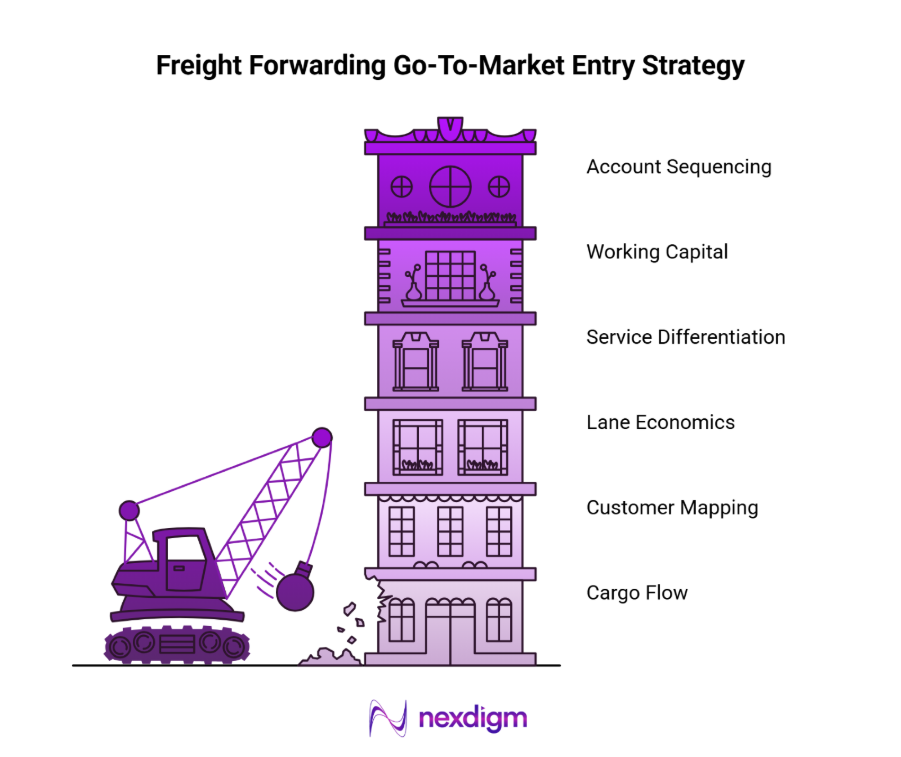
- Cargo and trade-flow opportunity: Identify attractive commodities, shipment patterns and defensible trade lanes.
- Customer-cluster mapping: Locate industrial ecosystems, exporters, importers and other high-potential accounts.
- Lane and carrier economics: Assess carrier availability, freight rates, consolidation potential and network fit.
- Service differentiation: Identify customs, consolidation, inland transport, cold-chain or visibility requirements that create commercial whitespace.
- Working-capital exposure: Evaluate customer credit, payment cycles and the funding requirements created by carrier and vendor terms.
- Target-account sequencing: Prioritize prospects according to shipment potential, service fit and probability of conversion.
This creates a focused commercial entry plan rather than a broad sales territory.
Nexdigm Case: Screening Partners for Freight Network Expansion
In an international freight network expansion engagement, Nexdigm evaluated more than 60 potential commercial partners across 15 cities. The assessment examined eight capability and compliance parameters covering operational and regulatory suitability.
The process shortlisted 12 qualified partners, providing a structured basis for network expansion while reducing projected execution and operational risks by 30%.
To take the next step, simply visit our Request a Consultation page and share your requirements with us.
Harsh Mittal
+91-8422857704