

Freight forwarding pricing elasticity research helps providers understand how shipment demand, customer retention, and trade-lane volumes respond to changes in freight rates. Freight forwarding pricing elasticity research combines pricing analysis with customer segmentation, historical quotations, conversion data, service alternatives, capacity conditions, and competitor benchmarks.
By measuring willingness to pay across routes, cargo types, and service levels, businesses can set responsive pricing corridors, protect margins, improve tender strategies, reduce volume loss, and balance commercial growth with profitability across volatile international forwarding markets and changing customer expectations worldwide with greater commercial confidence.
Studies show that a freight operator applied volume-linked, sustainable pricing and demand analysis, increasing parcel volumes by 14% and EBITDA margin from 4.5% to 6.5%. These results demonstrate stronger demand alignment, pricing discipline, and profitable trade-lane growth outcomes.
Freight Pricing Analysis for Demand Response Across Global Trade Lanes
Freight pricing analysis evaluates rate sensitivity, shipment volumes, customer behavior, capacity conditions, and corridor economics to understand demand responses, improve conversion, and strengthen pricing decisions across global trade lanes. Important dimensions of the freight pricing analysis are:
- Trade-Lane Demand Elasticity: Historical rate changes, booking volumes, shipment frequency, and customer responses are compared across corridors to determine how strongly demand reacts to freight price movements.
- Shipment Volume Response: Booking volumes before and after pricing changes are measured to reveal whether higher rates reduce shipments or whether service value supports stable demand.
- Service-Level Preference: Customers’ preferences for transit speed, reliability, visibility, guaranteed capacity, and handling support are assessed to determine which service benefits reduce sensitivity to freight prices.
- Competitor Rate Positioning: Competitor quotations, carrier rates, surcharges, service levels, and route coverage are benchmarked to understand how relative price positioning influences customer booking decisions across trade lanes.
Nexdigm’s Advisory Support for Trade-Lane Pricing and Demand Forecasting
Nexdigm provides advisory support for trade-lane pricing and demand forecasting through pricing analysis, freight forwarding pricing elasticity research, demand modeling, route profitability assessment, and market benchmarking. By evaluating customer price sensitivity, shipment volumes, capacity constraints, competitor rates, and trade-lane economics, Nexdigm helps businesses optimize freight pricing strategies, improve forecast accuracy, strengthen margin protection, and align pricing decisions with evolving demand patterns across global logistics networks.
Nexdigm’s Integrated Framework for Freight Forwarding Pricing Analysis
Nexdigm’s integrated framework combines pricing analysis, elasticity modeling, demand forecasting, trade-lane intelligence, and profitability strategies to evaluate freight rate sensitivity, optimize pricing decisions, and strengthen margin resilience globally. Some major strategies used in the model contributing to business growth are:
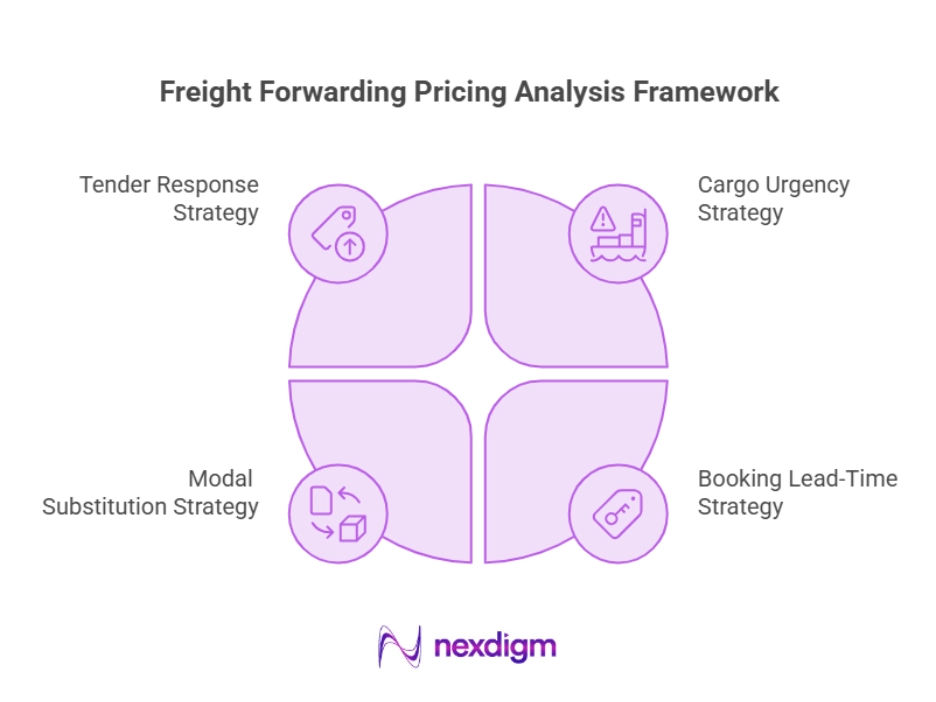
- Tender Response Strategy: Bid histories, customer requirements, competitor positioning, and target margins are compared to refine tender pricing and improve commercially attractive conversion rates.
- Cargo Urgency Strategy: Time-sensitive, high-value, perishable, and standard shipments are analyzed separately to determine how shipment urgency influences willingness to accept higher freight rates.
- Modal Substitution Strategy: Ocean, air, rail, and road alternatives are compared by cost, speed, reliability, and availability to understand how easily customers may switch when freight rates change.
- Booking Lead-Time Strategy: Early and late booking behavior is evaluated against capacity availability and rate movements, helping determine how advance commitments influence customer price sensitivity and pricing flexibility.
Nexdigm’s Case
Nexdigm supported a global freight forwarder with pricing analysis, elasticity modeling, and demand forecasting across major trade lanes. The initiative improved quotation conversion by 18%, increased shipment volumes by 14%, and strengthened operating margins by 9%, enabling more responsive pricing decisions and better alignment between freight rates and customer demand.
To take the next step, simply visit our Request a Consultation page and share your requirements with us.
Harsh Mittal
+91-8422857704