

Freight forwarding pricing feasibility analysis helps businesses evaluate whether entering global trade services can deliver sustainable revenue, competitive positioning, and acceptable margins. This assessment combines pricing services with market benchmarking, cost-to-serve analysis, carrier rates, customs requirements, trade-lane demand, customer expectations, and operational capabilities.
By examining freight modes, service bundles, surcharges, competitor pricing, and volume potential, companies can identify viable rate structures and avoid underpricing complex international movements. A structured freight forwarding pricing feasibility analysis also supports investment decisions and market-aligned logistics offerings with confidence and control.
Industry pricing benchmarks indicate logistics companies can increase revenue by 2–4% and operating profit by 30–60% through structured pricing transformation, demonstrating how Pricing Analysis Services strengthen feasibility decisions and commercially sustainable freight forwarding market entry strategies.
Global Trade Pricing Analysis for Freight Forwarding Ventures
Global trade pricing analysis evaluates market demand, forwarding costs, competitive rates, and service requirements to help businesses enter international logistics markets profitably, reduce commercial risk, and establish scalable pricing structures confidently. Core benefits of the same are:
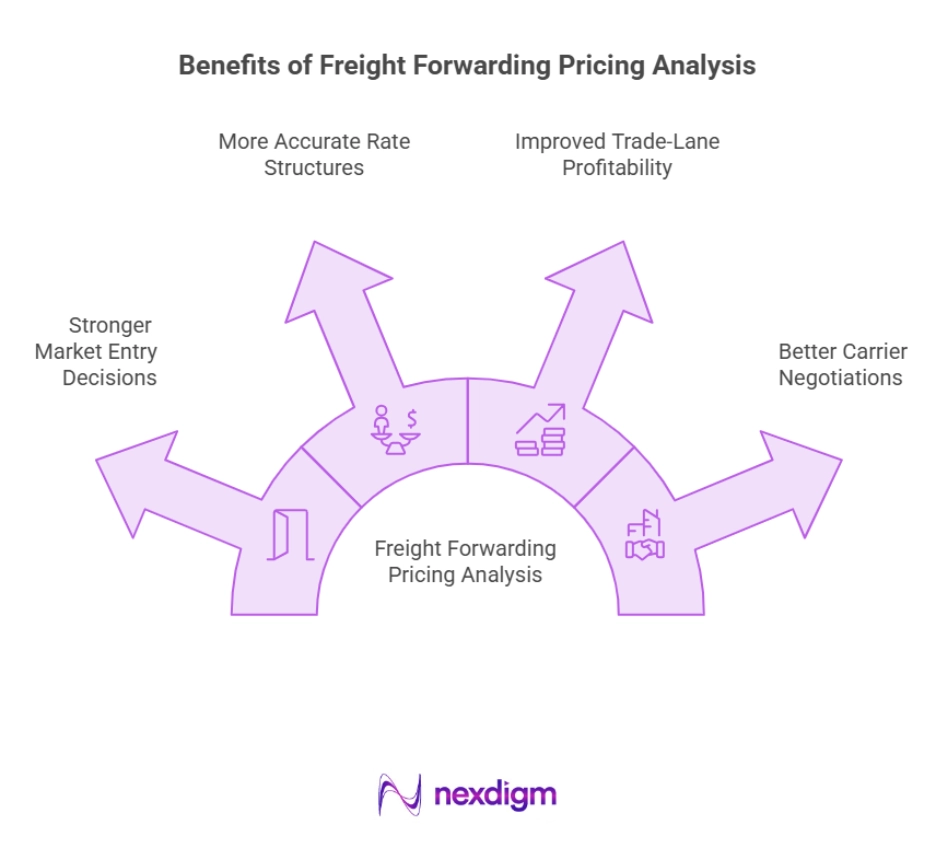
- Stronger Market Entry Decisions: Pricing analysis compares trade-lane demand, customer requirements, competitive intensity, and expected margins, helping businesses select forwarding markets with stronger commercial potential and manageable entry risks.
- More Accurate Rate Structures: Carrier charges, customs expenses, handling fees, documentation costs, and service margins are combined to create transparent freight forwarding rates that support sustainable cost recovery.
- Improved Trade-Lane Profitability: Revenue potential, shipment volumes, carrier availability, and operating complexity are evaluated by trade lane, helping businesses prioritize routes offering attractive demand and stronger contribution margins.
- Better Carrier Negotiations: Current air, ocean, road, and rail rates provide evidence for carrier discussions, helping forwarding ventures secure competitive capacity, suitable terms, and improved purchasing outcomes.
Nexdigm’s Strategic Support for Freight Forwarding Pricing Analysis
Nexdigm provides strategic support for freight forwarding pricing analysis by combining pricing analysis services, freight forwarding pricing feasibility analysis, market benchmarking, cost-to-serve assessment, and trade-lane profitability evaluation. By analyzing carrier rates, customs costs, demand patterns, competitor pricing, and operational capabilities, Nexdigm helps businesses optimize pricing strategies, strengthen commercial feasibility, protect margins, and establish scalable global trade services.
Nexdigm’s Strategic Blueprint for Global Freight Forwarding Pricing Analysis
Nexdigm’s strategic blueprint combines trade-lane intelligence, cost analysis, carrier benchmarks, customer segmentation, and pricing governance to build competitive forwarding rates, protect margins, and support scalable international logistics growth. Important strategies of the blueprint model are:
- Carrier Procurement Strategy: Carrier quotations, service reliability, sailing schedules, capacity commitments, and payment terms are compared to secure competitive buying rates and strengthen freight forwarding margin potential.
- Cost Mapping Strategy: Freight charges, customs expenses, terminal handling, documentation, insurance, storage, and local delivery costs are consolidated to establish complete and commercially sustainable forwarding prices.
- Customer Value Segmentation Strategy: Customers are grouped by shipment volume, urgency, cargo complexity, service dependence, and visibility needs, supporting differentiated rates aligned with the value delivered.
- Competitive Rate Positioning Strategy: Market prices, competitor offerings, service levels, and customer alternatives are benchmarked to establish attractive rates without weakening profitability or creating unsustainable discount expectations.
Nexdigm’s Case
Nexdigm supported a transport fleet with route profitability analysis, vehicle cost benchmarking, and utilization controls. The initiative reduced travel distance by 27%, lowered route requirements by 16%, and improved asset productivity, operating efficiency, margin visibility, and network-wide commercial performance.
To take the next step, simply visit our Request a Consultation page and share your requirements with us.
Harsh Mittal
+91-8422857704