

International shipping requirements are becoming more complex as businesses manage expanding trade flows, changing capacity conditions, and multiple transportation modes. India’s total exports reached an estimated US$568.84 billion during April–October FY 2026–27, growing 16.66% year-on-year, according to the Ministry of Commerce and Industry. Meanwhile, IATA reported that international air cargo demand increased 5.3% in August 2026, while capacity remained nearly unchanged.
These developments highlight the importance of selecting freight forwarders with suitable global networks, multimodal capabilities, and dependable service arrangements. Freight forwarding supplier identification consulting can help businesses evaluate providers against international shipping lanes, cargo requirements, and commercial priorities.
What Makes Freight Forwarder Selection Different from General Logistics Sourcing?
Freight forwarders coordinate multiple activities, including cargo consolidation, customs documentation, carrier arrangements, and shipment tracking. Their capabilities can vary significantly across trade lanes, cargo categories, and transportation modes. Businesses therefore need to examine international network strength, partner relationships, regulatory knowledge, and multimodal coordination capabilities. A provider’s suitability depends on how effectively these elements support the company’s shipping requirements.
Factors That Influence International Freight Partner Selection
Before shortlisting freight forwarders, procurement teams should examine three areas that directly influence international shipment execution:
- Trade Lane and Network Reach: Assess origin and destination coverage, overseas agent networks, port access, carrier relationships, and service frequency across important trade corridors.
- Multimodal Coordination: Examine capabilities across ocean, air, road, and rail freight, including intermodal connections, cargo consolidation, and shipment coordination.
- Customs and Cargo Expertise: Review customs brokerage, documentation support, regulatory knowledge, specialised cargo handling, and shipment visibility capabilities across relevant markets.
Evaluating these factors together helps businesses identify freight forwarders capable of managing international shipments while meeting operational and service expectations.
How Nexdigm Supports Freight Forwarder Identification
Nexdigm can help businesses navigate the international freight forwarding market through structured supplier intelligence and market research. Our freight forwarding supplier identification consulting can support international freight forwarding market through focused research across key areas:
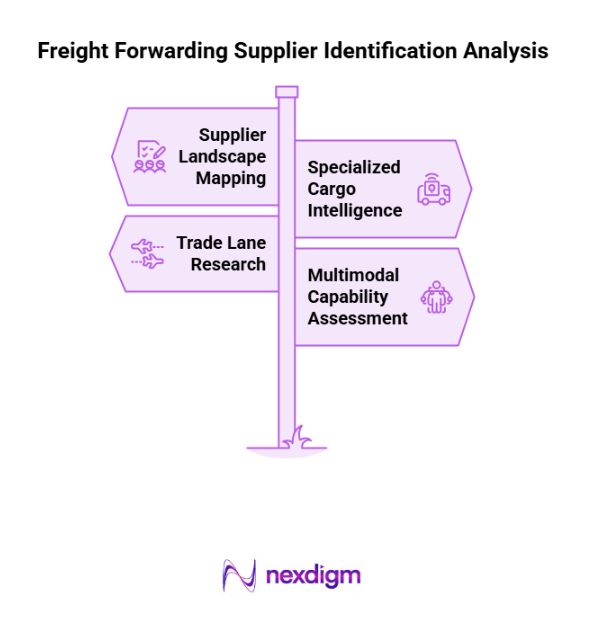
- Supplier Landscape Mapping: Identify global and regional freight forwarders based on service portfolios, geographic presence, industry focus, and operating markets.
- Trade Lane Research: Examine provider coverage across priority shipping corridors, port connectivity, overseas agent networks, and carrier relationships.
- Multimodal Capability Assessment: Evaluate ocean, air, road, and rail freight services, including intermodal coordination and cargo consolidation capabilities.
- Specialized Cargo Intelligence: Identify providers experienced in handling temperature-sensitive, hazardous, oversized, and high-value shipments.
By combining these research areas, Nexdigm can help businesses move beyond general supplier discovery and develop a shortlist aligned with their international shipping routes, cargo requirements, and commercial priorities.
Nexdigm’s Consulting Support Addressing Key Freight Sourcing Questions
Selecting an international freight partner involves more than comparing service offerings. Nexdigm’s consulting support can help procurement teams address specific sourcing questions such as:
- Which freight forwarders have the strongest coverage across target markets? Research supplier networks, overseas partnerships, port access, and trade lane presence to identify relevant providers.
- Which providers can manage complex multimodal shipping requirements? Assess transportation capabilities, intermodal coordination, cargo handling expertise, and service availability across relevant routes.
- How can businesses compare freight forwarders commercially? Examine available pricing information, surcharges, service models, and contractual considerations to understand supplier competitiveness.
- Where can companies identify alternative freight forwarding partners? Map regional and specialised providers to explore supplier diversification and reduce dependence on limited service networks.
Through these assessments, Nexdigm can help businesses connect supplier capabilities with specific shipping requirements and make more informed freight sourcing decisions.
Nexdigm as Strategic Partner for Smarter Freight Sourcing Decisions
Choosing the right freight forwarding partners requires a clear understanding of international markets, supplier capabilities, and commercial considerations. Nexdigm can support businesses through structured supplier research, market intelligence, and comparative assessments. By connecting shipping requirements with relevant provider capabilities, our research can help procurement teams identify suitable partners, explore sourcing alternatives, and build more informed international freight strategies.
Nexdigm’s Case
A pharmaceutical company sought to identify freight forwarding partners capable of managing temperature-sensitive international shipments across multiple markets. Nexdigm’s research evaluated 24 providers across 6 regions, examining cold-chain infrastructure, specialized cargo handling, regulatory documentation, shipment tracking, and service coverage. The assessment shortlisted 7 providers for further evaluation and identified opportunities to strengthen temperature-controlled shipping capabilities.
To take the next step, simply visit our Request a Consultation page and share your requirements with us.
Harsh Mittal
+91-8422857704