

Freight forwarders coordinate the movement of goods across international supply chains by arranging transportation, managing documentation, coordinating customs processes and working with multiple carriers. Their role connects several logistics activities, making them important partners for businesses involved in cross-border trade.
Outsourcing these activities does not eliminate supply chain risk. Freight forwarders may depend on a limited number of carriers, operate through vulnerable trade routes or rely on local agents and subcontractors to deliver services. Weaknesses in these relationships can affect shipment visibility, delivery schedules, compliance and business continuity.
A structured freight forwarding supplier risk consulting exercise helps organisations understand these dependencies, evaluate supplier exposure and establish stronger controls across international logistics arrangements.
Understanding Risk Within Freight Forwarding Networks
Freight forwarding involves multiple parties across the shipment journey. These may include shipping lines, airlines, road transport operators, customs brokers, terminal operators, warehouse providers and destination agents.
A freight forwarder may manage the overall shipment but depend on external suppliers for several critical activities. This creates indirect exposure that may not be visible through a standard supplier assessment.
Procurement teams should therefore examine both the forwarder’s internal capabilities and the wider network supporting its services.
The assessment should identify the providers involved at origin, during transit and at destination. It should also establish which activities are managed directly and which are outsourced.
Understanding this network provides a clearer picture of operational dependencies and potential points of disruption.
Assessing Carrier Dependency and Capacity Exposure
Carrier dependency is a major risk consideration in freight forwarding procurement.
A forwarder may rely heavily on one airline, shipping line or transportation operator for particular trade lanes. This can create exposure if the carrier reduces capacity, changes schedules, increases rates or experiences operational disruptions.
Procurement teams should evaluate the number of carriers available for important routes and examine the forwarder’s ability to secure alternative capacity.
The assessment should also consider the distribution of shipment volumes across carriers. A supplier with several carrier relationships may still be highly dependent on one operator if most shipments move through that provider.
Other relevant factors include carrier financial stability, service reliability, contractual relationships and access to capacity during peak shipping periods.
Evaluating Route and Geographical Exposure
International freight movements can be affected by port congestion, infrastructure limitations, border restrictions, geopolitical developments and extreme weather.
A freight forwarder’s route network should be assessed against the organisation’s key sourcing markets, production locations and customer destinations.
Procurement teams should identify routes with limited alternatives, dependence on specific transshipment hubs and exposure to recurring operational bottlenecks.
For example, a disruption at a major port or transshipment location can affect multiple shipments even when their origin and destination markets remain operational.
The assessment should examine alternative routes, expected transit-time variations, additional costs and the availability of alternative handling facilities.
Route diversification can improve resilience, but it should be evaluated against commercial and service requirements. Alternative routes may involve higher freight costs or longer transit times.
Compliance, Documentation and Customs Risk
Freight forwarders handle documentation and coordination activities that influence whether goods can move through international borders without unnecessary delays.
Errors in shipping documents, cargo declarations, classification information or customs submissions can result in inspections, penalties, additional charges and shipment delays.
Procurement teams should assess the forwarder’s compliance procedures, documentation controls, customs expertise and recordkeeping practices.
Relevant requirements vary according to cargo type, origin, destination and applicable trade regulations. Organisations handling regulated products may need additional checks relating to restricted goods, product documentation, safety requirements or specialised handling.
Supplier assessments should also examine how compliance responsibilities are allocated between the forwarder, shipper, carrier and customs broker.
Clear contractual responsibilities reduce ambiguity when documentation errors or regulatory issues occur.
Reviewing Financial Stability and Business Continuity
Financial instability can affect a forwarder’s ability to maintain operations, pay subcontractors and secure transportation capacity.
Businesses should review available financial information, ownership structure, revenue stability, debt exposure and dependence on major customers or suppliers.
Operational continuity is equally important. Procurement teams should examine contingency arrangements for carrier failures, technology outages, labour disruptions, port closures and other interruptions.
The forwarder should be able to explain how it identifies disruptions, communicates shipment status, activates alternatives and restores normal operations.
Technology resilience also deserves attention. Shipment management platforms, tracking systems and electronic documentation tools should have appropriate access controls, backup arrangements and incident response procedures.
Establishing Risk Controls Through Procurement
Risk assessment should influence how freight forwarding services are sourced and managed.
Contracts can include requirements relating to subcontractor disclosure, shipment visibility, service reporting, compliance responsibilities and disruption notifications.
Organisations may also establish alternative forwarders for critical trade lanes or maintain backup carrier arrangements for high-priority shipments.
Supplier monitoring should continue after contract award. Changes in ownership, carrier relationships, financial position, geographical exposure or service performance may alter the original risk profile.
Periodic reviews allow procurement teams to identify emerging vulnerabilities before they affect business operations.
Freight Forwarding Supplier Risk Assessment Framework
A structured freight forwarding supplier risk consulting exercise should include:
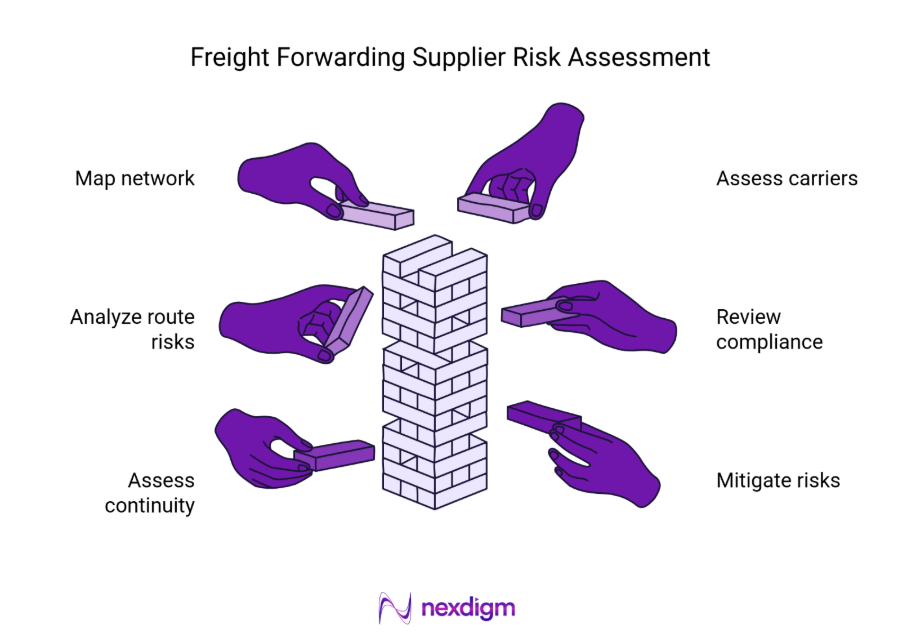
- Network mapping: Identify freight forwarders, carriers, subcontractors, agents and other service dependencies.
- Carrier assessment: Review carrier concentration, capacity access, reliability and alternative provider availability.
- Route risk analysis: Evaluate trade lane exposure, transshipment dependencies, congestion and geographical vulnerabilities.
- Compliance review: Assess customs expertise, documentation controls, regulatory obligations and subcontractor responsibilities.
- Financial and continuity assessment: Examine supplier stability, contingency planning, technology resilience and disruption response.
- Risk mitigation: Establish alternative sourcing arrangements, contractual controls, monitoring indicators and escalation procedures.
Nexdigm can support organisations through freight forwarding market research, supplier risk profiling, carrier intelligence and route-level exposure assessments. These services help procurement teams evaluate forwarding partners, understand indirect dependencies and strengthen international logistics sourcing decisions.
Nexdigm’s Case Study: Assessing Freight Forwarding Network Exposure
Nexdigm assessed 12 freight forwarders across 6 international trade lanes, reviewing carrier concentration, route exposure, compliance and continuity arrangements. The study identified 5 critical dependencies, mapped 4 alternative routing options and established 8 supplier risk indicators.
To take the next step, simply visit our Request a Consultation page and share your requirements with us.
Harsh Mittal
+91-8422857704