

Freight forwarding technology benchmarking is an important competitive intelligence activity that helps logistics companies assess how effectively they are adopting digital tools compared with industry peers. As freight forwarding operations become more dependent on shipment visibility platforms, transport management systems, automation, data analytics, and digital documentation, benchmarking technology adoption allows companies to identify capability gaps, track competitor maturity, and prioritize technology investments.
By comparing how leading freight forwarders use technology to improve efficiency, customer experience, and operational transparency, businesses can strengthen their market position and make more informed strategic decisions.
The digital freight forwarding market is expected to grow from USD 51.43 billion in 2026 to USD 118.12 billion by 2031, at a 18.09% CAGR. The broader digital logistics market is also projected to grow from USD 43.89 billion in 2026 to USD 155.29 billion by 2034. These figures indicate that forwarders are increasingly competing on digital maturity, automation, visibility, and data-driven efficiency.
Competitor Analysis of Automation and Digital Workflow Capabilities using Competitive Intelligence
Competitor analysis of automation and digital workflow capabilities using competitive intelligence evaluates how rival freight forwarders use automation, digital tools, and integrated workflows to improve speed, accuracy, cost efficiency, and customer responsiveness.
-
Automation Maturity Benchmarking
Measures how competitors automate bookings, documentation, invoicing, shipment updates, and routine freight forwarding tasks.
-
Digital Workflow Integration
Evaluates how competitors connect TMS, ERP, CRM, customs, carrier, and warehouse systems for smoother operations.
-
Operational Efficiency Improvement
Assesses how automation helps competitors reduce manual work, errors, delays, and operational turnaround time.
-
Customer-Facing Automation
Reviews competitor use of online quoting, shipment tracking, automated alerts, portals, and customer self-service tools.
-
Exception Management Capabilities
Analyzes how competitors use automated alerts, dashboards, and workflows to handle delays, disruptions, and shipment issues.
Nexdigm’s Digital Assessment for Freight Forwarding Operations
Nexdigm’s Digital Assessment for Freight Forwarding Operations evaluates how effectively freight forwarders use technology across core processes such as booking, documentation, tracking, customs coordination, customer service, and reporting. It helps identify digital maturity levels, operational gaps, automation opportunities, and competitor benchmarks, enabling businesses to improve efficiency, customer visibility, workflow integration, and technology-led competitiveness.
Nexdigm’s Technology Gap Analysis and Opportunity Mapping Across Freight Forwarders
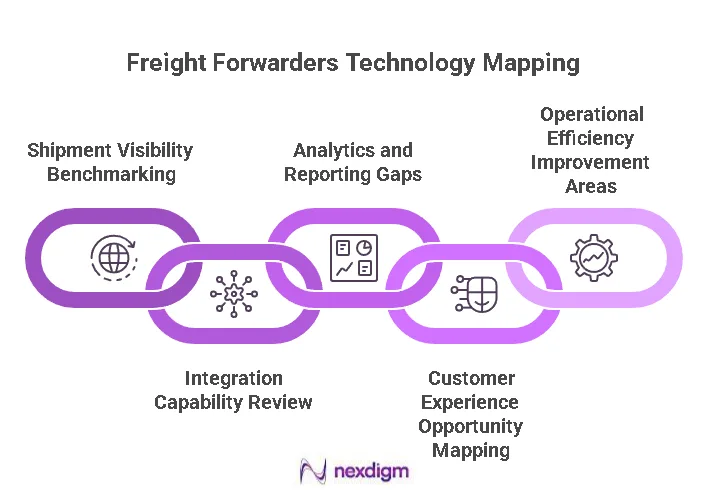
Nexdigm’s Technology Gap Analysis and Opportunity Mapping Across Freight Forwarders identifies where competitors lead in automation, visibility, integrations, and analytics, helping clients prioritize digital improvements and capture technology-led growth opportunities:
-
Shipment Visibility Benchmarking
Evaluates tracking tools, real-time updates, dashboards, and customer visibility platforms used by competitors.
-
Integration Capability Review
Assesses connectivity across TMS, ERP, CRM, customs, carrier, and warehouse systems.
-
Analytics and Reporting Gaps
Reviews competitors’ use of dashboards, performance metrics, forecasting, and data-driven decision-making tools.
-
Customer Experience Opportunity Mapping
Identifies improvements in digital portals, self-service tools, alerts, quoting, and customer communication.
-
Operational Efficiency Improvement Areas
Maps opportunities to reduce manual work, delays, errors, and process bottlenecks through technology.
Nexdigm’s case:
Nexdigm has helped a logistics service provider strengthen its transportation and warehouse operations through process benchmarking and performance review. Nexdigm assessed operations across more than 90 warehouses and identified around INR 45 lakh in revenue leakages. The engagement helped the company improve route cost control, reduce operational inefficiencies, and identify opportunities for better workflow standardization and technology-enabled process improvement.
To take the next step, simply visit our Request a Consultation page and share your requirements with us.
Harsh Mittal
+91-8422857704