

Freight market analysis is essential in understanding the dynamics of a global freight market. By evaluating growth trends, cost pressures, and demand cycles, businesses can anticipate shifts in cargo volumes and optimize operations. Integrating competitive intelligence allows companies to monitor competitor strategies, identify emerging opportunities, and make data-driven decisions.
Global freight demand continues to evolve, with air cargo volumes rising about 6 % year‑on‑year in late 2025, driven by intra‑Asia and Europe–Asia trade growth. Overall freight transport volumes reached approximately 11.6 billion tons while multimodal logistics markets expand alongside e‑commerce and manufacturing growth. Capacity increases have narrowed the gap with demand, moderating freight rate inflation and reshaping cost pressures across major trade corridors.
Leveraging these insights ensures more efficient capacity planning, cost management, and strategic positioning in an increasingly complex and competitive logistics landscape.
Using Competitive Intelligence to Gain an Edge in the Global Freight Market
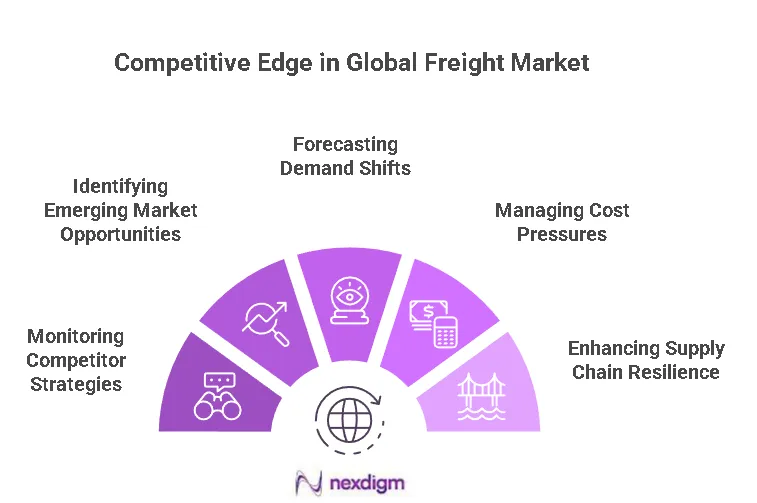
Using competitive intelligence in the global freight market enables businesses to monitor competitors, anticipate demand shifts, identify cost pressures, and make data-driven decisions, ensuring optimized operations and a strategic market advantage:
-
Monitoring Competitor Strategies
Competitive intelligence tracks competitor freight routes, pricing, and capacity strategies, helping businesses adjust operations and maintain a market advantage.
-
Identifying Emerging Market Opportunities
Analyzing trade flows and regional trends uncovers growth opportunities, allowing proactive entry into high-demand freight corridors.
-
Forecasting Demand Shifts
Competitive intelligence leverages data analytics to predict seasonal, regional, and industry-specific changes in freight volumes for better planning.
-
Managing Cost Pressures
Insights into market rates, fuel fluctuations, and operational expenses help optimize pricing, contracts, and resource allocation.
-
Enhancing Supply Chain Resilience
Monitoring global disruptions, port congestions, and geopolitical risks enables businesses to implement contingency plans effectively.
Nexdigm’s Freight Market Analysis Services
Nexdigm’s Freight Market Analysis Services provide comprehensive insights into global trade trends, cost pressures, and demand cycles. By combining competitive intelligence, data analytics, and predictive modeling, Nexdigm helps businesses optimize logistics planning, anticipate market shifts, and make informed decisions. These services enable companies to reduce operational costs, identify growth opportunities, and enhance overall supply chain efficiency.
Optimizing Freight Costs and Managing Demand Cycles with Nexdigm
Nexdigm helps businesses optimize freight costs and manage demand cycles by analyzing global trade trends, monitoring market shifts, and applying competitive intelligence for efficient, data-driven logistics and supply chain decisions.
-
Analyzing Cost Drivers
Nexdigm examines fuel, labor, and operational expenses to identify key cost drivers and opportunities for savings in freight operations.
-
Forecasting Demand Cycles
Using predictive analytics, Nexdigm anticipates seasonal and regional freight demand fluctuations, enabling proactive capacity and resource planning.
-
Competitive Benchmarking
By tracking competitors’ pricing, routes, and service strategies, Nexdigm helps businesses make informed cost and operational decisions.
-
Optimizing Logistics Networks
Nexdigm recommends route, carrier, and mode optimizations to reduce costs while maintaining service reliability and delivery timelines.
-
Scenario Planning and Risk Mitigation
Through scenario analysis, Nexdigm prepares businesses for disruptions, cost spikes, and demand surges to ensure supply chain resilience.
Nexdigm’s case:
In a recent engagement with a global consumer transporting company, Nexdigm’s strategic supply chain interventions avoided approximately USD 0.56 million in air freight costs, protected USD 192 million in net trade sales, and enabled creation of 30 days of safety stock to mitigate lead‑time risks and enhance service continuity. These results helped the client reduce cost exposure and improve supply chain resilience amid trade disruptions.
To take the next step, simply visit our Request a Consultation page and share your requirements with us.
Harsh Mittal
+91-8422857704