

Manufacturing growth does not translate into freight demand uniformly. A factory producing high-value electronics can increase output without generating the same tonnage as a steel or cement plant. Distance, product density, sourcing patterns, export orientation, and shipment frequency all determine how production becomes cargo movement.
For carriers, infrastructure investors, fleet operators, and logistics providers, aggregate industrial growth is therefore only the starting point. The commercial opportunity lies in identifying the lanes, commodities, and operating conditions created by that growth.
Production Growth Has to Be Converted into Freight Volume
The conversion depends heavily on cargo intensity. Heavy industrial products generate substantial tonnage relative to their value, while electronics and precision components can generate significant freight value with comparatively low tonnage.
The assessment needs to consider:
- Production volumes and capacity additions
- Raw-material requirements and sourcing locations
- Finished-goods output and shipment frequency
- Domestic versus export sales
- Average shipment size and load characteristics
A new manufacturing plant can create freight demand on both inbound and outbound legs, while a sourcing change can alter those flows without changing production volumes.
Distance Can Change the Economics Completely
The same tonne of cargo has different freight economics depending on where it originates and where it is consumed.
A manufacturing cluster close to its consumption market may favour road because direct delivery avoids transfer costs. Longer corridors create a stronger case for rail or multimodal movement when volumes are sufficient for consolidation.
India’s 2,843-km Dedicated Freight Corridor network is changing this calculation. Freight-only routes support average operating speeds of around 50–60 km/h, compared with 20–25 km/h on conventional mixed-use tracks. Transit time on the Dadri–JNPT corridor has fallen from more than 72 hours to under 48 hours.
These improvements can change corridor economics, but only where terminals and first- and last-mile connections can support the movement.
Cargo Characteristics Decide Which Mode Wins
Freight cannot be assessed on tonnes alone.
High-value, time-sensitive products such as pharmaceuticals, electronics, and perishables place greater value on speed, reliability, and limited handling. Heavy bulk commodities such as coal, iron ore, cement, and fertilizers have different economics because their low value-to-weight ratios favour lower-cost, high-capacity transportation.
Containerised manufactured goods sit between these extremes. They can shift between road and rail when long-haul savings compensate for terminal handling and drayage.
For containerised industrial cargo, the research indicates a road-to-DFC rail break-even range of roughly 500–600 km. Below that range, transfer costs can erode the line-haul advantage; beyond it, rail’s lower rate becomes increasingly relevant.
Freight Rates Tell Only Part of the Story
Headline rates can conceal the actual economics of a freight market.
The research benchmarks road freight at approximately ₹2.80–₹3.80 per tonne-kilometre, compared with about ₹1.50–₹1.96 for DFC rail. Yet the lower rail rate does not automatically produce a lower landed cost.
Handling, drayage, terminal charges, detention, inventory carrying costs, and transit reliability all affect the outcome. A route with a cheaper line-haul rate can become more expensive if cargo spends too long waiting at transfer points.
Utilisation matters too. Empty running, weak backhaul opportunities, seasonal demand, and fragmented shipment patterns can make an apparently attractive corridor difficult to operate profitably.
Where Does Freight Growth Become Commercially Attractive?
The strongest freight opportunities tend to combine:
- Sustained production or consumption growth
- Sufficient cargo density for regular movements
- Long or concentrated corridors
- Favourable backhaul potential
- Reliable infrastructure and terminal access
- Rates that support sustainable carrier margins
The assessment should also separate structural demand from temporary spikes. A factory shutdown, commodity cycle, or one-time export order can inflate freight volumes without creating a durable market.
That distinction matters when deciding where to add fleets, warehouses, terminals, rail services, or other logistics capacity.
How Nexdigm Converts Industrial Growth Into Freight Opportunities
Nexdigm’s freight market assessment connects production activity with actual cargo flows and corridor economics.
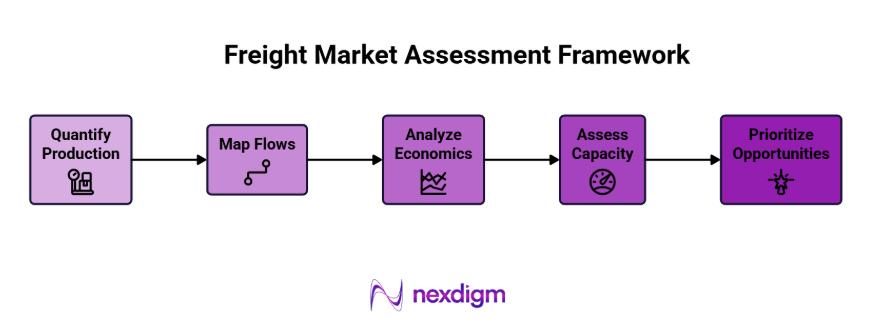
- Translate production into tonnage: Estimate inbound raw-material and outbound finished-goods movements by industry, product, plant, and destination.
- Map origin-destination flows: Identify corridors generated by manufacturing clusters, consumption centres, ports, and distribution networks.
- Segment cargo economics: Assess weight, volume, value, perishability, shipment frequency, and handling requirements to determine suitable transport modes.
- Benchmark freight rates: Compare Road, Rail, intermodal, and other relevant modes while incorporating drayage, handling, detention, and inventory costs.
- Assess utilisation and capacity: Examine load factors, empty running, backhaul availability, seasonal peaks, and infrastructure constraints.
- Prioritise freight opportunities: Rank corridors according to demand depth, margin potential, capacity requirements, competitive intensity, and investment needs.
How Nexdigm Identified the Freight Corridors Worth Pursuing
A manufacturing enterprise moving 1.6 million tonnes of steel, engineering equipment, and automotive components annually was heavily dependent on road freight. Nexdigm evaluated 12 corridors across four cargo categories, identifying three long-haul routes above the intermodal break-even range. Moving 1.1 million tonnes to DFC-integrated rail reduced landed logistics costs by 27.2%, saving ₹136 crore annually, while transit times fell 36%.
To take the next step, simply visit our Request a Consultation page and share your requirements with us.
Harsh Mittal
+91-8422857704