

Freight marketplaces are expanding as digital platforms connect shippers and carriers more efficiently, improving access to transport capacity, pricing transparency, and shipment coordination. As part of a market entry strategy, these platforms help businesses secure freight partners faster, compare rates, manage bookings, and improve delivery reliability in new markets.
A strong Freight marketplace platform entry strategy enables companies to reduce dependency on limited carrier networks, optimise transport costs, and respond quickly to changing shipment demand. By using digital freight marketplaces, businesses can build more flexible logistics operations, improve carrier access, and scale distribution efficiently across domestic and cross-border markets.
The need for a Freight marketplace platform entry strategy is supported by rapid digital freight adoption. The global digital freight matching market is expected to grow from USD 61.46 billion in 2025 to USD 247.58 billion by 2030, at a CAGR of 32.1%. Freight-matching services accounted for 81.96% of the market in 2025, showing strong demand for platforms that connect shippers and carriers more efficiently.
Freight Marketplace Platform Entry Strategy for Scalable Logistics Growth
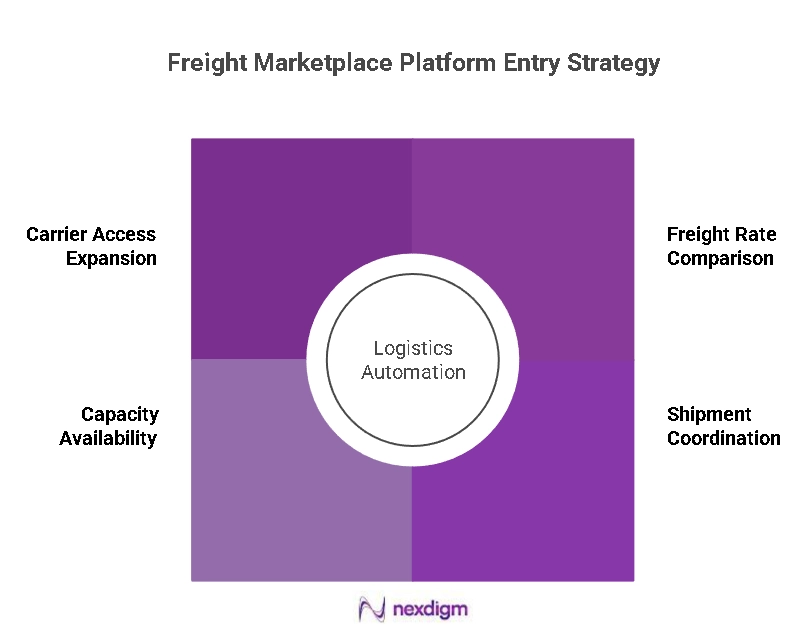
A freight marketplace platform entry strategy helps businesses access carriers, compare rates, secure transport capacity, improve shipment coordination, and scale logistics operations efficiently across new markets:
-
Carrier Access Expansion
Connects businesses with wider carrier networks, improving transport availability and flexibility during new market entry.
-
Freight Rate Comparison
Enables rate benchmarking across carriers, helping businesses control transport costs and select commercially viable freight options.
-
Capacity Availability
Supports access to transport capacity during demand spikes, seasonal volumes, or early-stage market expansion.
-
Shipment Coordination
Improves booking, dispatch, tracking, and communication between shippers and carriers for smoother logistics execution.
Nexdigm Operating Model Design for Digital Freight Marketplace Operations
Nexdigm can help design operating models for digital freight marketplace operations by defining carrier onboarding, shipment booking workflows, rate comparison processes, service-level controls, data reporting, and escalation mechanisms. This enables businesses to improve freight coordination, cost visibility, carrier access, and scalable market entry execution across target regions.
Nexdigm Risk and Compliance Advisory for Marketplace-Based Freight Networks
Nexdigm can assess carrier compliance, contract risks, shipment liability, data security, service standards, and regulatory obligations to support safer marketplace-based freight operations across target markets.
-
Carrier Compliance Review
Assesses carrier registrations, permits, insurance coverage, and documentation to reduce compliance exposure in marketplace-based freight networks.
-
Contract Risk Assessment
Reviews freight terms, liability clauses, payment conditions, service obligations, and dispute mechanisms before partner engagement.
-
Shipment Liability Controls
Evaluates responsibility for cargo loss, damage, delays, claims handling, and insurance coverage across freight marketplace transactions.
-
Data Security Checks
Reviews platform access, shipment data sharing, user permissions, and cyber controls to protect sensitive logistics information.
Nexdigm’s case:
Nexdigm helped a manufacturing company assess risk and compliance controls for marketplace-based freight networks across four target markets. By reviewing carrier documentation, insurance coverage, contract terms, shipment liability, data security, and regulatory obligations, Nexdigm helped the company reduce compliance gaps by 30%, improve carrier qualification accuracy by 35%, and lower shipment-related risk exposure by 20%.
To take the next step, simply visit our Request a Consultation page and share your requirements with us.
Harsh Mittal
+91-8422857704