

Freight rates often vary significantly across routes, carriers, service levels, and contract structures, creating hidden cost and margin gaps. Freight pricing gap benchmarking combines pricing analysis with lane-level comparisons, provider rate normalization, surcharge reviews, market intelligence, and cost-to-serve data.
By identifying pricing variances, businesses can challenge uncompetitive rates, improve carrier negotiations, refine customer pricing, and strengthen route profitability. This approach supports better procurement, clearer pricing governance, and cross-border transportation networks in volatile operating environments.
A freight benchmarking program identified average first-year savings of 18.65% through carrier, mode, route, and service comparisons. The results show how systematic pricing analysis can expose rate gaps, strengthen negotiations, improve cost control, and support more profitable freight operations.
Market-Based Pricing Analysis for Freight Route Competitiveness
Market-based pricing analysis evaluates route costs, competitor rates, capacity, demand, and service conditions to help freight providers establish competitive prices, improve lane profitability, and strengthen commercial positioning across transportation networks. Important dimensions of analytical process are:
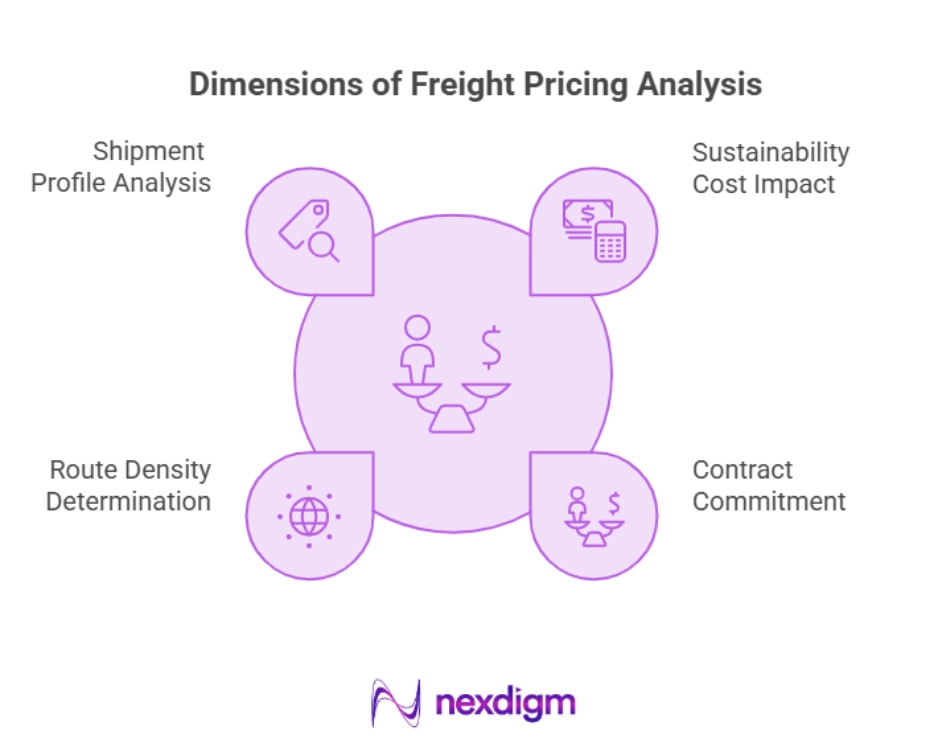
- Shipment Profile Analysis: Weight, volume, product type, handling requirements, and load configuration are compared across routes to identify how shipment characteristics influence freight rates and competitive positioning.
- Route Density Determination: Shipment concentration, pickup frequency, delivery clusters, and consolidation opportunities are assessed to determine where higher route density can support lower costs and stronger pricing competitiveness.
- Contract Commitment: Volume guarantees, contract duration, forecast accuracy, and capacity reservations are reviewed to determine whether committed business volumes justify preferential route pricing and commercial terms.
- Sustainability Cost Impact: Fuel efficiency, vehicle type, emissions requirements, load consolidation, and alternative transport modes are reviewed to understand how sustainability commitments influence route pricing.
Nexdigm’s Commercial Support for Freight Pricing Gap Analysis
Nexdigm supports freight rate variance analysis through pricing analysis, lane benchmarking, carrier comparisons, and cost-to-serve modeling, helping businesses to expand in new markets and maintain competitive position by:
- Improving freight procurement savings
- Strengthening carrier negotiations
- Protecting route-level margins
- Reducing logistics cost leakage
- Improving freight pricing decisions
With Nexdigm’s pricing intelligence, businesses get strategic support to maintain a competitive edge and positioning in the rapidly evolving landscape.
Nexdigm’s Strategic Model for Freight Pricing Gap Analysis and Benchmarking
Nexdigm’s strategic model combines lane benchmarks, carrier rates, route economics, and market signals to support profitable freight decisions across networks consistently. Some important strategies used by experts in this model are:
- Cost Driver Mapping Strategy: Fuel, tolls, labor, detention, handling, maintenance, and empty-mile costs are mapped by route, helping businesses determine whether rate variances reflect genuine operating differences.
- Disruption Premium Strategy: Temporary charges caused by congestion, closures, shortages, weather, or border delays are reviewed separately to distinguish genuine disruption costs from permanent pricing increases.
- Service Premium Review Strategy: Charges for express transit, guaranteed capacity, dedicated vehicles, tracking, and special handling are assessed to confirm whether service premiums deliver proportionate operational value.
- Mode Comparison Strategy: Road, rail, air, and multimodal costs are compared by route, transit time, capacity, and service reliability to identify more competitive transportation alternatives.
Nexdigm’s Case
Nexdigm supported a freight operator with lane benchmarking, rate normalization, and carrier comparisons. The initiative delivered 18.65% first-year savings, reduced pricing inconsistencies, strengthened negotiations, and improved route-level cost control, margin protection, and procurement decisions across its transportation network overall.
To take the next step, simply visit our Request a Consultation page and share your requirements with us.
Harsh Mittal
+91-8422857704