

Freight rates can vary considerably across transportation modes, trade lanes, shipment sizes and contractual arrangements. Businesses moving goods across domestic and international markets often receive quotations from multiple carriers and freight forwarders, but comparing these quotations is not always straightforward.
Differences in transit times, fuel adjustments, terminal charges, capacity commitments and service conditions can make apparently similar freight offers commercially different.
Freight rate benchmarking provides procurement teams with a structured way to compare market pricing, identify cost variations and assess whether contracted rates reflect prevailing market conditions.
Why Freight Rate Benchmarking Matters
Transportation costs are influenced by several factors, including fuel prices, available capacity, route demand, equipment availability, port conditions and the distance between origin and destination.
These factors affect freight rates differently across road, rail, air and ocean transportation.
For example, an ocean freight quotation may include a base rate and several surcharges, while road transportation pricing may depend on vehicle type, distance, fuel adjustments, tolls and waiting charges.
The Department for Promotion of Industry and Internal Trade’s September 2025 Assessment of Logistics Cost in India provides a useful domestic reference. The study estimates India’s total logistics cost at ₹24.01 lakh crore for 2023–24 and analyses cost differences across transportation modes and operating conditions.
Such research demonstrates why freight benchmarking should use comparable shipment profiles and clearly defined cost components.
Comparing Freight Rates Across Transportation Modes
Freight rate benchmarking should begin by separating transportation modes because their pricing structures and operational constraints differ.
- Road freight: Rates are generally influenced by distance, vehicle type, load utilisation, fuel, tolls, route conditions and return-load availability. Comparisons should distinguish full truckload and less-than-truckload movements.
- Rail freight: Pricing depends on cargo category, distance, wagon type, loading arrangements, terminal charges and applicable surcharges. Businesses should also consider first- and last-mile expenses.
- Air freight: Charges are influenced by chargeable weight, shipment dimensions, capacity availability, fuel surcharges, security fees and handling requirements. Urgent shipments may attract premium pricing.
- Ocean freight: Rates depend on trade lanes, container size, equipment availability, sailing conditions and market demand. Base ocean freight must be distinguished from port handling, documentation and additional surcharges.
A comparison should also account for differences in transit time and service reliability. A cheaper mode may not provide better commercial value when inventory carrying costs and delivery requirements are considered.
Understanding Lane Rates and Market Benchmarks
Freight benchmarking is most useful when performed at the individual lane level.
A company shipping from Mumbai to Rotterdam should compare quotations for the same origin, destination, container type, shipment conditions and service requirements.
For international container freight, the Freightos Baltic Index provides weekly spot-rate benchmarks for 40-foot containers across major trade lanes. The Drewry World Container Index provides another reference through route-specific assessments of container freight rates.
For dry bulk shipping, Baltic Exchange assessments provide route-based freight benchmarks. These indices serve different market segments and should not be treated as interchangeable.
Procurement teams should distinguish between:
- Spot market quotations and long-term contracted rates.
- Base freight and additional surcharges.
- Port-to-port and door-to-door pricing.
- Standard and specialised equipment.
- Normal and peak-season rates.
Historical comparisons are also useful. Reviewing rate movements over several periods can help identify seasonal variations and determine whether a quotation reflects a temporary market increase or a more persistent cost trend.
Identifying Surcharges and Commercial Variations
A freight quotation may contain several charges beyond the primary transportation rate.
For ocean freight, these may include bunker adjustment factors, peak season surcharges, equipment-related fees, terminal handling and security charges. Road freight may include fuel adjustments, tolls, detention and loading or unloading charges.
Air freight may involve fuel, security, screening, terminal handling and other service-specific fees.
Procurement teams should standardise these components before comparing suppliers. They should also review rate validity, minimum billing quantities, currency adjustments and contract escalation provisions.
The objective is to establish a consistent comparison basis rather than selecting the lowest headline quotation.
Freight Rate Benchmarking Framework
A structured freight rate benchmarking research exercise should include six stages:
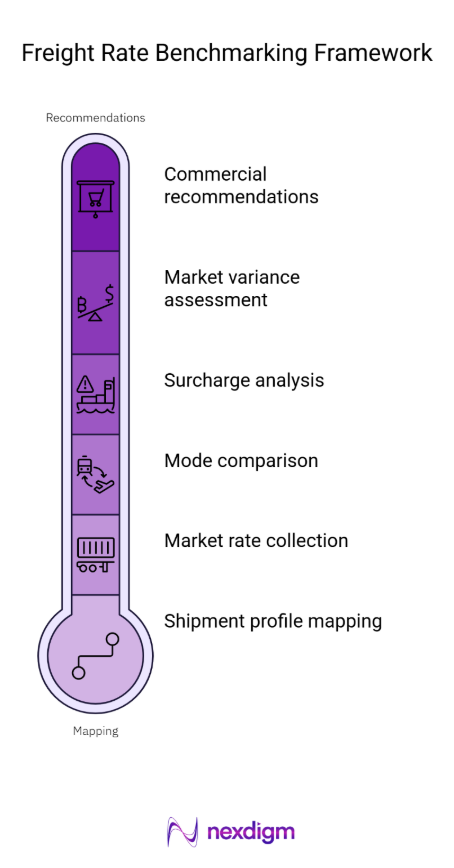
- Shipment profile mapping: Define origin-destination lanes, shipment volumes, cargo characteristics and delivery requirements.
- Market rate collection: Gather quotations from carriers, freight forwarders and relevant freight indices.
- Mode comparison: Compare road, rail, air and ocean rates using equivalent shipment assumptions.
- Surcharge analysis: Separate base freight, fuel adjustments, terminal charges and additional fees.
- Market variance assessment: Compare contracted rates with market benchmarks and historical pricing.
- Commercial recommendations: Identify negotiation opportunities, alternative routes and suitable contract arrangements.
Nexdigm can support organisations through freight market intelligence, lane-level rate benchmarking, carrier comparisons and commercial procurement research. These assessments help businesses understand pricing variations, evaluate supplier quotations and identify opportunities for more competitive transportation arrangements.
Nexdigm’s Case Study: Identifying Freight Rate Variations Across Trade Lanes
Nexdigm benchmarked 16 freight providers across 8 domestic and international lanes, comparing road, air and ocean rates. The analysis identified a 19% variation across comparable quotations, highlighted 5 recurring surcharge categories and established lane-specific benchmarks for procurement negotiations.
To take the next step, simply visit our Request a Consultation page and share your requirements with us.
Harsh Mittal
+91-8422857704