

Choosing a freight service provider involves more than comparing transportation rates. Businesses moving goods across domestic and international markets must consider delivery timelines, route coverage, cargo requirements, handling capabilities and service reliability. A provider offering competitive rates on one route may have limited capacity elsewhere or lack the infrastructure required for specialised shipments.
As supply chains become more geographically distributed, procurement teams need a structured method to compare freight providers across transportation modes and service requirements.
Understanding the Different Freight Transportation Modes
Freight providers generally operate across road, rail, air and sea transportation, with multimodal operators combining two or more modes to move shipments between origin and destination.
Each mode offers different advantages depending on cargo characteristics, delivery urgency, shipment volume and transportation distance.
- Road freight: Suitable for domestic distribution, regional transportation and last-mile delivery. Its flexibility makes it particularly useful for shipments requiring direct collection and delivery.
- Rail freight: Often suitable for bulk commodities, industrial materials and high-volume shipments over longer distances. Capacity, terminal access and schedule availability influence its effectiveness.
- Air freight: Preferred for high-value, perishable and time-sensitive shipments. However, higher transportation costs and cargo capacity limitations must be considered.
- Sea freight: Suitable for large-volume international shipments where cost efficiency is more important than transit speed. Container availability, port congestion and customs clearance influence overall delivery performance.
- Multimodal freight: Combines transportation modes to balance cost, delivery time and geographical coverage. Its effectiveness depends on coordination between carriers, terminals and handling partners.
What Should Businesses Compare When Selecting Freight Providers?
Freight procurement requires an evaluation of both provider-level capabilities and route-specific performance.
A provider’s global network may appear extensive, but this does not automatically translate into reliable service on every trade lane.
Key evaluation areas include:
- Geographical coverage: Examine origin and destination networks, regional warehouses, distribution centres and last-mile capabilities.
- Transportation capacity: Assess vehicle availability, container access, aircraft capacity arrangements and seasonal capacity constraints.
- Transit reliability: Compare actual delivery performance against contracted schedules.
- Cargo specialisation: Determine whether the provider can handle temperature-sensitive, hazardous, oversized or high-value shipments.
- Technology integration: Review shipment tracking, electronic documentation, exception alerts and integration with transportation management systems.
- Commercial competitiveness: Compare freight rates, fuel surcharges, handling charges, accessorial fees and contractual flexibility.
The World Bank’s Logistics Performance Index evaluates dimensions such as logistics service quality, infrastructure, shipment timeliness and tracking capabilities. These indicators provide useful market-level context, although individual freight providers still require direct performance evaluation.
Assessing Route and Service-Level Compatibility
Route-level analysis is particularly important for businesses operating across multiple markets.
A freight provider may have strong coverage between major commercial centres but rely on subcontractors for smaller destinations. Such arrangements can affect delivery consistency, shipment visibility and claims management.
Procurement teams should examine:
- Transit time by origin-destination pair.
- Frequency of scheduled departures.
- Availability of alternative routes.
- Customs brokerage and documentation support.
- Cargo insurance and claims procedures.
- Performance during peak shipping periods.
Businesses should also distinguish between published transit times and actual end-to-end delivery performance. A shipment’s journey includes collection, terminal handling, customs processing, transfers and final delivery.
Freight Service Provider Analysis Framework
A structured freight service provider analysis can help organisations shortlist providers according to their transportation requirements.
The assessment can follow five stages:
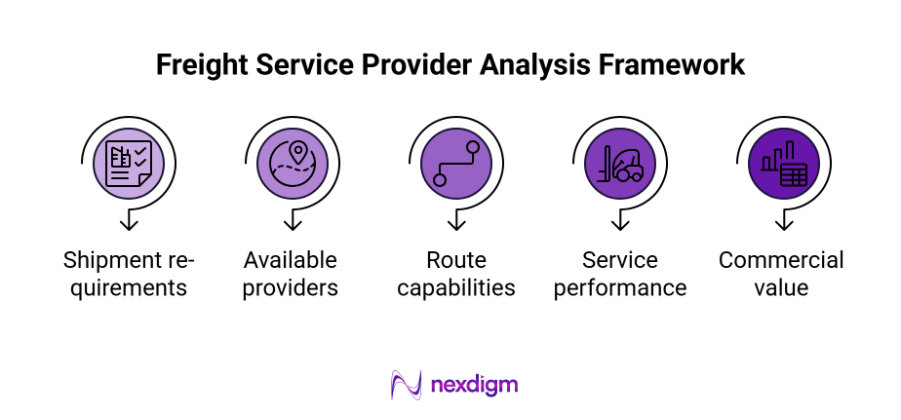
- Define shipment requirements: Categorise cargo by volume, weight, urgency, destination and handling requirements.
- Map available providers: Identify operators across road, rail, air, sea and multimodal transportation.
- Compare route capabilities: Assess network coverage, capacity, transit schedules and alternative routing options.
- Evaluate service performance: Compare delivery reliability, tracking capabilities, claims handling and customer support.
- Assess commercial value: Review total landed transportation costs rather than relying solely on headline freight rates.
Nexdigm can support organisations through freight market research, supplier identification, comparative benchmarking and procurement analysis. This helps businesses understand provider capabilities across transportation modes and identify suppliers aligned with their operational and commercial requirements.
Nexdigm’s Case Study
Nexdigm evaluated 12 freight service providers across 4 transportation modes and 8 trade routes. The assessment identified 4 providers with stronger route coverage and service reliability, highlighted cost variations of up to 18% across comparable shipments and helped the client develop a consolidated supplier shortlist.
To take the next step, simply visit our Request a Consultation page and share your requirements with us.
Harsh Mittal
+91-8422857704