
Frozen food demand is no longer determined only by whether consumers own a freezer. Urban lifestyles, convenience-led consumption, modern retail, quick commerce and improving cold-chain infrastructure are expanding the conditions under which frozen products can become regular purchases.
India’s frozen food market was valued at INR 216.59 billion in 2025 and is projected to reach INR 643.64 billion by 2034, representing a 12.86% CAGR. Frozen vegetable snacks held 52% of the market in 2025, while North India accounted for approximately 32% of revenue.
The forecasting challenge is understanding which parts of that growth are structurally sustainable.
Convenience Is Expanding the Consumption Occasion
Frozen food reduces preparation time and allows households to maintain products for longer periods. This makes the category particularly relevant to dual-income households, smaller households and consumers managing irregular schedules.
The uploaded market report identifies ready-to-cook appetizers and restaurant-style frozen meals as high-growth formats, with RTC appetizers growing at 8.1% CAGR and deconstructed frozen meal kits estimated at 9.5%–11.2% CAGR.
Forecasting therefore needs to distinguish between products purchased as occasional snacks and those capable of becoming repeat meal solutions.
Household Penetration Determines the Demand Ceiling
Market growth can come from existing users purchasing more frequently or from new households entering the category.
A demand model should therefore measure:
- Household penetration: Percentage of target households purchasing frozen products.
- Purchase frequency: Monthly or quarterly purchase occasions.
- Basket size: Number and value of frozen products purchased per transaction.
- Category breadth: Whether households buy only snacks or also vegetables, proteins and ready meals.
A city with low penetration but strong cold-chain availability may represent a different opportunity from a mature market where penetration is high but frequency has plateaued.
Cold Chain Determines Where Demand Can Scale
Cold-chain infrastructure is a commercial constraint, not simply a logistics issue. Storage availability, transport reliability and last-mile temperature control determine which geographies can support consistent product quality.
The Indian market’s expansion is being supported by continued investment in cold-chain infrastructure, while the government’s food-processing ecosystem is also expanding processing and preservation capacity.
For manufacturers, demand forecasts should therefore be linked directly to distribution feasibility. Forecasting 20% demand growth in a geography without adequate cold storage creates a spreadsheet victory and a physical-world disaster.
Quick Commerce Is Changing Product Accessibility
Digital grocery channels can reduce the friction associated with purchasing frozen products by bringing them closer to consumers and shortening the time between consideration and consumption.
This is particularly relevant in dense urban catchments, where quick-commerce infrastructure is expanding beyond the largest metros. Swiggy’s quick-commerce network had already reached 100 cities by April 2025, including 32 new cities added during that expansion.
Forecasting models should therefore incorporate channel availability alongside household characteristics.
Nexdigm Frozen Food Demand Forecasting Framework
Nexdigm’s frozen food demand forecasting consulting can connect demand signals with operational capacity through four layers:
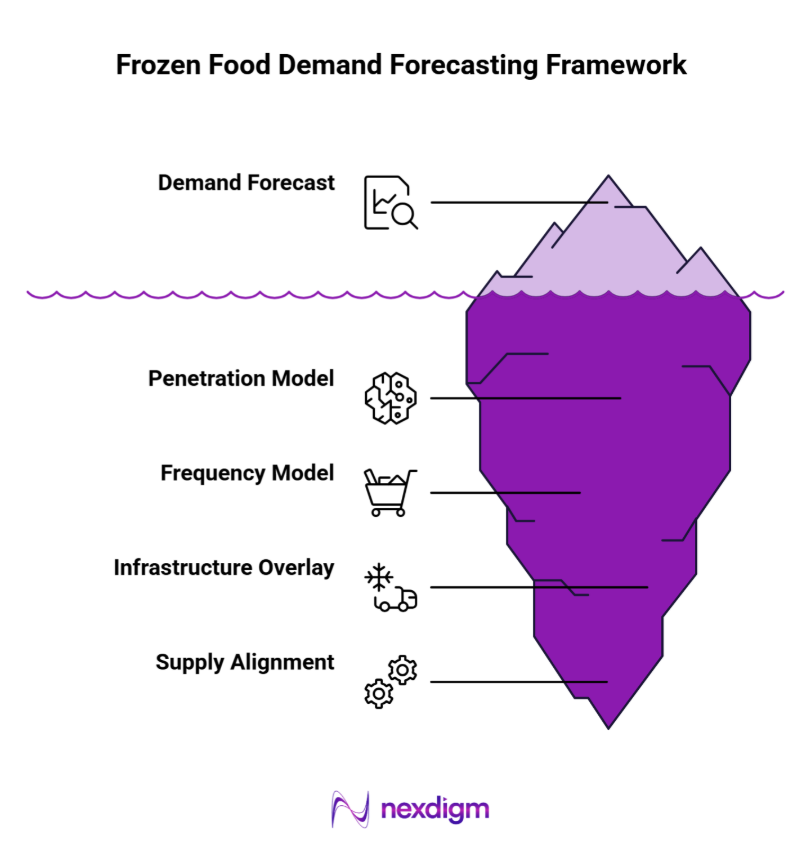
- Penetration model: Estimate current and potential household adoption by geography.
- Frequency model: Forecast purchases by product, household segment and consumption occasion.
- Infrastructure overlay: Map cold storage, distribution coverage and delivery feasibility against projected demand.
- Supply alignment: Translate demand forecasts into SKU-level production, inventory and replenishment requirements.
This creates a forecast that connects consumer demand to the physical ability to serve it, rather than treating market growth as a standalone CAGR.
Nexdigm Case: Improving Frozen Food Forecasting and Supply Efficiency
Nexdigm assessed 18 months of demand data across 320 SKUs and 5 distribution regions. The engagement identified forecasting and cold-chain utilization gaps, improving inventory turnover by 18%, reducing wastage by 16%, and increasing on-time delivery by 20%.
To take the next step, simply visit our Request a Consultation page and share your requirements with us.
Harsh Mittal
+91-8422857704