
Frozen food has historically been positioned around convenience. India’s market is increasingly moving toward a broader proposition involving household meal preparation, snacking, foodservice, digital grocery and year-round availability.
The opportunity is substantial, but scaling frozen food requires more than consumer interest. Products need reliable cold-chain infrastructure, suitable price points, sufficient freezer access and enough repeat consumption to justify the logistics involved.
IMARC estimates that India’s frozen-food market reached INR191 billion in 2024 and projects it to reach INR593 billion by 2033, representing a 13.4% CAGR.
The question is whether infrastructure and consumer behaviour can develop quickly enough to support that trajectory.
The Consumer Has to Cross Three Barriers
Frozen products compete with an unusually strong alternative in India: freshly prepared food.
Consumers have historically associated freshness with quality, particularly for traditional foods. Frozen products therefore need to overcome concerns around taste, texture, ingredients and preparation.
Mintel’s India research found that half of Indians had consumed at least one frozen food item during the preceding six months. Convenience, time savings and cost-effectiveness compared with takeaway were among the motivations identified, while taste and freshness remained important barriers to wider adoption.
That creates three separate tests:
- Trial: Will consumers buy the product once?
- Acceptance: Does the product meet expectations for taste, texture and preparation?
- Repeat: Does the convenience justify purchasing it again?
A large trial base without repeat consumption does not create a durable market.
Frozen Snacks Are Building the Category
Frozen snacks are particularly suited to India’s consumption patterns because they can occupy multiple occasions.
Samosas, aloo tikki, fries, momos and other snack formats can be prepared quickly at home, served to guests or used as additions to meals.
The Indian Frozen Food Institute’s 2026 flagship study, covering 1,400 households across 22 cities, reports that 64% of surveyed urban households purchase frozen food at least monthly. It identifies frozen snacks as the leading category by both volume and value.
This is important because it suggests the category is developing beyond occasional freezer purchases.
The same research reports that Tier-2 cities are growing 3.4 times faster than metros, pointing toward a potential second wave of geographic expansion.
Cold Chain Determines How Far the Market Can Travel
Frozen demand cannot scale without physical infrastructure.
The Ministry of Food Processing Industries’ Integrated Cold Chain scheme covers pre-cooling, multi-temperature storage, IQF, blast freezing, reefer vehicles, mobile cooling units and distribution hubs.
As of March 2026, the Ministry listed 408 approved cold-chain projects.
Earlier government data showed 286 completed projects under the Integrated Cold Chain and Value Addition Infrastructure component, with 112.35 lakh tonnes per annum of processing capacity and 25.39 lakh tonnes per annum of preservation capacity created.
For frozen-food companies, infrastructure needs to be evaluated at the route level.
A market may have sufficient consumers but still be commercially unattractive if freezer penetration, warehousing, reefer availability or delivery density cannot support the required service level.
Pricing Cannot Be Separated From Logistics
Frozen products often carry additional costs from processing, packaging, storage and temperature-controlled transportation.
That can push retail prices above fresh alternatives.
The commercial challenge is therefore to identify where consumers perceive sufficient value in exchange for convenience.
A product with a 20% price premium may succeed if it saves substantial preparation time. A product priced similarly to a fresh alternative may require stronger differentiation through taste, portioning, ingredients or shelf life.
Pricing assessment should therefore connect willingness to pay with the complete supply-chain cost.
Digital Retail Is Expanding Access
Quick commerce is particularly relevant because frozen products traditionally required consumers to plan purchases around supermarket visits and freezer capacity.
Mordor Intelligence estimates that online retail represented 6.52% of India’s frozen traditional-meals distribution in 2025 and forecasts 6.52% CAGR for the channel through 2031. Supermarkets and hypermarkets remained dominant at 55.47%.
The combination is commercially useful: modern retail provides freezer visibility and assortment, while quick commerce enables immediate replenishment and smaller purchase occasions.
Nexdigm’s Frozen Food Feasibility Lens
Nexdigm’s frozen food market feasibility consulting helps companies evaluate consumer acceptance, category demand, pricing, cold-chain requirements, channel economics and geographic scalability before committing to expansion.
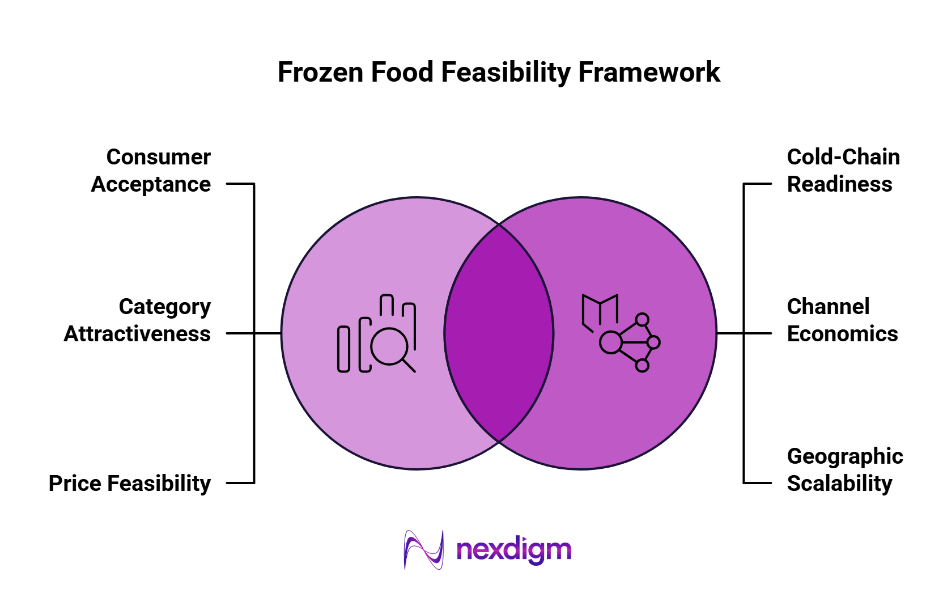
- Consumer Acceptance: Measure trial, taste expectations, preparation behaviour, freshness perceptions and repeat intent.
- Category Attractiveness: Compare snacks, ready meals, vegetables, meat, seafood, bakery and other formats.
- Price Feasibility: Benchmark fresh alternatives, competing frozen products and willingness to pay.
- Cold-Chain Readiness: Assess storage, transport, freezer penetration and route economics.
- Channel Economics: Compare modern trade, general trade, foodservice, e-commerce and quick commerce.
- Geographic Scalability: Identify markets where demand density and infrastructure can support profitable expansion.
The resulting assessment can show whether a frozen product is simply convenient or capable of becoming a repeat-consumption category.
Nexdigm Case: Testing Frozen Food Expansion Potential
A frozen-food company assessed expansion across 5 cities, 1,600 households and 28 retail chains. Nexdigm identified frozen snacks and ready-to-cook products as priority categories, with 19% projected demand growth and potential for a 16% reduction in distribution gaps.
To take the next step, simply visit our Request a Consultation page and share your requirements with us.
Harsh Mittal
+91-8422857704