
Frozen food is moving into a broader set of consumption occasions as urban households become more time constrained, cold-chain infrastructure improves, and retail access expands.
The opportunity is no longer limited to determining whether consumers are willing to buy frozen products. Companies need to understand which categories can scale, which consumer groups are driving adoption, where distribution can support the proposition, and whether the economics remain attractive as the business expands.
India’s frozen foods market was valued at INR 216.59 billion in 2025 and is projected to reach INR 643.64 billion by 2034, representing a 12.86% CAGR. Frozen vegetable snacks accounted for 52% of the market in 2025, while North India represented approximately 32% of national revenue.
Convenience Is Creating the Initial Demand
Convenience is one of the strongest structural drivers behind frozen food adoption.
Frozen products can reduce preparation time, extend shelf life, and provide predictable availability. These attributes are particularly relevant for working households, younger consumers, smaller households, and consumers seeking quick meal or snacking solutions.
But convenience alone does not determine which category will succeed.
Frozen snacks, fruits and vegetables, ready-to-eat meals, meat products, bakery products, and meal components serve different consumption needs. Their adoption can vary according to preparation requirements, perceived quality, price, dietary preferences, and frequency of use.
The opportunity therefore needs to be assessed at the category and consumer level rather than treating frozen food as a single market.
The Next Question Is Where Adoption Can Deepen
Household penetration is a useful starting point, but it does not provide the full picture.
A category with relatively low penetration may have substantial headroom if consumers understand the product, distribution is improving, and the price is accessible. Another category may already have high awareness but limited frequency because consumers use it only for occasional consumption.
Consumer research should examine:
- Awareness and trial
- Household penetration
- Consumption frequency
- Preferred product formats
- Preparation habits
- Price sensitivity
- Quality and safety perceptions
- Purchase barriers
- Repeat purchase intent
This allows companies to identify whether growth is likely to come from acquiring new households, increasing frequency among existing users, or encouraging consumers to shift from competing categories.
Cold Chain Determines How Far the Opportunity Can Travel
Frozen food has a structural dependency that many ambient categories do not: the distribution system must protect the product throughout its journey.
Cold-storage capacity, temperature-controlled transportation, retail freezer availability, inventory management, and last-mile handling can all determine whether a category is commercially viable in a particular geography.
India’s frozen food market is benefiting from improvements in cold-chain infrastructure and digital retail. IMARC identifies urbanization, rising disposable incomes, cold-chain development, and quick-commerce expansion among the major forces supporting market growth.
This creates an important distinction between consumer demand and addressable demand. A consumer may want the product, but the market may remain commercially inaccessible if distribution cannot maintain product quality at an acceptable cost.
From Category Screening to Commercial Prioritization
Nexdigm’s frozen food opportunity assessment consulting can evaluate the opportunity through a progression from demand to scalability.
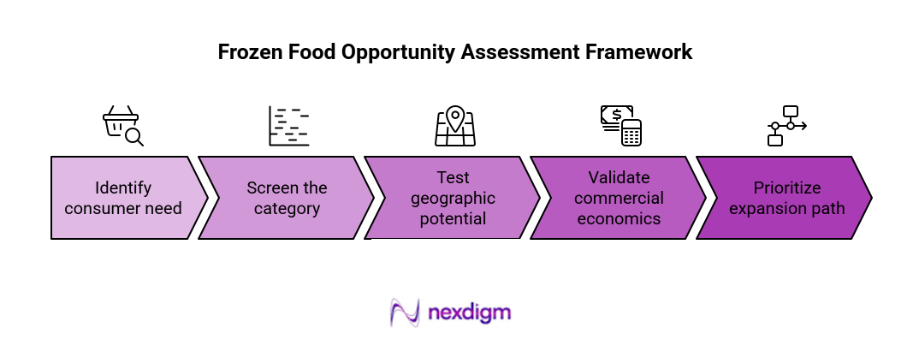
- Stage 1: Identify the consumer need
Map the occasions where frozen products provide a meaningful convenience advantage and establish the consumers most likely to adopt them. - Stage 2: Screen the category
Compare frozen categories according to market size, growth, household penetration, consumption frequency, competition, pricing, and product differentiation. - Stage 3: Test geographic potential
Assess city and regional demand alongside cold-chain availability, modern retail penetration, foodservice demand, and distribution infrastructure.
- Stage 4: Validate commercial economics
Evaluate pricing, margins, storage requirements, logistics costs, inventory turnover, wastage, and expected demand to determine whether the opportunity remains attractive beyond the consumer proposition. - Stage 5: Prioritize the expansion path
The final assessment can identify which products, consumer segments, geographies, and channels should receive investment first.
This approach prevents companies from treating category growth as sufficient evidence for expansion. A frozen product can have strong consumer interest and still struggle to scale if supply-chain economics, availability, or price acceptance are weak.
The Operational Side of Frozen Food Growth
Once a category has been selected, demand forecasting becomes critical. Frozen inventory has a direct cost when demand is overestimated, while stockouts can weaken consumer trust and retailer relationships.
Nexdigm’s frozen food benchmarking work examines demand forecasting, cold-chain utilization, inventory turnover, wastage, distribution performance, and delivery reliability to identify operational inefficiencies.
The connection between opportunity assessment and operational benchmarking is important because category growth ultimately has to translate into reliable product availability.
A Frozen Food Benchmarking Engagement With Measurable Results
In a frozen food benchmarking engagement, Nexdigm identified inefficiencies in demand forecasting and cold-chain utilization. The resulting improvements increased inventory turnover by 18%, reduced product wastage by 16%, and improved on-time delivery performance by 20%.
To take the next step, simply visit our Request a Consultation page and share your requirements with us.
Harsh Mittal
+91-8422857704