

Frozen food procurement cannot be benchmarked on product price alone. The purchase cost includes processing, freezing, packaging, cold storage, transportation, handling, and the risk of product loss. A supplier may offer a lower rate but deliver inconsistent product quality, shorter remaining shelf life, or unreliable temperature control.
For manufacturers, retailers, food-service businesses, and distributors, the relevant measure is the cost of receiving compliant, usable product at the required location.
Cold-Chain Capacity Is Becoming More Important
A Ministry of Food Processing Industries assessment of India’s food-processing infrastructure placed the cold-storage market at approximately ₹42,600 crore in FY2024. It estimated that total cold-chain warehousing capacity was around 37 million tonnes. The study also noted that temperature-controlled warehousing represented close to 90% of cold-storage market volume.
The same assessment projected the cold-storage market could reach ₹66,000 crore to ₹69,000 crore by FY2028, implying annual growth of approximately 10% to 13%. These are industry estimates reported in the ministry-commissioned study, not audited capacity figures for every product category.
The report also identified a distinction between potato and non-potato storage. Potato cold-storage utilisation was estimated at 85% to 90%, while non-potato facilities were more relevant to multi-product storage requirements. For frozen-food buyers, this underlines why general cold-storage capacity figures should not be treated as proof that suitable facilities are available for every product.
Vendor Benchmarking: Can Suppliers Meet the Specification?
Frozen-food suppliers should be evaluated according to product type. Frozen vegetables, seafood, meat, bakery products, snacks, and ready meals have different processing and handling requirements.
Compare vendors on:
- Product grade, size, net weight, and processing method.
- Freezing capability and temperature control procedures.
- Production capacity and seasonal availability.
- Batch consistency, defects, and rejection rates.
- Lead times, geographic reach, and backup arrangements.
A supplier’s ability to maintain product condition throughout storage and transport should be part of the vendor assessment, not an assumption based on its marketing claims.
Pricing Benchmarking: Calculate the Landed Cost
The quoted product rate should be combined with freight, cold storage, handling, insurance where relevant, minimum orders, and delivery charges. Buyers should also account for usable yield and product-specific differences such as glaze or coating where applicable.
For frozen food procurement benchmarking services, comparisons should use consistent units and specifications. Cost per kilogram received may not be comparable if net usable weight, processing method, or product quality differs.
The analysis should also examine remaining shelf life at delivery. A low-priced shipment with limited usable life may increase wastage or force the buyer to use stock earlier than planned.
Logistics Benchmarking: The Cold Chain Is Part of the Product
Cold-chain performance affects both cost and product integrity. A logistics provider should be assessed on vehicle availability, temperature monitoring, storage conditions, delivery windows, traceability, and incident response.
Key performance indicators include:
- On-time and complete delivery rates.
- Temperature excursions and corrective actions.
- Product damage and rejection rates.
- Remaining shelf life at receipt.
- Cost per shipment, pallet, or kilogram delivered.
The buyer should also map transport routes and storage locations. Longer distances, fragmented deliveries, and limited regional capacity may increase the cost of maintaining temperature-controlled supply.
Frozen Food Procurement Benchmarking Framework
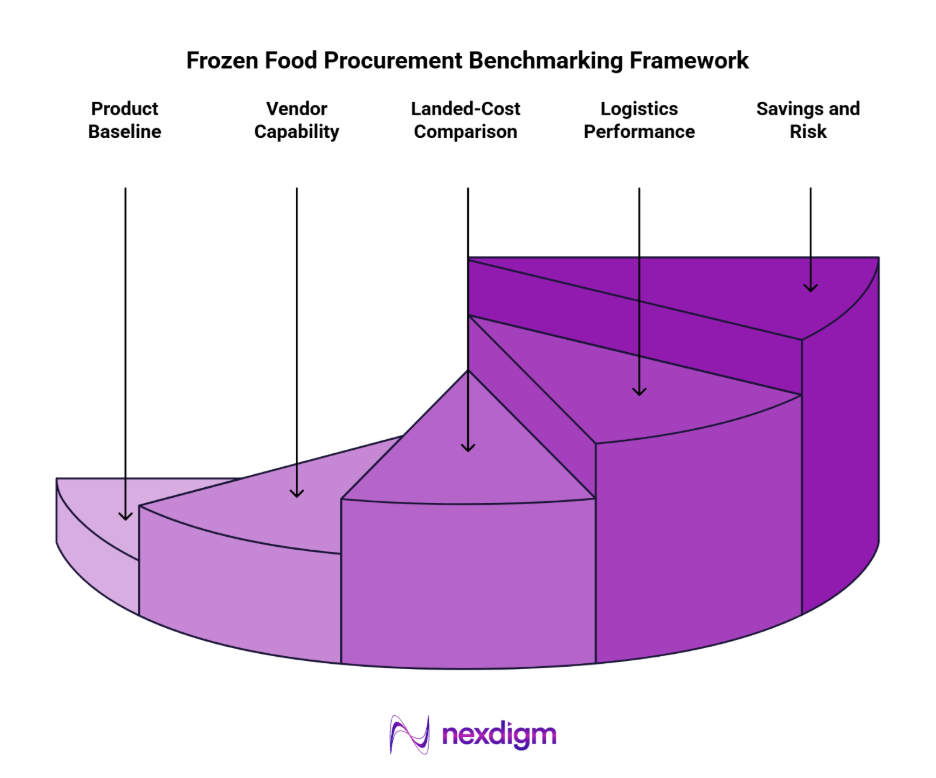
- Product Baseline: Segment frozen purchases by category, specification, supplier, location, and annual spend.
- Vendor Capability: Assess processing capacity, freezing methods, quality systems, temperature controls, and geographic coverage.
- Landed-Cost Comparison: Include product price, freight, storage, handling, minimum orders, and usable yield.
- Logistics Performance: Benchmark delivery reliability, temperature compliance, traceability, damage, and remaining shelf life.
- Savings and Risk: Evaluate supplier negotiations, route consolidation, alternative sourcing, and inventory changes without weakening cold-chain requirements.
Where Procurement Teams Should Focus
The strongest opportunities may come from combining supplier and logistics reviews. Consolidating compatible deliveries can reduce transport cost, while improving forecast accuracy can reduce emergency shipments and excess frozen inventory. Supplier diversification may also improve resilience where several buyers depend on one processing facility or distribution route.
However, reducing cold-chain expenditure without checking product requirements can create greater costs through rejection, spoilage, or food-safety incidents. Procurement savings should be measured against compliant product delivered, not simply against the quoted rate.
Nexdigm’s Case Study
A frozen-food company planning to expand its distribution footprint needed to identify markets with adequate cold-storage infrastructure and growing consumer demand. Nexdigm assessed 10 cities, mapping cold-storage capacity, logistics connectivity, retail penetration and competing brands. The assessment shortlisted 4 markets for expansion and identified infrastructure gaps that could influence distribution costs by an estimated 12–16%.
To take the next step, simply visit our Request a Consultation page and share your requirements with us.
Harsh Mittal
+91-8422857704