

Frozen food supply chains require continuous control over production, storage and distribution. A product may leave a processing facility in compliant condition but lose quality if freezing, storage or transportation conditions are not maintained. For manufacturers and retailers, supplier evaluation must therefore extend beyond the factory gate.
The supplier ecosystem includes farms, seafood processors, meat suppliers, food manufacturers, cold-storage operators, packaging companies and refrigerated transport providers. Each participant can affect product safety, shelf life and delivery reliability. The challenge is to understand whether the entire chain can maintain the required operating conditions.
India’s Frozen Food Supply Chain Is Expanding
India’s cold-chain infrastructure has received significant public investment through the Pradhan Mantri Kisan Sampada Yojana. By December 2025, 404 integrated cold-chain projects had been approved under the scheme, of which 300 had been completed.
The Ministry of Food Processing Industries reported that 286 completed projects had created 8.46 lakh metric tonnes of cold-storage, controlled-atmosphere, modified-atmosphere and deep-freezer capacity by December 2024. The same projects included 1,477 reefer vehicles and individual quick-freezing capacity of 274.65 metric tonnes per hour.
These figures show the development of infrastructure, but they do not establish that capacity is evenly distributed or available to every frozen food business. Location, temperature capability, product compatibility and transport connectivity determine whether a facility can support a particular supply network.
The Operational Standards That Matter in Frozen Food
Freezing Capacity and Process Control
Freezing performance influences product texture, shelf life and quality. Suppliers should be assessed on freezing technology, throughput, temperature monitoring, equipment maintenance and the consistency of finished-product specifications.
Individual quick freezing, for example, may be relevant for products such as peas, seafood and cut vegetables. Its availability and throughput should be assessed against actual production requirements rather than treated as interchangeable with general cold-storage capacity.
Cold Storage and Temperature Records
Storage facilities need to maintain conditions appropriate to the product category. Assessment should cover temperature monitoring, alarm systems, backup power, inventory rotation, segregation and procedures for handling temperature deviations.
A facility’s total storage capacity is not sufficient evidence of suitability. The relevant questions include whether the required temperature range is supported, how much capacity is available during peak periods and whether the facility is connected to the supplier’s production and distribution locations.
Refrigerated Transport and Delivery Performance
Frozen products may travel through several transport and storage points before reaching a distribution centre or retailer. Reefer vehicle availability, route length, loading procedures, temperature records and delivery scheduling all affect product integrity.
Businesses should also evaluate what happens when a vehicle breaks down, a route is disrupted or a destination warehouse cannot receive a shipment on time.
Traceability and Product Recall Readiness
Frozen food suppliers should maintain records linking raw materials, processing batches, packaging and dispatches. This is especially relevant for seafood, meat and ready-to-eat products, where a quality or safety issue may require rapid identification of affected batches.
The supplier should be able to provide product origin information, testing records, batch codes and documented corrective actions.
Export Markets Add Another Layer of Compliance
India exported 1.70 million metric tonnes of seafood worth US$7.45 billion in FY2024–25. Frozen shrimp accounted for 741,529 metric tonnes of exports and approximately 69.46% of total seafood export earnings.
This concentration makes frozen seafood a particularly important category for supplier and facility assessment. Export-oriented processors must consider destination-market requirements, testing protocols, traceability and the ability to maintain product integrity through international logistics.
The compliance requirements can vary by destination and product. A supplier qualified for one market may need additional documentation, approvals or process controls before serving another.
Nexdigm’s Frozen Food Supplier Assessment
A frozen food supplier compliance consulting engagement can examine processing capacity, cold-storage availability, logistics networks, supplier presence and regulatory conditions across selected markets. Nexdigm’s market research capabilities can help businesses identify infrastructure gaps, compare supplier ecosystems and assess the operational readiness of regions being considered for sourcing or expansion.
This analysis is useful when a company needs to evaluate whether a supplier network can support higher volumes, additional product categories or entry into export markets.
Frozen Food Supplier Compliance and Cold-Chain Assessment Framework
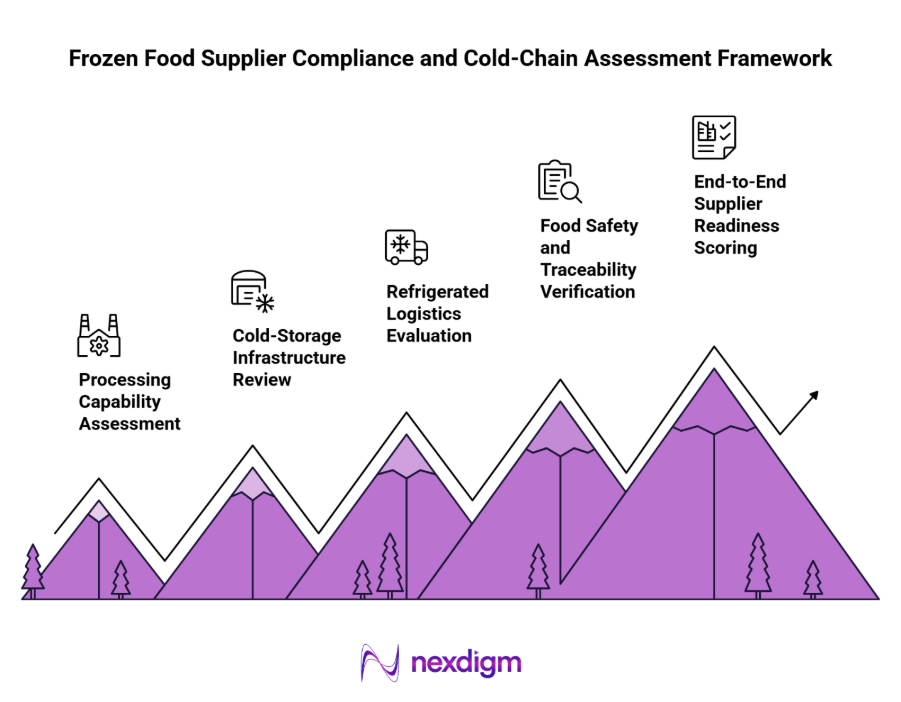
- Processing Capability Assessment: Evaluate freezing technology, production capacity, throughput and process controls.
- Cold-Storage Infrastructure Review: Examine storage capacity, temperature ranges, monitoring systems and backup arrangements.
- Refrigerated Logistics Evaluation: Assess reefer availability, route coverage, transit times and temperature-control procedures.
- Food Safety and Traceability Verification: Review applicable licences, product testing, batch records and recall readiness.
- End-to-End Supplier Readiness Scoring: Combine production, storage, logistics and compliance findings to identify operational vulnerabilities.
The framework helps distinguish suppliers with adequate nominal capacity from those with the infrastructure and operating controls required for dependable frozen food distribution.
Nexdigm’s Case Study
A frozen food exporter assessed 24 processing and logistics vendors across 3 coastal states. The review identified 6 facilities with inadequate temperature-monitoring systems and 4 transport corridors with recurring capacity constraints. The client prioritised 5 alternate facilities and increased qualified cold-chain coverage from 71% to 92%.
To take the next step, simply visit our Request a Consultation page and share your requirements with us.
Harsh Mittal
+91-8422857704