
Frozen food sourcing depends on the product’s manufacturing process and the ability to maintain required temperatures throughout storage and distribution. Vegetables, seafood, meat, ready meals, bakery products, and frozen desserts have different processing, packaging, handling, and shelf-life requirements.
A supplier may have adequate production capacity but still be unsuitable if its storage infrastructure, transport arrangements, or distribution partners cannot protect product quality across the intended market.
Map Producers and Product Categories
Supplier research should distinguish primary processors, frozen-food manufacturers, contract producers, and distributors. Some suppliers specialise in freezing and packing raw ingredients, while others manufacture finished products that require specific cooking or preparation methods.
India’s processed-food export base spans products such as processed fruits and vegetables, meat, dairy, cereals, and ready-to-eat foods. APEDA’s export reporting identifies processed food as an established part of India’s agri-food trade. For frozen food sourcing, however, national export figures must be supplemented with product-level data, destination requirements, and supplier-specific capability checks.
Verify Cold-Chain Readiness
Frozen products require appropriate storage, handling, transport, and temperature monitoring. Buyers should assess freezing capacity, cold-storage availability, loading procedures, vehicle capability, temperature records, and arrangements for equipment failure or transport delays.
For frozen food supplier identification consulting, a key distinction is between a supplier’s own infrastructure and the services it outsources. A manufacturer may depend on third-party cold stores or logistics providers, creating additional hand-offs that need to be assessed for reliability and accountability.
Compare Delivered Cost and Market Access
The commercial comparison should include product price, freezing and packing costs, storage, refrigerated transport, energy-related charges, customs duties where applicable, and losses from damaged or temperature-abused stock. Importers should also assess documentation, product standards, permitted ingredients, and any destination-specific approval requirements.
Market reach depends on more than the supplier’s export history. Buyers should verify which destinations the supplier currently serves, whether the product meets local requirements, and whether the supplier can support the required volumes and delivery frequency.
Frozen Food Supplier Assessment Framework
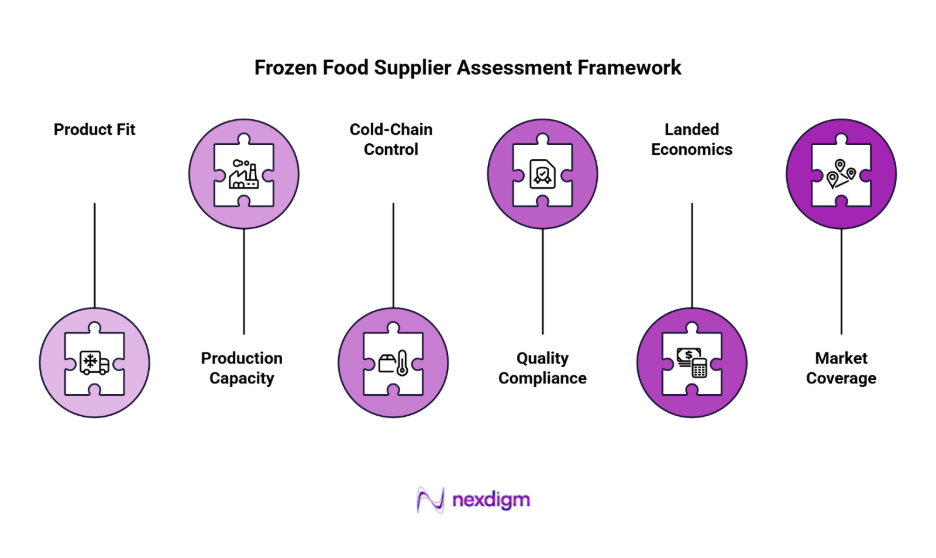
- Product Fit: Confirm product grade, processing method, freezing format, pack size, ingredients, shelf life, and intended application before shortlisting producers.
- Production Capacity: Review freezing lines, available production volumes, raw-material sourcing, seasonal constraints, packaging capability, and capacity reserved for existing customers.
- Cold-Chain Control: Assess freezing and storage infrastructure, temperature monitoring, transport partners, loading practices, contingency arrangements, and responsibility for temperature excursions.
- Quality Compliance: Verify food safety systems, batch traceability, testing records, export documentation, and requirements applicable to the destination market.
- Landed Economics: Compare product price, packing, storage, freight, duties, insurance, handling, and potential losses using consistent shipment and delivery assumptions.
- Market Coverage: Evaluate existing distribution routes, export experience, lead times, order minimums, and the ability to serve the target geography consistently.
Qualify the Entire Supply Route
Supplier approval should extend beyond the factory. Buyers should validate the storage and transport route, review temperature records, test product quality on receipt, and confirm how deviations will be handled. This helps ensure that competitive pricing translates into dependable supply rather than hidden losses.
Nexdigm’s Case Study
A food distributor evaluating frozen vegetables for 40 outlets compared four suppliers on product quality, cold storage, and delivery costs. A revised sourcing mix reduced average landed cost by 5.2%, while temperature records and receiving checks helped maintain agreed product standards across the distribution network.
To take the next step, simply visit our Request a Consultation page and share your requirements with us.
Harsh Mittal
+91-8422857704