

Fresh produce procurement involves more than identifying growers or distributors offering competitive prices. Buyers must account for product quality, freshness, shelf life, seasonal fluctuations, handling practices, and the ability to fulfil volume requirements consistently.
India’s horticulture sector is projected to reach 386.9 million tonnes in 2025–26, according to the Ministry of Agriculture and Farmers Welfare’s November 2026 third advance estimates. Fruit production is estimated at 123.07 million tonnes, while vegetables are projected at 227.27 million tonnes.
These figures highlight the scale and diversity of the domestic supply base. Against this backdrop, fruit and vegetable supplier intelligence helps businesses identify relevant suppliers, understand their operational capabilities, and evaluate sourcing options across products and markets.
Why Fresh Produce Sourcing Requires a Different Procurement Approach
Unlike many processed or shelf-stable products, fruits and vegetables are sensitive to time, temperature, handling, and transportation conditions. Their quality can deteriorate during storage and distribution, while production volumes fluctuate with weather and harvest cycles. Buyers therefore need suppliers who can maintain product standards, manage seasonal availability, and coordinate deliveries with changing demand across retail, foodservice, and processing operations.
Considerations That Shape Produce Supplier Selection
Before evaluating individual suppliers, businesses should establish the factors that influence the suitability of fresh produce sourcing partners:
- Product Quality and Freshness: Examine grade, size, appearance, maturity, ripeness, residue compliance, and post-harvest handling practices against product requirements.
- Volume and Seasonal Supply: Understand production capacity, harvest calendars, sourcing regions, seasonal fluctuations, and the ability to fulfil recurring or bulk orders.
- Storage and Distribution Readiness: Assess packaging, cold-chain access, storage infrastructure, transportation arrangements, and delivery coverage to maintain product condition.
These considerations provide a practical starting point for evaluating suppliers across different produce categories and sourcing markets.
Mapping the Produce Supply Base with Nexdigm’s Expertise
Our industry-led expertise helps businesses understand the structure of fruit and vegetable supply markets by identifying participants across the agricultural value chain. Our research can cover farmers, farmer-producer organizations, cooperatives, aggregators, wholesalers, distributors, exporters, and organized fresh produce suppliers.
We examine supplier locations, product portfolios, sourcing arrangements, customer segments, and market presence across selected regions. This helps businesses understand how produce moves from cultivation and aggregation to wholesale distribution, retail, foodservice, and food processing.
Through fruit and vegetable supplier intelligence, our experts can also identify specialized suppliers for individual categories, such as tropical fruits, citrus varieties, leafy vegetables, root vegetables, and other commercially relevant produce.
Mapping the Produce Supply Base with Nexdigm’s Structured Intelligence Approach
Our industry-led expertise helps businesses understand the fruit and vegetable supplier ecosystem through a structured research process. Our fruit and vegetable supplier intelligence approach connects market-level information with supplier-specific capabilities through the following steps:
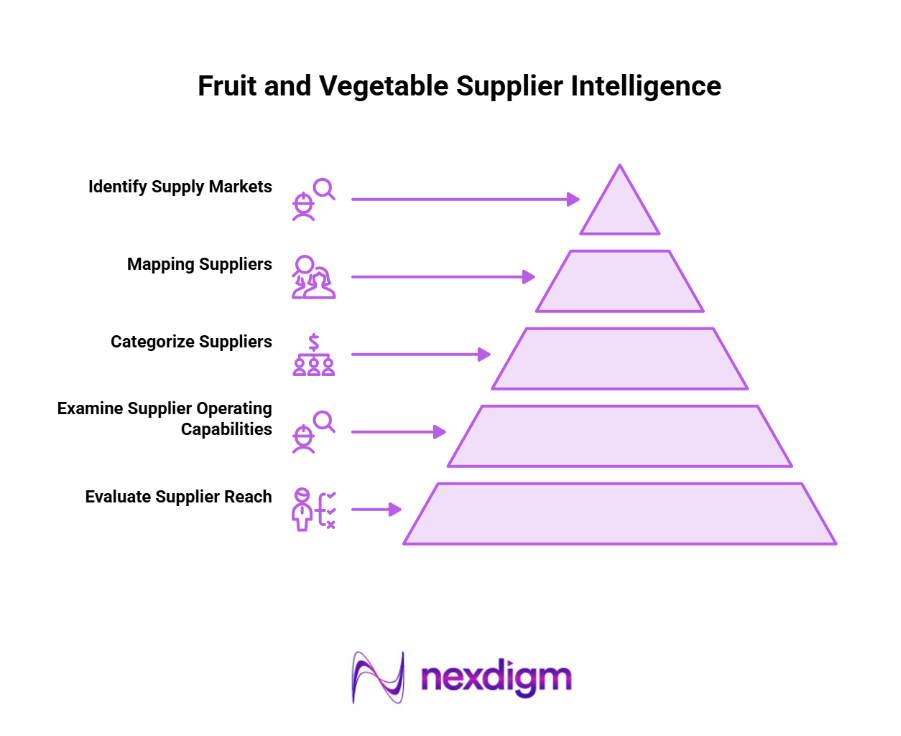
- Step 1: Identify Key Producing and Supply Markets
Examine major fruit and vegetable producing regions, cultivation patterns, sourcing clusters, and distribution centres to understand where relevant supply opportunities exist. - Step 2: Map Suppliers Across the Value Chain
Identify farmers, farmer-producer organizations, cooperatives, aggregators, wholesalers, distributors, exporters, and organized fresh produce suppliers across selected markets. - Step 3: Categorize Suppliers by Produce Portfolio
Classify suppliers according to fruit and vegetable categories, product varieties, sourcing specializations, customer segments, and geographic presence. - Step 4: Examine Supplier Operating Capabilities
Assess available information on procurement networks, aggregation arrangements, post-harvest handling, grading, packaging, storage, and cold-chain infrastructure. - Step 5: Evaluate Supply and Distribution Reach
Review indicative supply volumes, seasonal availability, delivery coverage, logistics arrangements, and access to key consumption markets to understand supplier reach.
This process gives businesses a consolidated view of the supplier landscape and establishes a foundation for more detailed quality, operational, and commercial comparisons.
Business Benefits of Nexdigm’s Produce Supplier Intelligence
A structured supplier assessment helps procurement teams move beyond basic vendor identification and make decisions based on product and operational requirements. Our intelligence can help businesses:
- Improve Supplier Discovery: Identify relevant suppliers across produce categories, sourcing regions, and distribution channels.
- Strengthen Quality Evaluation: Understand differences in grading, freshness management, handling practices, and quality-control capabilities.
- Anticipate Seasonal Constraints: Recognize supply fluctuations and identify alternative sourcing regions or supplier options.
- Assess Operational Readiness: Compare storage, cold-chain access, logistics, and delivery capabilities against procurement needs.
- Prioritize Sourcing Opportunities: Develop focused supplier shortlists for further verification, engagement, and commercial evaluation.
These insights support more informed supplier selection and help businesses build sourcing networks aligned with changing demand and supply conditions.
Nexdigm’s Case
A retail distribution company sought to expand its fresh produce supplier network across multiple regions. Nexdigm assessed 28 suppliers across fruit and vegetable categories, examining quality practices, seasonal availability, storage, and distribution capabilities. The assessment found that 32% had limited cold-chain infrastructure, while 25% lacked consistent documentation of quality procedures. The company prioritized suppliers for operational verification and commercial discussions.
To take the next step, simply visit our Request a Consultation page and share your requirements with us.
Harsh Mittal
+91-8422857704