
Fuel-station choice is shaped by the alternatives available along a driver’s route. Price, accessibility, waiting time, payment convenience and service quality influence which station makes the shortlist and which ultimately receives the purchase. Repeat visits depend on whether the experience justifies returning, particularly when competing stations offer similar fuel prices.
The 2025 Consumer Survey: Driver Behaviors and Perspectives, conducted by Bold Decision for the Transportation Energy Institute and the National Association of Convenience Stores (NACS), surveyed 1,203 American adults. It found that 72% considered price the most important factor when choosing where to buy gasoline, while 69% said they would drive five minutes out of their way to save five cents per gallon. These findings illustrate the influence of price, although preferences vary across locations and customer groups.
For fuel retailers, the commercial challenge is to determine which factors actually change customer behaviour. A station may attract price-sensitive motorists through discounts but struggle to retain them when promotions end. Another may sustain repeat traffic through reliable service, convenient access or complementary retail offerings. Investment decisions require evidence of these differences within the specific market being assessed.
The Competitive Set Is Defined by the Driver’s Journey
A station competes with the alternatives a motorist can realistically reach, not every outlet within a fixed geographic radius. Road direction, turning restrictions, congestion, entry and exit arrangements, opening hours and travel time determine whether a nearby station is a practical substitute.
This makes location analysis central to demand assessment. A station on a commuter’s established route may benefit from recurring traffic, while an outlet requiring a detour must offer a sufficiently compelling advantage to justify the additional time or cost. Highway locations, urban neighbourhoods and industrial corridors also serve different mobility patterns, creating distinct competitive conditions.
Customer segmentation adds another layer. Private motorists may respond to fuel prices and convenience, while taxi and rideshare operators can place greater weight on predictable access and frequent-refuelling efficiency. Commercial fleets may prioritise fuel quality, payment arrangements, consolidated invoicing and network coverage. Heavy-vehicle operators require suitable entry geometry and facilities, whereas customers travelling with families may value clean restrooms, food and safe stopping conditions.
These distinctions affect both pricing strategy and site development. A station designed around commuter traffic may not benefit from investments aimed at long-haul drivers, even when both groups purchase the same fuel products.
Separate Stated Preferences From Actual Station Choice
Customer surveys reveal preferences, but they cannot independently establish which attributes generate profitable demand. Drivers may claim to prioritise low prices while routinely choosing a more convenient station. Others may express loyalty to a brand without visiting frequently enough to justify substantial retention spending.
A stronger assessment combines customer research with observed behaviour. Discrete-choice surveys can test how motorists trade off price, travel time, waiting, payment methods, brand familiarity and amenities. These findings can then be compared with anonymised point-of-sale records, loyalty redemptions, visit frequency, transaction values and changes in local competitor pricing.
The distinction becomes particularly important when evaluating promotions. A discount may increase fuel volumes by attracting new customers, shifting purchases from nearby stations or simply bringing forward a planned refill. Tracking visits before, during and after the promotion helps distinguish incremental demand from temporary switching. Route changes, seasonality and differences in local competition must also be considered.
Experience attributes require similar scrutiny. Working pumps, accurate dispensing, clean facilities, reliable payment systems and consistent staff service can protect customer retention. Their commercial value may appear through fewer abandoned transactions, more repeat visits or higher in-store spending rather than an immediate ability to charge more for fuel.
When Convenience Retail and Digital Services Create Value
Fuel stations increasingly compete for spending beyond the forecourt. In-store food and beverages, convenience retail, loyalty programmes and digital payments can strengthen the proposition, but their effectiveness depends on customer needs and the economics of the site.
NACS reported in 2025 that 64% of drivers who refuelled also entered the convenience store, the highest proportion recorded in its series at that point. The finding indicates an opportunity to connect fuel traffic with additional purchases, although store entry alone does not establish incremental profitability. Product availability, purchase conversion, basket size and operating costs determine the return.
Digital payments and loyalty programmes can reduce transaction friction and support repeat engagement. However, discounts may subsidise purchases that would have occurred anyway. Similarly, EV charging or additional amenities may attract new visits, but utilisation, dwell time, infrastructure costs and the characteristics of passing traffic determine whether the investment is commercially justified.
A fuel station customer preference analysis can help retailers distinguish broadly appealing services from attributes that influence specific customer segments. Nexdigm can combine competitor mapping, consumer research, behavioural analysis and site-level economics to identify which interventions are most likely to improve customer acquisition, retention and revenue.
Customer Choice to Capital Allocation Framework
A practical assessment should connect four questions to the economics of each location:
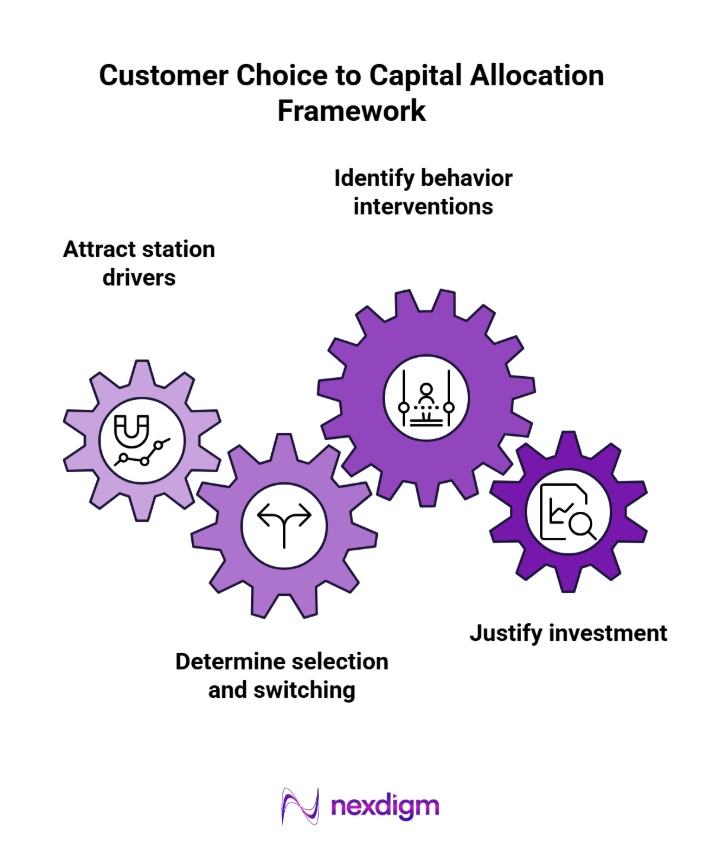
- Which drivers can the station realistically attract? Map traffic flows, competing outlets, route accessibility and customer segments to establish the addressable demand pool.
- What determines selection and switching? Measure the influence of price, detours, waiting time, brand, payment convenience and service attributes through customer research and transaction analysis.
- Which interventions change behaviour? Test pricing, loyalty incentives, service improvements and retail additions against observed changes in visits, repeat frequency and purchase value.
- Does the resulting demand justify investment? Estimate incremental fuel volume, non-fuel revenue, contribution margins and implementation costs. Compare scenarios to identify which improvements produce sustainable returns rather than temporary traffic gains.
The outcome is a commercially grounded view of where a retailer should compete on price, where service differentiation offers greater potential and which sites warrant further investment. It also helps identify locations where structural disadvantages, such as poor access or intense competitor density, may limit the return from additional spending.
Nexdigm Case: Identifying the Drivers of Repeat Visits
An assessment compares 25 fuel stations across three urban and highway corridors, combining customer surveys, competitor prices and transaction patterns. The analysis identifies eight locations where access and service reliability outweigh modest price differences for priority segments. Targeted operational improvements are prioritised over blanket discounts, with returns evaluated through repeat visits and contribution margins.
To take the next step, simply visit our Request a Consultation page and share your requirements with us.
Harsh Mittal
+91-8422857704