

A busy road creates visibility, but visibility is only the first condition for a profitable fuel station. The commercial case depends on how many vehicles can realistically access the site, how many will stop, how much they will purchase and what margin the station can retain. Convenience retail, food, fleet services and charging can materially change the economics when fuel margins alone are insufficient.
The UK Competition and Markets Authority’s review of road-fuel markets highlights location and price as important factors in station choice. For a proposed site, this makes catchment definition particularly important. A station should be assessed by actual drive time and direction of travel rather than a simple radius. Median barriers, junction layouts, congestion, one-way systems and limited turning opportunities can exclude motorists who appear geographically close.
Traffic should therefore be treated as the starting point for a demand model, not as the demand model itself.
Build the Volume From the Road Up
The first commercial calculation is the conversion of traffic into potential fuel throughput. Classified traffic counts should distinguish cars, taxis, light commercial vehicles, buses and heavy trucks, while time-of-day and directional flows reveal when the site can realistically capture demand.
The next layer is behavioural. Estimate the proportion of passing vehicles likely to stop, purchase frequency, litres per visit and the share that can be captured from competing stations. Comparable station sales provide a useful reality check. Competitor pricing, brand loyalty, opening hours, queues, canopy capacity and accessibility can all change the achievable share.
This approach can expose apparently attractive sites with weak underlying demand. A highway location with substantial truck traffic may outperform a busier urban road if heavy vehicles have fewer suitable alternatives. Conversely, a site surrounded by several established stations may struggle even with high traffic volumes.
Fuel Sales Are Only One Part of the Return
Once throughput has been estimated, the location needs to be treated as a retail investment.
Fuel contribution depends on actual margins and litres sold, while the cost base includes land, construction, staffing, utilities, maintenance, payment fees and working capital. Non-fuel services can alter the return materially. A convenience store may increase gross profit per customer but requires inventory, labour and additional space. Food service can generate stronger margins but introduces higher operating complexity. Fleet facilities can secure repeat demand where local commercial traffic is concentrated.
EV charging presents a further consideration. Its economics depend on utilisation, charger speed, grid connection costs, electricity prices and dwell time. It should therefore be modelled as a specific revenue and investment stream rather than treated as an automatic hedge against declining fuel volumes.
Road development also needs to be incorporated into the forecast. A bypass may increase regional traffic while reducing the number of vehicles passing the station itself. Construction schedules, planned junction changes and future route openings can therefore affect the value of land acquired today.
Rank Sites by Resilience, Not Traffic
A useful expansion programme should distinguish between sites that work immediately and those that require additional revenue streams to become viable. For fuel station market feasibility assessment, each location can be tested against addressable traffic, competitive capture, fuel margin, ancillary contribution, capital cost and exposure to changing vehicle technology.
The objective is not simply to identify the busiest locations. It is to determine which sites can sustain an acceptable return when traffic capture, margins, investment requirements and future fuel demand move away from the base case.
Forecourt Expansion Viability Framework
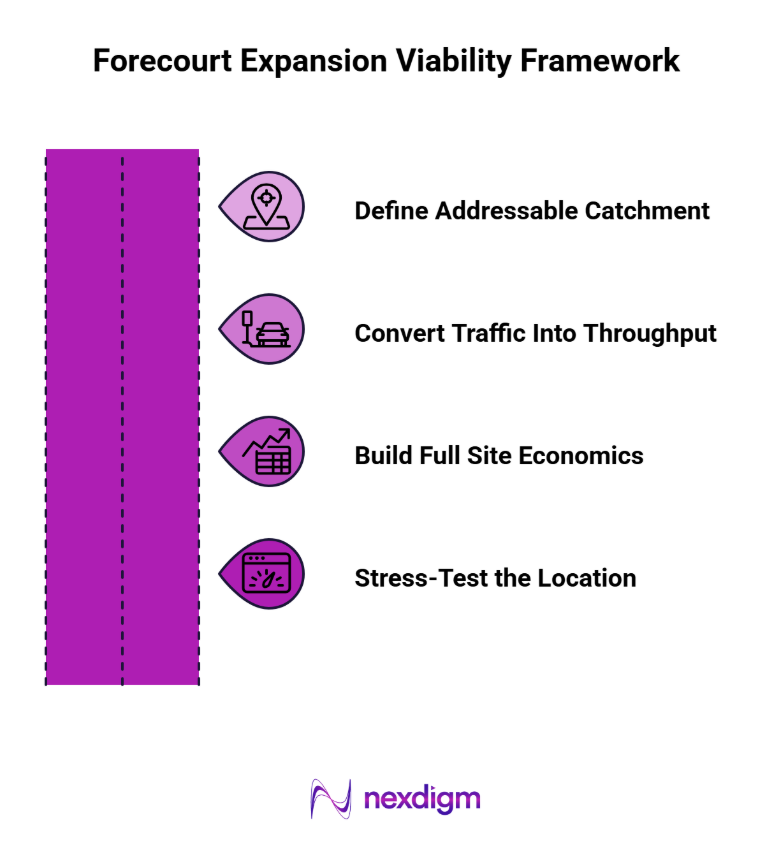
- Define the Addressable Catchment
Measure traffic by vehicle type, direction and time period, then remove flows that cannot realistically access the proposed site. - Convert Traffic Into Throughput
Estimate stop rates, purchase frequency, litres per visit and competitor capture to establish realistic fuel demand. - Build the Full Site Economics
Combine fuel contribution with land, construction, operating costs and potential income from convenience, food, fleet services and charging. - Stress-Test the Location
Model competitor entry, road changes, fuel-efficiency improvements, electrification and weaker-than-expected traffic capture before committing capital.
Nexdigm can use this assessment to compare individual sites and build a phased expansion portfolio around risk-adjusted returns rather than traffic volumes alone.
Nexdigm Case Study
Nexdigm screened 6 highway and urban forecourt locations using classified traffic counts, competitor drive-time analysis, projected fuel mix and ancillary revenue. 2 sites met the target return through fuel economics alone, while a third required food retail and fleet access. 1 bypass-sensitive site was deferred pending clearer evidence on future traffic capture.
To take the next step, simply visit our Request a Consultation page and share your requirements with us.
Harsh Mittal
+91-8422857704