

Fulfillment centers operating under high order volumes and strict service-level agreements require pricing models that balance speed, capacity, labor, technology, and risk. A well-designed fulfillment center pricing strategy uses detailed pricing analysis to align charges with order complexity, peak demand, storage utilization, processing intensity, and promised turnaround times.
By applying activity-based costing, volume tiers, SLA-linked fees, and performance incentives, operators can protect margins while giving clients greater transparency, predictable costs, and scalable service. Effective pricing analysis also supports contract negotiations and continuous operational improvement.
A recent fulfillment benchmark found that automated order processing reached 90% and carrier-related financial penalties fell 65%. These results indicate that data-led pricing analysis and automation can strengthen SLA performance while significantly improving fulfillment of economics.
Performance-Linked Pricing Analysis for Fulfillment Center Networks
Performance-linked pricing analysis connects fulfillment charges with measurable operational outcomes, enabling networks to strengthen SLA compliance, reward efficiency, and achieve scalable service quality across high-volume distribution environments. Core benefits of the analytical process are:
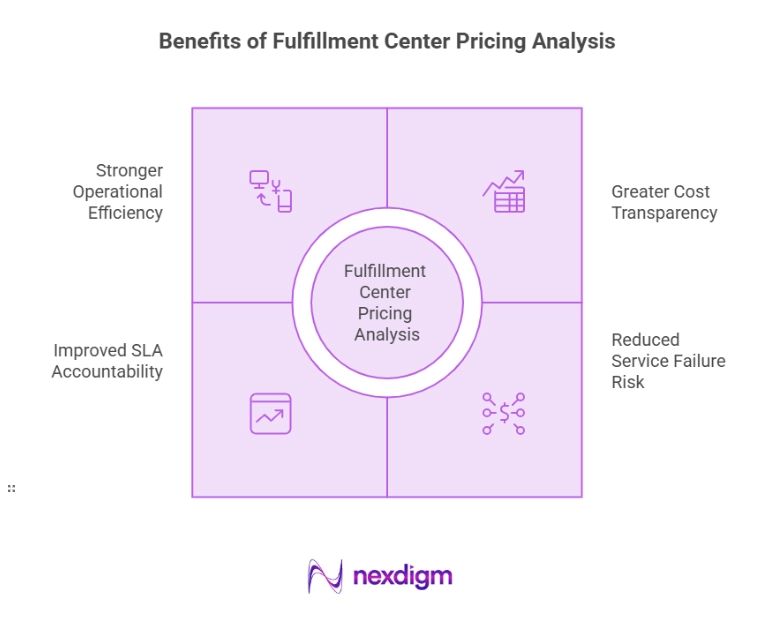
- Improved SLA Accountability: Linking pricing to delivery accuracy, processing speed, and order completion creates clear accountability, encouraging fulfillment providers to consistently meet contractual service levels and performance expectations.
- Greater Cost Transparency: Performance-based pricing separates fixed charges, variable costs, and outcome-linked fees, helping clients understand spending drivers, validate invoices, and identify opportunities for cost optimization.
- Stronger Operational Efficiency: Connecting financial incentives with productivity metrics motivates providers to improve picking accuracy, labor utilization, automation adoption, and throughput while reducing delays, errors, and unnecessary operating expenses.
- Reduced Service Failure Risk: Penalty and incentive structures help control risks associated with missed deadlines, inaccurate orders, inventory discrepancies, and system downtime, protecting customer experience and network reliability.
How Nexdigm Supports Performance-Linked Fulfillment Pricing Analysis
Nexdigm combines operational data, cost benchmarking, and SLA assessment to deliver performance-linked fulfillment pricing analysis, helping businesses with long-term network profitability across operations in the following ways:
- optimize fulfillment center pricing through detailed cost benchmarking
- align pricing structures with SLA performance metrics
- identify cost-saving opportunities using activity-based pricing analysis
- compare provider rates and negotiate competitive contracts
- manage peak-order volumes with scalable pricing models
Nexdigm’s pricing analysis expertise enables businesses to balance cost, service quality, and operational efficiency, creating fulfillment networks that are both competitive and performance driven.
Nexdigm’s Integrated Pricing Intelligence Framework for Fulfillment Operations
Nexdigm’s integrated pricing intelligence framework combines operational data, cost drivers, market benchmarks, and SLA metrics to guide structured pricing decisions, strengthen profitability, and improve fulfillment network performance sustainably. Strategic steps of the framework model are:
- Analyze Fulfillment Cost Drivers: Nexdigm evaluates storage, labor, packaging, transportation, technology, and overhead expenses to establish a reliable cost baseline that supports accurate pricing analysis and informed commercial decisions.
- Benchmark Pricing and Service Performance: Internal pricing is compared with market rates, provider capabilities, and SLA outcomes to identify competitive gaps, optimization opportunities, and areas requiring pricing adjustments.
- Segment Orders and Build Pricing Strategies: Orders are categorized by volume, complexity, urgency, and channel requirements, enabling businesses to model multiple pricing scenarios and assess profitability under changing conditions.
- Design Performance-Linked Pricing Models: Base rates, incentives, and penalties are aligned with measurable performance indicators, encouraging operational efficiency, service quality improvements, and stronger contractual accountability.
- Monitor Contract Performance: Continuous review of invoices, benchmarks, margins, and service metrics help businesses control pricing variances, support negotiations, and maximize long-term fulfillment value.
Nexdigm’s Case
Nexdigm supported a consumer-goods company by benchmarking 3PL operations, diagnosing warehouse performance, and assessing transportation costs. The engagement improved delivery performance by 25%, and strengthened supply-chain visibility, vendor governance, and fulfillment efficiency across the network.
To take the next step, simply visit our Request a Consultation page and share your requirements with us.
Harsh Mittal
+91-8422857704