

Functional beverages have moved beyond a narrow association with sports and energy drinks. Gut health, hydration, protein, immunity, cognitive performance and low-sugar consumption are creating new reasons for consumers to choose beverages.
The challenge is turning these need states into repeatable mass-market behaviour.
IMARC estimates India’s functional beverages market at US6.9billionin2025andUS8.3 billion in 2026, with the market projected to reach US$18.8 billion by 2034 at a 10.74% CAGR.
The headline growth is substantial. Whether that growth becomes mainstream depends on accessibility, price, credibility and whether consumers understand the benefit well enough to build it into everyday routines.
Need States Are Expanding the Category
Traditional beverage consumption is often organized around taste, refreshment or energy.
Functional beverages introduce a different purchase logic: the consumer chooses a drink because it performs a particular job.
The major need states include:
- Energy: Sustained alertness, exercise and active lifestyles.
- Hydration: Replenishment during exercise, travel or daily activity.
- Gut health: Probiotic or digestive-health positioning.
- Nutrition: Protein, vitamins, minerals and other nutrients.
- Wellness: Herbal, Ayurvedic or immunity-linked propositions.
- Cognitive performance: Focus and mental-performance claims.
The opportunity lies in identifying which need states have enough consumer frequency to support repeat purchase.
Consumer Intent Is Strong, But Trust Is Uneven
NIQ’s 2025 India health and wellness research found that 53% of consumers proactively take steps to improve their health and wellness. Forty-nine percent planned to increase high-fibre food consumption, 37% intended to add more plant-based proteins, and 33% were interested in probiotic-rich options.
The same research identifies a significant credibility challenge.
Sixty-four percent of consumers wanted detailed product information, 61% wanted clearer labels and 47% did not fully trust the effectiveness of products or services intended to improve health.
For functional beverages, this means a health claim cannot be treated as sufficient differentiation. Consumers need to understand what the product does, why it works and whether the benefit justifies the price.
Price Could Determine Whether the Category Scales
Health and functionality create opportunities for premiumization, but price remains a barrier.
NIQ found that 51% of Indian consumers considered healthier alternatives too expensive, while another 51% struggled to find healthier alternatives in the market.
This creates a fundamental mainstreaming challenge.
A functional beverage positioned exclusively as a premium wellness product may appeal to affluent early adopters without achieving sufficient frequency. A lower-priced product may broaden adoption but potentially weaken the margin required to support functional ingredients, packaging and marketing.
Price research should therefore test whether consumers are willing to pay a premium for the specific benefit rather than for the word “functional.”
Distribution Is Expanding the Addressable Consumer
IMARC identifies supermarkets and hypermarkets as the dominant distribution channel for functional beverages, while e-commerce is expanding as a flexible route for health-focused brands. Energy drinks currently lead the market by type, with sports drinks, dairy-based beverages and juices also forming important segments.
This creates different roles for different channels.
Modern retail can provide visibility and physical trials. E-commerce can reach targeted wellness consumers. Foodservice and gyms can create consumption occasions. Quick commerce can support immediate replenishment.
A mainstream product therefore needs more than national distribution. It needs the right distribution for the state it serves.
The Mainstream Test Is Repeatability
A functional beverage becomes a mainstream proposition when the benefit is:
- Relevant to a sufficiently large consumer group.
- Easy to understand.
- Experienced frequently enough to support habitual consumption.
- Available through convenient channels.
- Priced within a realistic premium.
- Supported by credible product information.
This is why category feasibility needs to move beyond market-size forecasts.
A US$6.9 billion category can contain both mass-market opportunities and highly specialized niches.
Nexdigm’s Functional Beverage Feasibility Framework
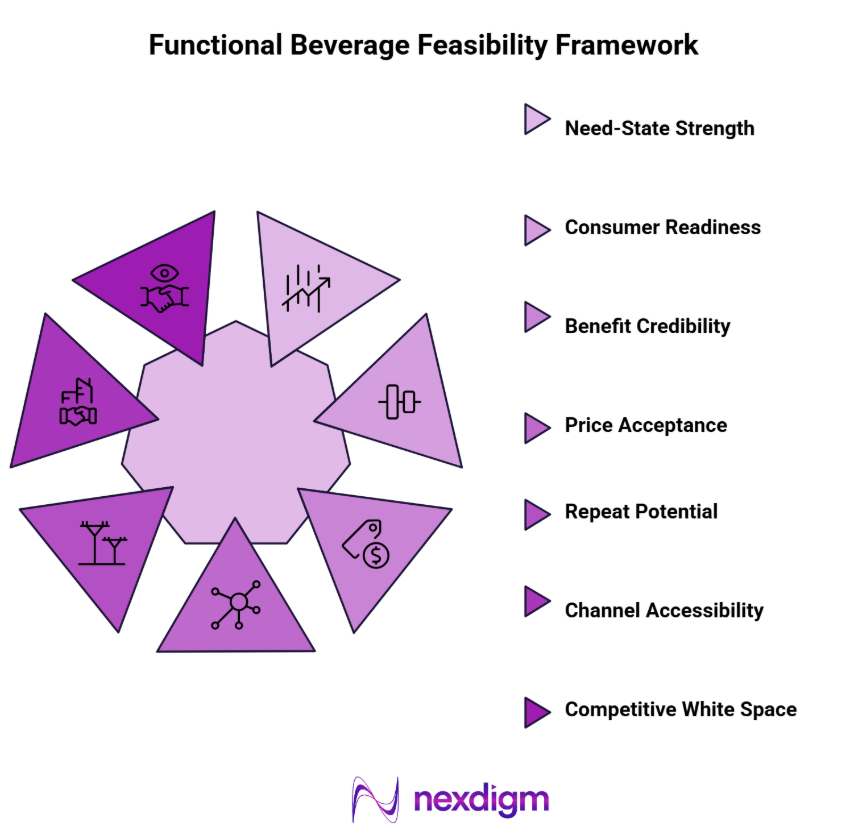
- Need-State Strength: Quantify the consumer problem the beverage addresses and its frequency.
- Consumer Readiness: Measure awareness, trial intent and category familiarity.
- Benefit Credibility: Test understanding and trust in functional claims.
- Price Acceptance: Establish willingness to pay across consumer segments.
- Repeat Potential: Assess consumption frequency and reasons for repurchase.
- Channel Accessibility: Identify where consumers discover, purchase and replenish the product.
- Competitive White Space: Map existing products by benefit, price, format and consumer target.
Nexdigm’s functional beverages market feasibility research helps companies assess need states, consumer readiness, willingness to pay, trust in claims, repeat potential, competition and channel economics. The framework helps distinguish genuine category expansion from growth driven mainly by premium niche consumption.
Nexdigm Case: Assessing Functional Beverage Demand and Price Acceptance
A beverage company tested functional-drink concepts among 2,400 consumers across 6 cities. Nexdigm identified energy, gut health and hydration as leading need states. The strongest concept achieved 34% purchase intent, with a ₹120–₹140 optimal price band.
To take the next step, simply visit our Request a Consultation page and share your requirements with us.
Harsh Mittal
+91-8422857704