

Global gas markets are being reshaped by expanding LNG capacity, changing regional demand, infrastructure constraints, and disruptions to established trade routes. The GECF reports that global gas trade increased 3% to 1.20 trillion cubic metres in 2025, while LNG trade rose 6.5% to a record 437 million tonnes.
Europe’s LNG imports increased by 29 million tonnes, while Asian imports declined by 8 million tonnes. In the United States, LNG exports averaged 17.4 Bcf/d during the first half of 2026, up 23% year-on-year. In July, U.S. LNG exports reached 16.74 Bcf/d, the highest July level on record.
These movements demonstrate why gas trade intelligence needs to look beyond shipment volumes. Supply availability, destination demand, pricing, infrastructure, storage, suppliers, and trade routes can collectively reveal market imbalances and sourcing risks.
Gas Flows Are Becoming More Flexible
LNG is allowing gas to move between markets that are not connected by pipelines, increasing flexibility in global supply. At the same time, this flexibility can create stronger competition for available cargoes when disruptions occur. In 2025, Europe’s LNG imports increased substantially while Asian imports declined, demonstrating how pricing and supply conditions can redirect flexible cargoes between regions.
Market Imbalances Can Reshape Sourcing Decisions
A gas market can become commercially attractive or vulnerable when demand changes faster than supply, infrastructure, or storage capacity. In 2026, disruptions around the Strait of Hormuz affected LNG availability and pushed Asian buyers toward alternative spot cargoes. U.S. LNG shipments to Asia more than doubled year-on-year during the first half of 2026.
Nexdigm’s Role in Assessing Changing Gas Trade
Gas trade patterns can change quickly as supply availability, demand, pricing, and infrastructure evolve. Nexdigm brings these signals together to help businesses understand:
- Trace Supply Movements: Nexdigm analyses LNG and pipeline flows, supplier activity, origins, destinations, and shipment patterns to identify where supply relationships are changing.
- Read Market Signals: Demand, pricing, storage, infrastructure, and buyer activity are assessed together to explain market imbalances and changing trade economics.
- Spot Strategic Implications: Trade findings are translated into insights around sourcing alternatives, supplier exposure, market opportunities, and competitive positioning.
This approach helps businesses move from observing gas-market movements to understanding the commercial decisions and risks behind them.
What Nexdigm’s Gas Trade Assessment Seeks to Identify
The objective is not simply to track gas moving between countries. Nexdigm assesses the commercial meaning behind those movements through a gas trade intelligence, focusing on four questions that matter to energy businesses:
- Where is supply shifting? Identify changing production, LNG availability, exporter participation, and sourcing relationships.
- Where is demand changing? Examine imports, consumption, storage, buyer activity, and market dependence to identify emerging imbalances.
- How accessible is the supply? Evaluate pipelines, LNG terminals, ports, shipping routes, storage, pricing, and transportation economics.
- What does the shift mean commercially? Translate these findings into sourcing alternatives, market opportunities, competitive implications, and potential risks.
These questions provide a direct bridge into Nexdigm’s gas trade assessment, moving from market signals to actionable intelligence.
Nexdigm’s Gas Trade Assessment Approach
Nexdigm can translate these questions into a structured assessment covering supply, demand, market access, and commercial risk. The assessment helps connect individual trade signals with broader market conditions through the following steps:
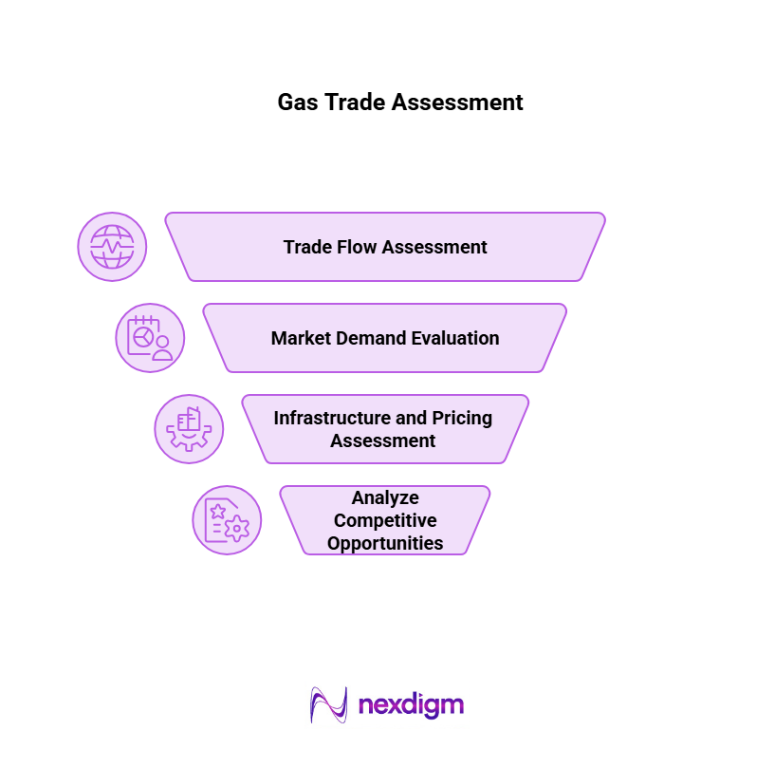
- Map Supply and Trade Flows: Assess gas production, LNG capacity, pipeline suppliers, exports, imports, origins, destinations, volumes, and shipment activity to understand where supply is coming from and how trade relationships are changing.
- Evaluate Demand and Market Balance: Examine consumption, import dependence, storage levels, buyer activity, seasonal requirements, domestic production, and market growth to identify emerging supply-demand gaps.
- Assess Infrastructure, Pricing, and Access: Evaluate LNG terminals, pipelines, regasification capacity, ports, storage, shipping routes, regional prices, and transportation costs to determine how accessible and commercially attractive different supply options are.
- Analyze Competition and Prioritize Opportunities: Compare suppliers, buyers, companies, market shares, alternative sources, trade corridors, and competitive conditions to identify sourcing alternatives, market opportunities, and potential exposure.
This assessment approach by Nexdigm, provides a connected view of where gas is moving, what is driving the movement, how accessible supply is, and where businesses may need to act.
Nexdigm’s Case
Nexdigm supported an energy-sector client in assessing 42 gas-import markets and 28 potential suppliers, analysing trade flows, pricing, infrastructure, and demand indicators. The assessment shortlisted 9 priority markets and 11 viable sourcing options, helping the client strengthen supplier diversification and focus its international growth strategy on commercially attractive opportunities.
To take the next step, simply visit our Request a Consultation page and share your requirements with us.
Harsh Mittal
+91-8422857704