

General insurance growth is becoming increasingly differentiated across product lines. Motor insurance continues to provide scale, but property, engineering, travel, and specialty liability are gaining importance as manufacturing, infrastructure, logistics, international mobility, and corporate risk exposures evolve.
For insurers, the strategic question is therefore less about where premiums are growing and more about where premium growth can translate into sustainable underwriting economics.
Motor Remains Large, But Scale Does Not Mean the Best Economics
Motor insurance remains one of the largest premium-generating lines across non-life markets, supported by vehicle ownership and mandatory third-party coverage. Yet its scale can mask pressure on underwriting profitability.
Repair costs are rising as vehicles incorporate more sensors, advanced driver-assistance systems, composite components, and expensive electronic systems. Electric vehicles add another layer of claims complexity because battery systems can represent a substantial share of vehicle value. At the same time, price competition through digital comparison and aggregator channels can constrain premiums.
For insurers, motor therefore remains an important volume business, but expanding the book does not automatically mean improving returns.
Property and Commercial Risks Are Creating New Premium Pools
Industrial expansion, logistics infrastructure, renewable energy projects, and commercial real estate development are increasing the need for property and engineering protection. Businesses are also seeking broader coverage for business interruption and operational risks.
Commercial liability is expanding alongside these exposures. Directors & Officers, Professional Indemnity, Commercial General Liability, and cyber insurance are becoming increasingly relevant as regulatory obligations, digital operations, and litigation risks evolve.
A general insurance market study can help insurers compare these segments across premium growth, claims experience, pricing conditions, competitive intensity, and capital requirements rather than evaluating growth in isolation.
Travel Insurance Has a Different Growth and Claims Profile
Travel insurance follows a different demand curve from motor and commercial property. International travel, visa requirements, and embedded insurance within travel-booking platforms can create relatively straightforward distribution opportunities.
The line also has a shorter claims cycle than many liability businesses, reducing some of the long-tail reserving uncertainty associated with motor third-party and corporate liability risks. Digital distribution and automated claims processes can further improve operating efficiency.
This makes travel particularly relevant for insurers looking to build digitally distributed products without the capital intensity associated with some commercial underwriting lines.
The Strongest Opportunity Depends on More Than Premium Growth
Comparing product lines requires insurers to consider several dimensions simultaneously:
- Exposure growth: Which underlying assets, activities, or risks are expanding?
- Premium opportunity: How large is the existing and addressable premium pool?
- Claims economics: What are the frequency, severity, repair-cost, and loss-ratio trends?
- Pricing environment: Is premium growth supported by disciplined pricing or aggressive competition?
- Distribution: Which agency, broker, OEM, platform, or digital channels can reach the target customer efficiently?
- Risk concentration: How exposed is the portfolio to catastrophe, accumulation, or correlated losses?
- Capital requirements: What level of regulatory and reinsurance capacity is required?
- Strategic fit: Does the line strengthen the insurer’s existing capabilities and customer relationships?
The resulting assessment can distinguish between markets that are simply growing and those where growth offers attractive risk-adjusted returns.
Nexdigm’s General Insurance Market Study Framework
Nexdigm evaluates competing insurance lines through a structured commercial lens:
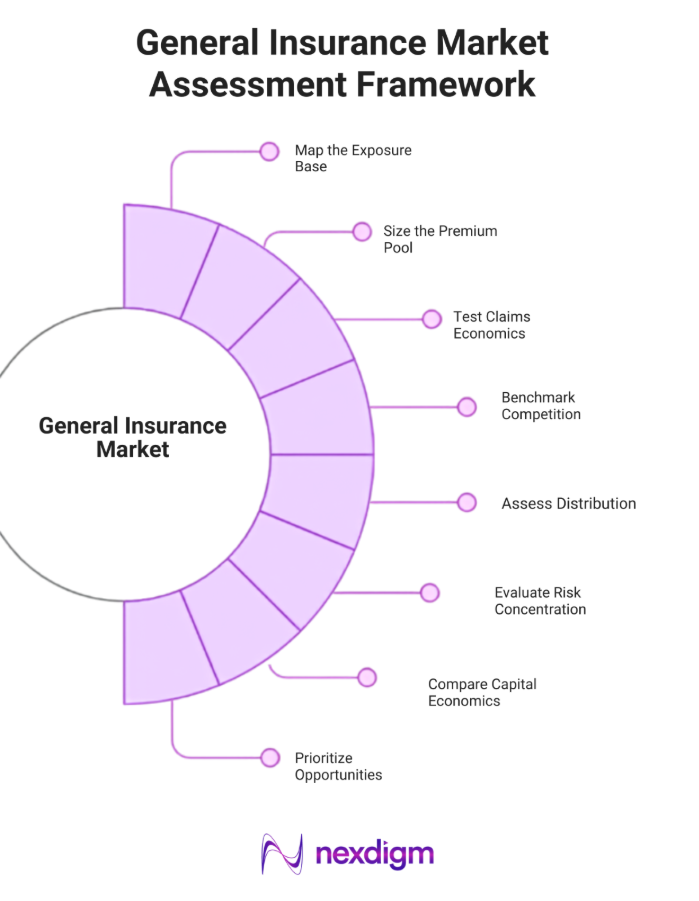
- Map the Exposure Base: Assess industrial CapEx, vehicle volumes, property development, travel activity, and emerging risk exposures.
- Size the Premium Pool: Establish current premiums and the addressable growth opportunity by product and customer segment.
- Test Claims Economics: Examine loss ratios, claims frequency, severity, repair inflation, and settlement trends.
- Benchmark Competition: Evaluate market concentration, pricing discipline, commissions, and reinsurance availability.
- Assess Distribution: Identify the channels best suited to each product, from brokers and agencies to OEMs and digital platforms.
- Evaluate Risk Concentration: Test catastrophe exposure, accumulation risk, secondary perils, and portfolio correlations.
- Compare Capital Economics: Assess expected underwriting returns against capital and regulatory requirements.
- Prioritize Opportunities: Rank product lines based on growth, profitability, risk, competitive intensity, and strategic fit.
This allows insurers to determine where additional underwriting capacity should be deployed and where portfolio exposure may need to be reduced.
How Nexdigm Helps Insurers Select the Right Lines of Business
A Tier-2 general insurer reviewed four business lines across 10 commercial markets after rising repair costs and digital price competition weakened its motor economics. The analysis found a 107.2% combined ratio in private motor versus 14.8% annual premium growth and 58.4% average loss ratios in selected commercial property and engineering segments. The insurer subsequently shifted capacity toward SME commercial property and digital travel partnerships.
To take the next step, simply visit our Request a Consultation page and share your requirements with us.
Harsh Mittal
+91-8422857704
[email protected]