

Generative AI platforms operate across rapidly evolving pricing structures shaped by model capability, token consumption, context length, inference intensity, multimodal processing, and service performance. Generative AI pricing intelligence helps businesses compare model economics, normalize usage charges and anticipate changing expenditure as workloads scale.
With the help of pricing analysis services, organizations can benchmark AI providers, assess input and output token costs, evaluate premium model value, and optimize model selection to improve cost visibility, budgeting, scalability, and commercial decision-making.
The pricing model comparison study reveals 20%–30% differences in effective generative AI costs depending on token volumes, model selection, and workload complexity. Pricing Analysis Services help businesses quantify these variations and strengthen AI cost efficiency.
Generative AI Pricing Analysis for Model Economics and Usage Cost Optimization
Generative AI pricing analysis helps businesses improve cost visibility, model selection, scalability, and AI spending efficiency. A structured pricing analysis process helps to detect and analyze trends and consumption economics into sourcing decisions through the following steps:
- Map AI Workload and Usage Profiles: Assess token volumes, prompt complexity, context length, multimodal requirements, concurrency, and application demand to establish realistic consumption patterns across generative AI workloads.
- Assess Model Pricing Structures: Standardize input, output, cached token, inference, API, and service charges across providers to enable meaningful comparisons between different generative AI models.
- Benchmark Cost-to-Performance Value: Compare model costs against accuracy, latency, reasoning capability, throughput, and task performance to identify options delivering stronger economic value for specific workloads.
- Model Usage and Scaling Scenarios: Simulate changing token volumes, user growth, application demand, and model mixes to estimate future AI expenditure and identify potential cost escalation risks.
- Optimize Model Allocation and Spend: Match workloads with appropriate models based on capability, performance, and cost requirements to reduce unnecessary premium-model usage and improve overall AI spending efficiency.
Nexdigm’s Pricing Analysis Expertise for Generative AI Usage Economics
Nexdigm supports enterprises in navigating evolving Generative AI economics through structured pricing analysis services, usage intelligence, and model cost benchmarking. Combining generative AI pricing intelligence, AI pricing analysis, token cost analysis, usage-based pricing analysis, AI model pricing benchmarking and cost-to-performance analysis, Nexdigm helps organizations strengthen model selection, forecast expenditure, optimize workloads, and improve AI investment efficiency.
Nexdigm’s Pricing Intelligence Playbook for Generative AI Usage Economics
Nexdigm’s AI usage economics playbook combines model pricing intelligence and performance benchmarks to help enterprises optimize Generative AI cost and investment efficiency. Its key features provide structured visibility into rapidly changing AI landscape and support more informed decisions, including:
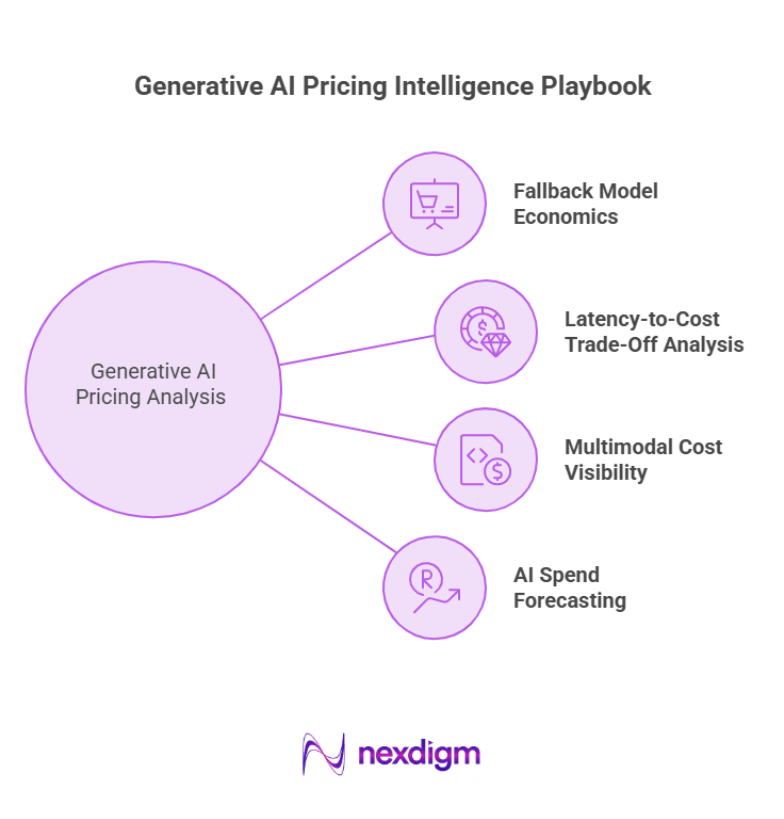
- AI Spend Forecasting: Combines workload growth, model mix, usage patterns, and pricing assumptions to improve budgeting visibility and anticipate potential cost escalation across AI deployments.
- Multimodal Cost Visibility: Assesses text, image, audio, video, and other multimodal processing requirements to understand how different input formats influence overall Generative AI economics.
- Latency-to-Cost Trade-Off Analysis: Compares model response speed with usage charges to determine whether faster inference provides sufficient business value to justify additional AI expenditure.
- Fallback Model Economics: Evaluates lower-cost backup models for routine or non-critical requests, helping enterprises maintain service continuity while controlling premium model dependence.
Nexdigm’s Case
Nexdigm supported an enterprise in benchmarking Generative AI models across token costs, workload performance, and usage economics. The engagement contributed to 14% lower AI expenditure, 15% improved model utilization, and 12% stronger cost-to-performance efficiency, enhancing scalability and investment value.
To take the next step, simply visit our Request a Consultation page and share your requirements with us.
Harsh Mittal
+91-8422857704