

Generic medicines play an important role in expanding access to treatment and supporting healthcare affordability. Their supplier ecosystem includes large pharmaceutical manufacturers, specialised formulation companies, contract manufacturers and regional producers serving domestic and international markets.
For healthcare buyers, distributors and pharmaceutical procurement teams, comparing generic drug suppliers requires more than looking at price or brand availability. Product registrations, manufacturing credentials, regulatory-market exposure, production capacity and distribution networks all influence supplier suitability. A manufacturer with competitive pricing may not offer the same product range or regulatory reach as a larger, diversified company.
Understanding the Generic Drug Supplier Landscape
Generic drug manufacturers operate across multiple dosage forms and therapeutic categories. Their capabilities may include conventional oral solids, injectables, topical products, respiratory medicines, complex generics and specialised formulations.
The supplier landscape can be segmented into:
- Large diversified manufacturers: Companies with broad portfolios, multiple facilities and established domestic and international market presence.
- Specialist generic manufacturers: Producers focused on particular dosage forms, therapeutic categories or complex formulations.
- Contract manufacturers: Organisations supplying finished products under arrangements with other pharmaceutical companies.
- Export-oriented manufacturers: Companies with manufacturing and regulatory capabilities aligned with overseas markets.
- Regional formulation producers: Suppliers serving domestic markets through established distribution and marketing networks.
This segmentation helps buyers compare manufacturers with similar business models and product requirements. A supplier specialising in sterile injectables should not be ranked against a conventional oral-solid manufacturer without accounting for the differences in manufacturing complexity.
Regulatory Standing and Market Approvals
Regulatory capability is one of the most important criteria in generic supplier assessment. Requirements differ across markets, and a manufacturer’s regulatory position must be examined against the countries and product categories relevant to the buyer.
Key indicators include:
- Manufacturing licences and applicable GMP credentials.
- Product registrations and marketing authorisations.
- Regulatory approvals in target export markets.
- Publicly available inspection outcomes and enforcement actions.
- Product-specific documentation and traceability.
- Experience with regulatory submissions and post-approval changes.
Regulatory history should be interpreted carefully. An inspection observation, warning letter, import alert or licence restriction can have different implications. Buyers should examine the relevant facility, product, date and regulatory outcome rather than treating every public notice as equivalent.
The importance of this assessment is reflected in recent industry data. CareEdge Ratings reported that USFDA issued 33 warning letters to Indian pharmaceutical companies between 2022 and May 2025. Quality and purity failures accounted for 24% of the cited causes, while documentation discipline and hygiene each accounted for 21%. The findings reinforce the need to assess facility-level regulatory information alongside company-level credentials.
Comparing Commercial Competitiveness
Generic drug pricing is influenced by input costs, production scale, formulation complexity, packaging, regulatory requirements and distribution economics. Manufacturers with large production volumes may benefit from economies of scale, although specialised products can have different cost structures.
Commercial evaluation should consider:
- Unit price by strength, dosage form and pack size.
- Minimum order quantities and batch-size flexibility.
- API and excipient sourcing exposure.
- Packaging and labelling costs.
- Freight, distribution and storage requirements.
- Payment terms and credit arrangements.
- Price revision practices and contract conditions.
Comparisons must use equivalent product specifications. Two medicines with the same generic name may differ in strength, dosage form, release characteristics, packaging or approved market status. These differences can affect both product suitability and pricing.
Capacity, Product Portfolio and Supply Reliability
Manufacturing capacity is relevant only when it aligns with the required product and production schedule. A large pharmaceutical group may have significant total manufacturing capacity but limited available capacity in a particular formulation category.
Supplier profiling should examine:
- Manufacturing facilities and geographic distribution.
- Product-specific installed capacity.
- Production utilisation and available capacity indicators.
- Dosage-form and technology specialisation.
- API sourcing and upstream manufacturing dependencies.
- Export exposure and customer concentration.
- Capacity expansion and investment plans.
Supply reliability also depends on the number of independent manufacturing sources. Multiple brands may be supplied by the same contract manufacturer or depend on the same API source. Mapping these relationships can reveal concentration that is not visible from a conventional list of brands.
Identifying Suppliers with Strong Strategic Fit
India’s generic pharmaceutical industry includes companies such as Sun Pharmaceutical Industries, Dr. Reddy’s Laboratories, Cipla, Lupin, Aurobindo Pharma, Zydus Lifesciences, Torrent Pharmaceuticals, Alkem Laboratories and other specialised manufacturers. Their product portfolios, manufacturing footprints, regulatory-market exposure and commercial positioning differ.
A structured generic drug supplier benchmarking exercise should compare these manufacturers within relevant therapeutic and dosage-form categories. It should also distinguish between company-wide scale and the capability of individual manufacturing facilities.
Nexdigm’s procurement research can support supplier mapping, portfolio comparisons, manufacturing-footprint analysis and examination of market and regulatory positioning. The research helps buyers understand the competitive supplier landscape before conducting formal quality audits, regulatory due diligence and product qualification.
Generic Drug Supplier Benchmarking Framework
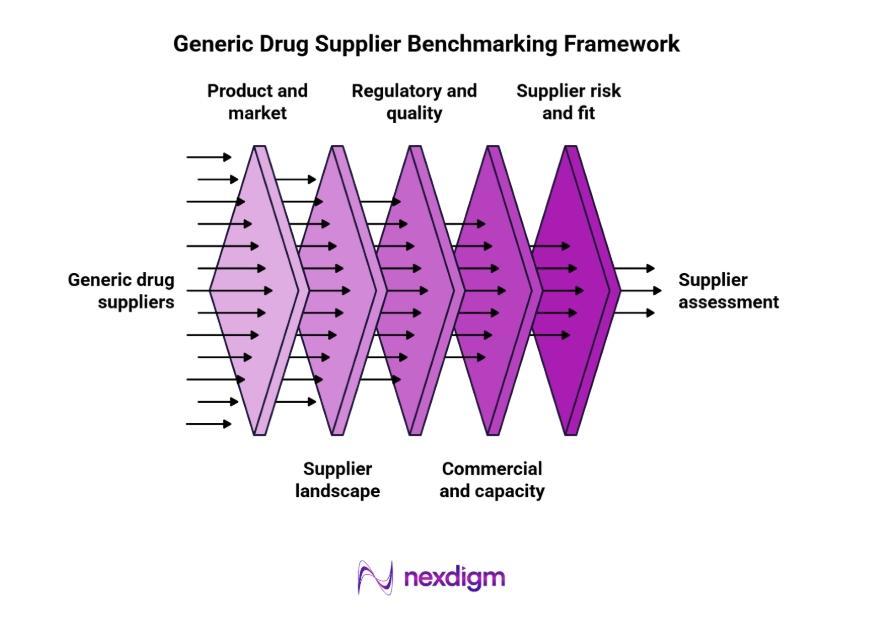
- Product and market definition: Identify the generic molecule, strength, dosage form, target market, demand profile and applicable product requirements.
- Supplier landscape mapping: Identify manufacturers by therapeutic category, formulation capability, geographic presence and commercial positioning.
- Regulatory and quality-profile comparison: Review relevant licences, GMP credentials, product registrations and publicly available regulatory history.
- Commercial and capacity benchmarking: Compare prices, production scale, batch flexibility, facility footprint, input dependencies and distribution reach.
- Supplier-risk and strategic-fit assessment: Examine manufacturing concentration, API dependencies, customer exposure, market access and alternative supplier availability.
Case Study: Benchmarking Generic Drug Manufacturers
A pharmaceutical distributor reviewing generic suppliers across selected therapeutic categories needed to compare regulatory presence and commercial competitiveness. Nexdigm’s research mapped 28 manufacturers across four markets, assessed product portfolios and manufacturing footprints, and shortlisted seven suppliers for further product-level and regulatory evaluation.
To take the next step, simply visit our Request a Consultation page and share your requirements with us.
Harsh Mittal
+91-8422857704