

The logistics sector sits at the center of Europe’s trade, moving freight daily across tightly connected road, rail, air, and water routes. Rapid e-commerce growth, supply chain shifts closer to Europe, and stricter EU sustainability rules are reshaping what shippers expect from logistics partners. At the same time, digital freight platforms and large integrated providers are setting new service benchmarks, making it harder for traditional operators to stay competitive without understanding changing customer priorities.
A Germany logistics consumer preference survey helps reveal how shippers truly choose between providers across routes, service levels, and digital channels. It brings out real-world trade-offs between price and reliability, expectations around customs and documentation support, and frustrations with booking or tracking tools that internal metrics rarely capture. These insights allow logistics firms to refine services and investments around what customers genuinely value in Europe’s evolving supply chains.
Why Germany Logistics Consumer Preference Survey is Essential
Unclear Cross-Border Expectations
Without directly asking customers, providers rely on assumptions about shipper priorities across routes and services. Offerings drift from real needs, leading to lost contracts and weak differentiation in Europe’s complex logistics market.
Weak Pricing Insight
Lack of preference data obscures willingness to pay for speed, reliability, or flexibility. Firms underprice and lose margin or overprice and lose deals, weakening negotiation power with large European clients.
Service Gaps That Frustrate Customers
Investment often goes into assets customers value less, while visibility, documentation accuracy, and issue resolution lag. Friction rises, satisfaction drops, and repeat business becomes harder to retain.
Compliance and Sustainability Misalignment
Shippers expect customs support, emissions transparency, and greener transport options. Without surveying these needs, providers fall behind regulations and ESG expectations, risking exclusion from tenders.
Digital Experience Lag
Buyers expect easy booking, real-time tracking, and integrated documentation. Without feedback, platforms evolve slowly, pushing customers toward competitors with smoother digital journeys.
Misguided Market Focus
Without preference-based segmentation by industry and corridor, firms target the wrong opportunities. Sales and investments scatter, limiting growth in Germany’s central role in European trade.
Nexdigm’s Frameworks of Logistics Consumer Preference Survey
Nexdigm runs logistics surveys through a practical, end-to-end approach that focuses on how shippers actually choose and use providers. It combines structured feedback, corridor and industry views, and digital experience checks to capture real preferences. Insights are converted into clear actions across service design, pricing, and customer experience.
- Preference Segmentation Design
- Corridor and Industry Stratified Sampling
- Digital Journey Mapping
- Decision Driver and Trade-off Modeling
- Advanced Analytics Dashboards
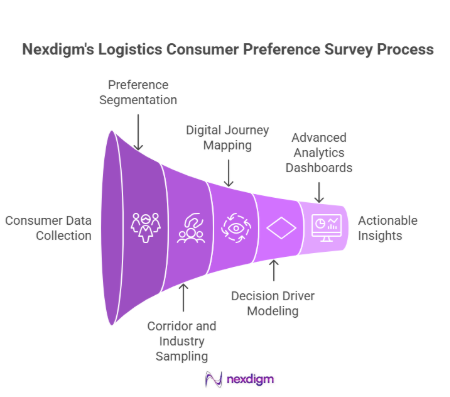
Nexdigm’s Approach to Logistics Consumer Preference Surveys
Preference Segmentation Design
Brings shippers into meaningful groups based on what they move and how they operate.
Keeps feedback tied to real buying situations rather than broad averages.
Corridor and Industry Stratified Sampling
Includes voices from key Germany–Europe routes and different business sectors.
Reflects how needs shift by lane difficulty, rules, and cargo realities.
Digital Journey Mapping
Looks at the full customer path from booking through tracking to issue resolution.
Surfaces moments where processes or tools feel slow, unclear, or frustrating.
Decision Driver and Trade-off Modeling
Explores how shippers weigh cost, speed, reliability, and support in choices.
Shows what really drives selection and long-term relationships.
Advanced Analytics Dashboards
Turns feedback into simple visual views by segment, route, and service factor.
Makes it easy for teams to spot strengths and areas needing attention.
Nexdigm’s Case
A multimodal logistics provider engaged Nexdigm to understand declining win rates on cross-border tenders despite competitive pricing. The survey revealed that shippers valued proactive delay communication and documentation accuracy more than marginal cost differences. By redesigning customer touchpoints and introducing structured status alerts aligned to survey insights, the provider improved tender conversion by 18% within two bidding cycles.
To take the next step, simply visit our Request a Consultation page and share your requirements with us.
Harsh Mittal
+91-8422857704