

Germany’s logistics sector anchors economy through dense multimodal networks and export-led supply chains. Market activity expanded modestly across, with logistics real estate take-up rising about 6% year-on-year after recovery from a subdued baseline. The freight and logistics market also continued gradual value growth in this period, reflecting mature-market dynamics rather than rapid expansion.
In such a mature, competitive logistics environment, retention depends heavily on consistent service reliability and relationship quality. Customer satisfaction surveys provide structured evidence on delivery performance, communication clarity, and contract experience across shipper segments. These insights allow firms to detect churn risks early, align service standards with expectations, and sustain long-term logistics partnerships in complex European trade flows.
Understanding Customer satisfaction Survey
Customer satisfaction surveys are systematic tools that capture how customers evaluate their experience with a company’s products or services. They use structured questionnaires to measure perceptions of quality, reliability, communication, value, and overall satisfaction across interactions and touchpoints.
Organizations use these surveys to identify service gaps, monitor performance trends, and understand drivers of loyalty or dissatisfaction. When linked with operational data, results guide targeted improvements that strengthen customer relationships and retention.
Key Challenges in Customer Satisfaction Surveys
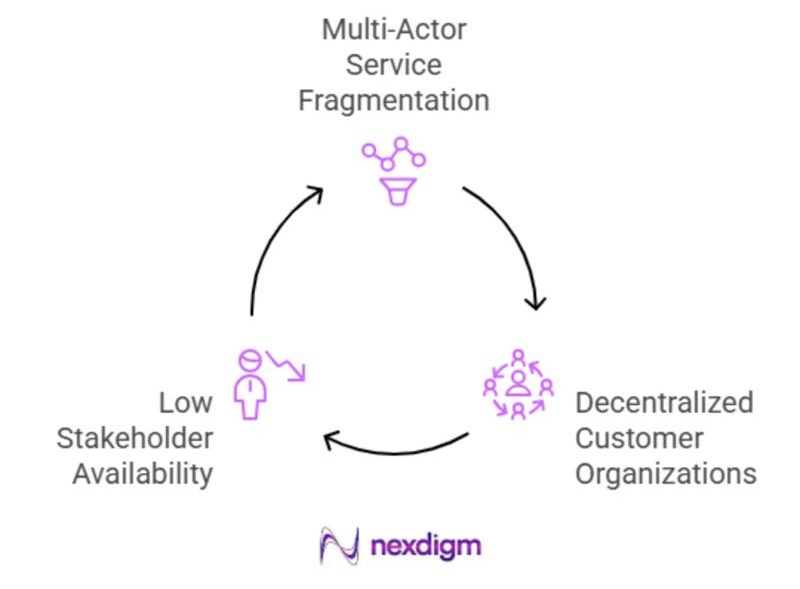
Multi-Actor Service Fragmentation
Logistics services involve carriers, forwarders, warehouses, and customs partners, making it difficult for surveys to isolate which provider or process drives satisfaction or dissatisfaction.
Decentralized Customer Organizations
Large shippers have separate procurement, logistics, and operations teams across sites, creating inconsistent respondents and conflicting feedback on the same service relationship.
Low Stakeholder Availability
Time-critical transport environments limit managers’ willingness to complete surveys, resulting in low response rates and overrepresentation of extreme experiences.
Disconnection from Operational Data
Survey responses are rarely linked with shipment KPIs such as delays, damages, or billing accuracy, reducing credibility and preventing root-cause validation.
How does Nexdigm Overcome Survey Challenges
Nexdigm addresses logistics survey constraints through integrated design, analytics, and execution methods tailored to complex B2B service ecosystems. Multi-stakeholder sampling architecture maps shipper organizations and logistics roles, ensuring responses from procurement, operations, and strategic decision layers to achieve balanced representation.
-
Operational Data Integration
Nexdigm’s survey responses are linked with shipment of KPIs including transit time and claims records, enabling validation of perceptions against actual performance.
-
Standardized Satisfaction Index Models
Nexdigm’s Uniform metrics and scoring scales are applied across regions and services, allowing consistent benchmarking and trend tracking across logistics portfolios.
-
Advanced Driver and Churn Analytics
Nexdigm’s statistical modeling identifies service attributes most influencing retention risk, enabling firms to prioritize operational improvements with measurable loyalty impact.
Nexdigm’s case:
Nexdigm supported a global logistics provider operating across 12 European corridors by conducting a structured satisfaction survey covering 350 enterprise shippers. The engagement improved response rates by 42% identified three critical churn drivers, and contributed to a 9 percent increase in contract renewals within one year.
To take the next step, simply visit our Request a Consultation page and share your requirements with us.
Harsh Mittal
+91-8422857704