


The Logistics Employee Engagement Metrics Survey helps organizations understand workforce satisfaction, operational challenges, and productivity levels within logistics operations.
By collecting feedback from employees involved in transportation, warehousing, and supply chain management, companies can identify areas affecting workforce efficiency.
The Germany Logistics Employee Engagement Metrics Survey measures workforce satisfaction, productivity drivers, and operational challenges across logistics teams.
Insights from the survey help companies strengthen employee engagement, improve supply chain coordination, enhance service quality, and support more efficient logistics operations.
Insights from the survey enable logistics companies to improve communication, optimize workflows, and address employee concerns.
Engaged employees are more productive and motivated, which leads to smoother operations, reduced delays, and improved coordination across supply chain activities, ultimately enhancing overall workforce efficiency.
Steps for Logistics Employee Engagement Metrics Survey to Improve Workforce Efficiency
Implementing an employee engagement metrics survey within logistics organizations helps identify workforce challenges affecting operational efficiency. By evaluating employee satisfaction, communication, and workflow effectiveness, logistics companies can develop strategies that enhance productivity, strengthen coordination, and improve overall supply chain performance.
Step 1: Define Survey Objectives
Clearly define the purpose of the survey by identifying key workforce efficiency metrics such as productivity, communication effectiveness, operational challenges, and job satisfaction. This ensures the survey captures insights directly related to improving logistics operations.
Step 2: Design Relevant Survey Questions
Develop structured questions that measure employee engagement, workplace satisfaction, and operational bottlenecks within logistics activities. Tailored questions help gather meaningful insights from employees involved in transportation, warehousing, and supply chain coordination.
Step 3: Encourage Workforce Participation
Communicate the purpose and importance of the survey to employees across logistics functions. Encouraging transparent participation helps generate honest responses that reflect real operational challenges and workforce engagement levels.
Step 4: Analyze Engagement Metrics
Analyze survey responses to identify patterns affecting workforce efficiency, such as workflow delays, communication issues, or resource gaps. These insights allow logistics companies to understand the factors impacting employee productivity.
Step 5: Implement Operational Improvements
Use survey findings to introduce improvements in training programs, workflow management, and communication practices. Data-driven actions help logistics organizations strengthen workforce efficiency and support smoother supply chain operations.
Nexdigm’s Employee Engagement Metrics Survey Efficiency in Logistics
Nexdigm’s Employee Engagement Metrics Survey provides logistics organizations with valuable insights into workforce satisfaction, operational challenges, and productivity drivers. By aligning employee engagement with operational goals, the survey helps logistics companies improve coordination, streamline processes, and enhance overall supply chain efficiency.
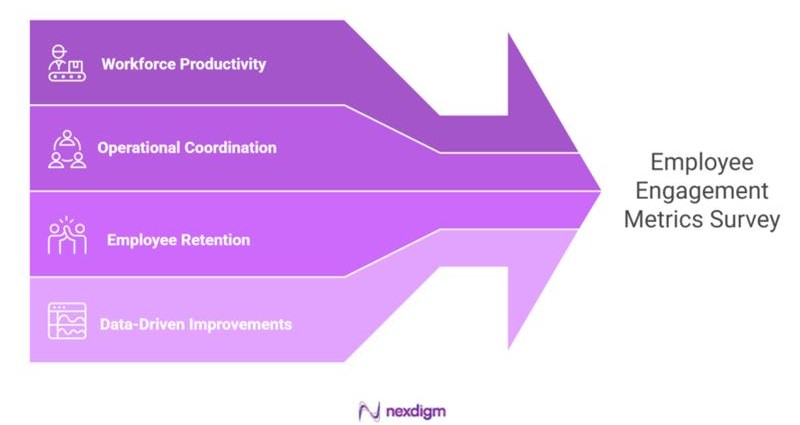
Enhancing Workforce Productivity
Nexdigm’s survey identifies factors that affect employee performance, such as workload management and workplace systems. Addressing these issues enables logistics companies to boost employee productivity and support smoother supply chain operations.
Improving Operational Coordination
By capturing feedback on communication and workflow challenges, Nexdigm’s survey helps logistics organizations improve coordination between departments. Better collaboration supports efficient transportation, warehousing, and distribution activities across supply chain networks.
Strengthening Employee Retention
Nexdigm’s survey highlights areas affecting employee satisfaction and engagement. By improving workplace practices and addressing employee concerns, logistics companies can retain experienced staff and maintain stable operational performance.
Supporting Data-Driven Efficiency Improvements
Insights generated from Nexdigm’s survey allow logistics companies to make informed decisions about training, workforce management, and operational processes, enabling organizations to continuously improve efficiency across logistics and supply chain activities.
Nexdigm’s Case:
Nexdigm helped a logistics company deploy employee engagement metrics surveys across warehouse and transport teams, increasing workforce engagement by 25%, improving operational productivity by 17%, and reducing order processing delays by 14% within nine months through targeted workflow and workforce improvements.
To take the next step, simply visit our Request a Consultation page and share your requirements with us.
Harsh Mittal
+91-8422857704