

Logistics employee performance survey for enhancing efficiency in the trade economy evaluates workforce productivity, process adherence, and operational capability, helping logistics firms improve delivery reliability, turnaround speed, and overall supply chain performance across trade networks.
The Germany Logistics Employee Performance Survey logistics sector underpins international trade and supply chains, with market value around USD 3.93 trillion and steady expansion driven by e-commerce growth, infrastructure investment, and technology-enabled distribution. Within this large trade economy, logistics of employee performance surveys help organizations strengthen operational efficiency and service reliability.
Why Logistics Performance Surveys Matter?
Clients recognize the need for logistics performance surveys because workforce execution directly determines delivery speed, accuracy, and cost efficiency in supply chains. Without structured insight into employee productivity, process adherence, and operational barriers, performance gaps remain hidden. Surveys provide evidence-based understanding that enables targeted workforce improvements, stronger service reliability, and measurable gains in logistics efficiency and competitiveness.
Logistics Performance Survey Implementation Challenges
Logistics employee performance surveys in trade-driven environments face structural and operational complexities that affect measurement accuracy and actionability. Diverse roles across transport, warehousing, and last-mile operations create inconsistent performance benchmarks, while high workforce mobility and shift-based work limit response continuity.
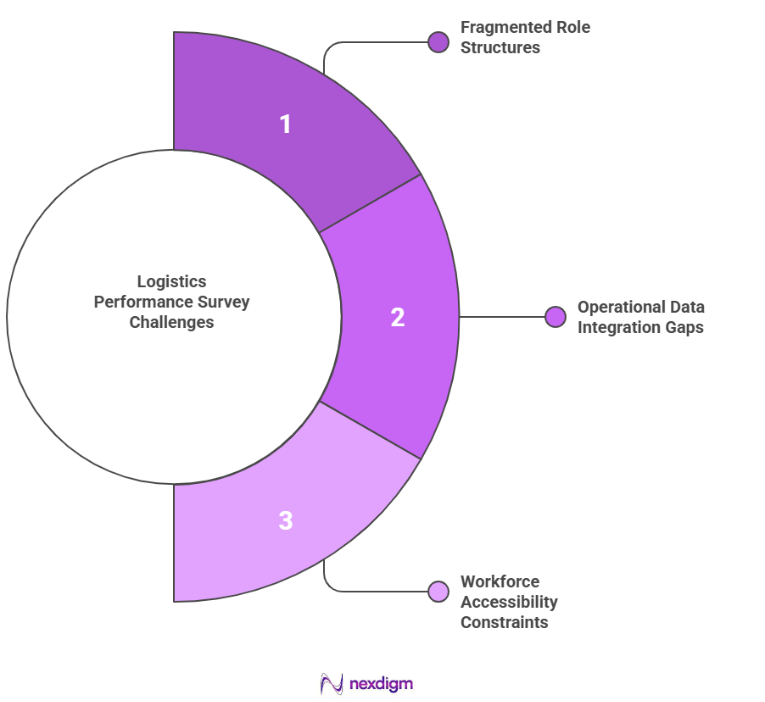
Fragmented Role Structures
Logistics functions span drivers, handlers, planners, and warehouse staff, each with distinct performance indicators, complicating standardized survey design and cross-role comparison.
Operational Data Integration Gaps
Employee feedback often remains disconnected from logistics KPIs like on-time delivery or inventory accuracy, limiting ability to translate survey insights into measurable efficiency gains.
Workforce Accessibility Constraints
Shift work, field deployment, and contract labor reduce survey reach and participation consistency, affecting representativeness and longitudinal performance tracking across logistics networks.
Nexdigm’s Logistics Performance Optimization Approach
Nexdigm addresses logistics employee performance survey challenges through sector-specific survey architecture that reflects the realities of transport, warehousing, and last-mile operations. We design role-aligned performance instruments for drivers, warehouse staff, supervisors, and planners, ensuring relevant productivity and process metrics are captured consistently. Our deployment model accommodates shift-based and field-based workforces through mobile-enabled and multilingual surveys, improving reach and participation across dispersed logistics networks.
We further integrate employee survey insights with operational performance indicators such as delivery timeliness, handling accuracy, and throughput efficiency. By correlating workforce feedback with logistics KPIs, we enable clients to identify precise performance drivers and operational barriers..
Role-Specific Performance Mapping
We create differentiated survey modules for transport, warehouse, and planning roles, aligning questions with task realities and enabling valid cross-function performance comparison across logistics operations.
Employee–Operations Data Integration
We connect survey responses with delivery, inventory, and productivity metrics to reveal how workforce factors influence logistics efficiency and service reliability outcomes.
Accessible Field Workforce Engagement
We deploy mobile-first, multilingual surveys and flexible scheduling to capture feedback from shift-based and remote logistics employees, ensuring representative and actionable performance insights.
Nexdigm’s Case:
A logistics provider partnered with Nexdigm to assess performance across 3,500 drivers and warehouse staff. Surveys linked shift fatigue and process gaps with delivery delays. Targeted scheduling and workflow redesign improved on-time delivery by 12 percent and warehouse throughput by 17 percent within two quarters.
To take the next step, simply visit our Request a Consultation page and share your requirements with us.
Harsh Mittal
+91-8422857704