

Agricultural sourcing increasingly connects producers, input manufacturers, processors, exporters and distributors across international markets. A supplier operating in one country may provide products to buyers subject to regulatory and certification requirements in several others. This creates a procurement environment in which supplier competitiveness depends not only on price and capacity, but also on the ability to meet different compliance expectations.
The requirements can vary significantly by product and destination market. Food safety controls, pesticide residue limits, organic certification, environmental practices, labour standards, traceability and quality management may all influence supplier qualification.
For organisations sourcing agricultural commodities, processed food, seeds, fertilizers or crop protection products internationally, verifying supplier compliance can become a complex exercise. A certificate accepted in one market may not satisfy the requirements of another, and a supplier’s compliance status may differ across facilities or product categories.
Global agriculture supplier compliance consulting helps organisations evaluate suppliers against relevant international and destination-market requirements. It provides a structured method for comparing compliance capabilities, identifying documentation gaps and assessing whether suppliers are suitable for specific sourcing arrangements.
Why Global Agricultural Supplier Compliance Is Complex
Regulatory requirements differ across destination markets
Agricultural products can be subject to different import, food safety, labelling, chemical residue and traceability requirements depending on the destination market.
For example, buyers sourcing food products for the European Union may need to consider applicable EU food safety and pesticide residue requirements. Suppliers serving the United States may need to meet relevant FDA, USDA or other applicable regulatory requirements. Organic products also require certification arrangements recognised under the relevant market’s rules.
A supplier operating successfully in its domestic market may therefore require additional controls or documentation before becoming eligible for international sourcing.
Certifications do not establish universal compliance
Agricultural suppliers may hold certifications such as GlobalG.A.P., organic certification, food safety management certifications or other recognised standards. These credentials provide useful evidence of specific controls, but they do not automatically establish compliance with every buyer or destination-market requirement.
The scope of certification matters. Buyers need to verify the certified entity, facility, product category, validity period and activities covered.
A certificate issued for one processing site should not be assumed to cover all facilities operated by the same supplier. Similarly, a management-system certification does not replace product-specific regulatory verification.
Traceability requirements extend beyond the immediate supplier
Global agricultural sourcing often involves several intermediaries. Products may move from farms to aggregators, processors, exporters and logistics providers before reaching the buyer.
When records are incomplete, organisations may struggle to establish the origin of raw materials, identify production batches or verify the conditions under which products were handled.
This becomes especially important when a product is subject to residue testing, recall requirements, sustainability claims or customer-specific traceability obligations.
Environmental and social requirements are expanding
International buyers increasingly assess suppliers on environmental management, labour practices, responsible sourcing and production transparency. Requirements may relate to water use, chemical handling, worker safety, land management and supply-chain traceability.
The challenge is that these expectations may differ between buyers and markets. Suppliers may maintain multiple reporting systems or certifications, creating administrative complexity without necessarily providing a complete picture of operational performance.
Compliance information can become outdated
Supplier certificates, audit reports and regulatory registrations have validity periods and defined scopes. Operational practices can also change when suppliers expand facilities, introduce new products or modify sourcing arrangements.
A supplier that passed an assessment several years earlier may no longer meet current procurement requirements. Compliance benchmarking must therefore be treated as an ongoing process rather than a one-time onboarding exercise.
What Buyers Should Compare Across Agricultural Suppliers
Organisations need a common assessment structure that can accommodate differences between products, countries and supplier types. A fertilizer manufacturer, organic producer and food processor will not require identical compliance criteria.
The assessment should distinguish between mandatory regulatory obligations, buyer-specific requirements and voluntary certifications. This prevents organisations from treating every certificate as equally relevant or overlooking requirements that are legally necessary.
Key assessment areas include:
- Regulatory registrations and product-specific approvals.
- Food safety, quality management and manufacturing controls.
- Organic, sustainability and agricultural production certifications.
- Chemical residue management and testing arrangements.
- Traceability, batch documentation and record retention.
- Environmental practices, labour standards and supplier audit procedures.
Buyers should also verify whether certifications apply to the actual products and facilities being considered for procurement.
How Nexdigm Supports Global Agricultural Supplier Compliance Assessment
Nexdigm supports organisations through supplier research, market intelligence, compliance benchmarking and commercial assessment. Its research can help buyers map supplier capabilities across markets, evaluate certification coverage and identify potential gaps in supplier documentation or operating practices.
The analysis can also support international sourcing decisions by comparing suppliers across geographic markets and identifying those that are better positioned to meet specific buyer requirements.
Global Agriculture Supplier Compliance Benchmarking Framework
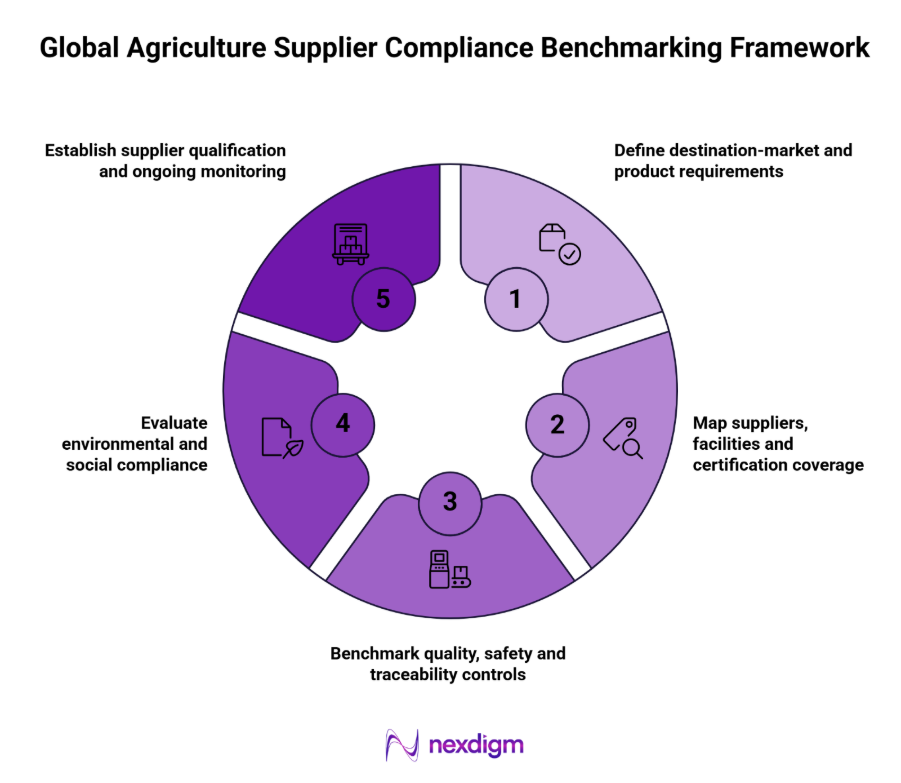
- Define destination-market and product requirements
Identify the countries, product categories and regulatory frameworks relevant to the procurement arrangement. Separate mandatory legal requirements from customer-specific standards and voluntary certification expectations. - Map suppliers, facilities and certification coverage
Identify manufacturers, farms, processors, exporters and intermediaries. Record certification scope, facility coverage, validity periods and product categories rather than relying on supplier-level claims alone. - Benchmark quality, safety and traceability controls
Compare supplier practices covering production controls, testing, chemical management, batch traceability, documentation and corrective actions. Assess whether the evidence supports the requirements of the intended market. - Evaluate environmental and social compliance
Review relevant sustainability standards, labour practices, environmental management and responsible sourcing controls. Identify areas where supplier reporting or certification may not provide sufficient assurance. - Establish supplier qualification and ongoing monitoring
Classify suppliers according to compliance readiness, documentation completeness and operational risk. Define onboarding requirements, periodic reviews, corrective-action timelines and escalation procedures for non-compliance.
Nexdigm’s Case Study: Benchmarking Agricultural Suppliers Across Markets
Nexdigm assessed 19 agricultural suppliers across 4 international sourcing markets and 6 compliance dimensions. The research identified 7 suppliers requiring additional verification and established a supplier comparison structure covering certification, traceability and regulatory readiness.
To take the next step, simply visit our Request a Consultation page and share your requirements with us.
Harsh Mittal
+91-8422857704